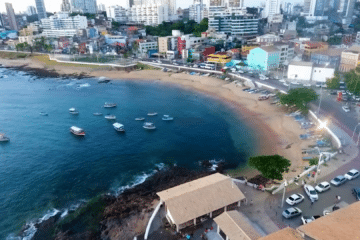
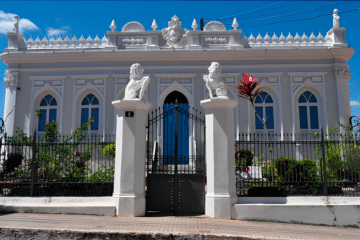
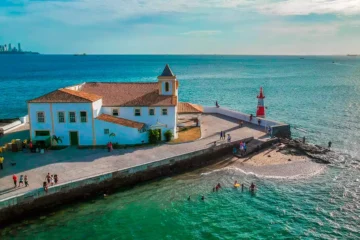
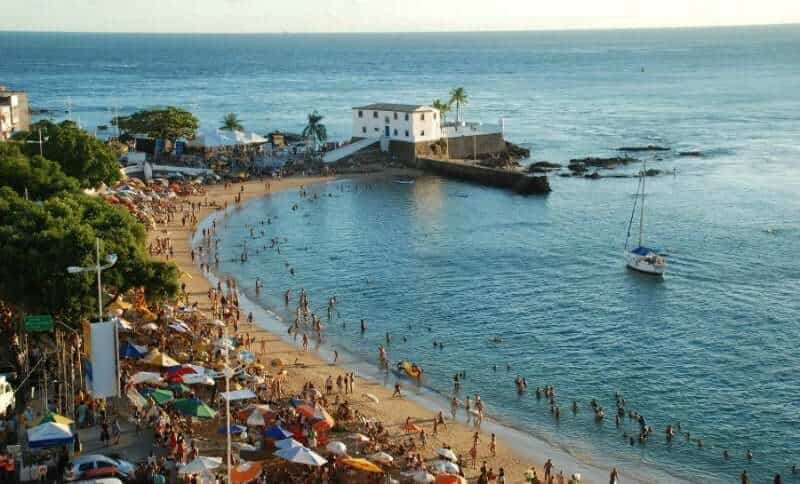
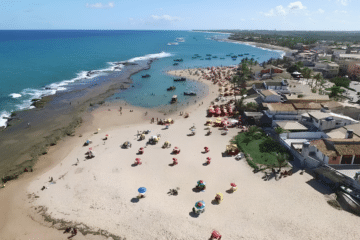
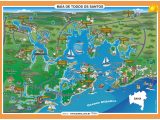
The Todos os Santos Bay and its inland bays form a vast amphitheatre where nature, history and culture come together, creating an ideal setting for water-based tourism and ecotourism.
This magnificent landscape consists of a vast expanse of calm waters, from which 56 islands emerge, as well as beaches, forests, trails, rivers, waterfalls, rapids, mangrove swamps, nature reserves, the ruins of sugar mills, old churches and old convents, reminders of the wealth generated by the sugar cane fields in the lands of Massapê.
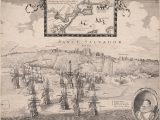
Dominating the landscape, facing west, stands the city of Salvador, on Baía de Todos os Santos, which for over two centuries was the capital of Brazil and the most important city in the Americas.
As a city of art and Baroque excesses, Salvador’s colonial architecture made its mark on the towns and cities that sprang up around the sugar mills of the Recôncavo Baiano, reflecting the urban planning ideals of Renaissance Portugal.
Alongside these hallmarks of colonisation, a unique cultural fusion between European, African and indigenous cultures gave rise to a rich folklore, an unrivalled cuisine and artistic expressions that combine the influences of these three cultural traditions.
In order to protect its islands, regulate socio-economic activities and preserve areas of ecological importance, the Baía de Todos os Santos Environmental Protection Area was established in June 1999.

TODOS OS SANTOS BAY
-
- HISTORICAL AND CULTURAL ASPECTS
- A TREASURE OF BEAUTY AND HISTORY
- SHIPWRECKS AND HIDDEN TREASURES
1. HISTORICAL AND CULTURAL ASPECTS
- The Legend of the Creation of Baía de Todos os Santos
- The First European Explorers
- Ponta do Padrão and the Fort of Santo Antônio da Barra
- Geography of the Bay of Todos os Santos
- Indigenous Presence and Colonisation
- Relations between the Tupinambás and the French and Portuguese
- The Arrival of Cristóvão Jacques and the Fight against the French Privateers
- The Legend of Caramuru
- Founder of the Captaincy of Bahia de Todos os Santos
- The Tupinambá Revolt
- The Transformation of the Recôncavo Baiano and the Legacy of Sugar Cane
1. The Legend of the Creation of Baía de Todos os Santos
A legend of the Indians, recorded by the chroniclers of the early days of settlement in Brazil, tells that, at the beginning of the world, a great bird with very white feathers set off from far away and, flying day and night without stopping, reached the coast of a vast land where, exhausted by the long journey, it fell down dead.
Its long, snow-white wings, spread out on the ground, turned into white beaches. Where its heart struck the earth, a large, deep depression opened up, which the waters of the sea flooded, and its banks were fertilised by the blood of the legendary bird.
This was the belief of the region’s first inhabitants — the Tupinambás — that kirimuré had come into being: the vast bay of gentle waters and its Recôncavos, which white Europeans later named Baía de Todos os Santos.
2. The First European Explorers
According to the records, the first European to enter these sheltered waters appears to have been the Portuguese navigator Gaspar de Lemos, captain of the supply ship in the fleet of Pedro Álvares Cabral, tasked with delivering the letter from Pero Vaz de Caminha bearing news of the discovery to the King of Portugal, King Manuel, the Fortunate.
This messenger ship, which set sail from Porto Seguro on 2 May 1500, bound for Lisbon, probably anchored in Baía de Todos os Santos on 5 May.
However, the official discovery is attributed to the Florentine cosmographer Amerigo Vespucci, who, on 1 November 1501, entered the wide mouth of this bay aboard one of the six ships of the exploratory expedition led by Gaspar de Lemos, the same pilot as that of the messenger ship.
3. Ponta do Padrão and the Fort of Santo Antônio da Barra
It was customary, in those days, to name the places where ships called at after the saint of the day; thus the great gulf – “capable of sheltering, without any confusion, all the fleets of the world”, as a foreign traveller visiting Bahia described it centuries later – came to be known as Baía de Todos os Santos.
Gaspar de Lemos’s expedition stayed there for about five days.
On a rocky outcrop of the sandbar, which separates the bay with its calm waters from the open sea, a stone pillar was erected — a monument — which the Portuguese used to erect at the sites they discovered, as a mark of ownership and dominion over the land.
For many years, the place was known as Ponta do Padrão.
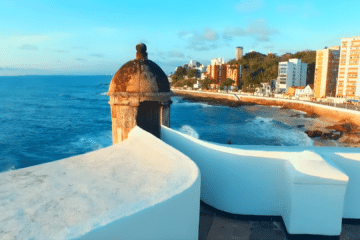
Between 1583 and 1587, on the site of the monolith bearing the coat of arms of Portugal, the Fort of Santo Antônio da Barra, or Fort of Barra, whose lighthouse still today warns ships of the presence of reefs and shallows at the entrance to the bay.
The site came to be known as Farol da Barra, a name it still bears today.
Once you have rounded Ponta do Padrão, you are met by Baía de Todos os Santos in all its vastness: an immense amphitheatre with a circumference of approximately 200 kilometres, indented by coves, inlets, lagoons and the small bay of Aratu.

4. Geography of the Bay of Todos os Santos
The mouth, a wide opening facing south, between Ponta do Padrão and Ponta do Garcez, is approximately 18 nautical miles (33 km) wide. Its straight-line length is 50 km, from the mouth to the town of São Francisco do Conde; and 35 km, running west–east, from Paripe to the mouth of the Paraguaçu River.
Within the bay lie 56 islands of various sizes: Madre de Deus, dos Frades, Maré, do Medo, Grande, Cajaíba, Bimbarras, das Vacas, Maria Guarda, das Fontes, Bom Jesus dos Passos, Pati and, in the south-western part, the largest of them all, Itaparica, with an area of 246 km.
Halfway along the western shore of the bay, the Paraguaçu River flows into the bay; its indigenous name means ‘big river’. Around 36 km south of the mouth of the Paraguaçu, the Jaguaripe River (or yaguar-y-be, ‘jaguar river’) flows into the bay at a place known as Barra Falsa da Baía de Todos os Santos.
5. Indigenous Presence and Colonisation
At the start of the colonial period, the bay and its Recôncavos were inhabited by the Tupinambás Indians, who had, shortly before, driven the Tapuias – the region’s former inhabitants – into the hinterlands.
In Bahia, the Tupinambás dominated the coast from the mouth of the São Francisco River to beyond the Jaguaripe River, where the territory of the Tupiniquins began.
The vast expanse of water in Baía de Todos os Santos provided vessels with a safe anchorage, making it a favourite with sailors along the extensive Brazilian coastline.
French privateers had been raiding the unguarded coasts of Bahia since 1504, drawn mainly by the lucrative smuggling trade in brazilwood, the red dye from which was in high demand by the textile industries of Flanders.
This trade grew to such an extent that, for a certain period, it overshadowed the trade of the Portuguese, the rulers of the colony.

6. Relations between the Tupinambás and the French and Portuguese
The French managed to forge alliances with the Tupinambás, facilitating trade. As Eduardo Bueno observes in Captains of Brazil: the saga of the first colonisers: “It did not take the Tupinambás long to realise that the Portuguese were different from the French.”
Unlike the French, who came to Bahia solely to collect brazilwood — trading goods as friends and leaving without arousing suspicion —, the Portuguese had come to stay and, as well as taking possession of the land, were prepared to enslave the natives.
Consequently, the French did not arouse suspicion amongst the Tupinambás, whereas the Portuguese were seen as future conquerors.
For many years, Baía de Todos os Santos remained without a single Portuguese settlement, with trade being dominated by the French, who were allies of the indigenous peoples living on its shores and islands.
7. The Arrival of Cristóvão Jacques and the Battle against the French Privateers
In 1526, a Portuguese fleet commanded by Cristóvão Jacques was sent to Brazil to drive the French privateers from the coast.
On entering Baía de Todos os Santos, the fleet encountered three French ships carrying brazilwood on the Paraguaçu River, at the mouth of the Iguape Lagoon, at the site now known as Ilha dos Franceses.
The battle lasted a whole day. The French were defeated and around three hundred crew members were taken prisoner.
8. The Legend of Caramuru
The illegal trade in brazilwood found a commercial agent for the French in Bahia: the Portuguese Diogo Álvares Correia, who went down in history under the legendary name of Caramuru.
He was a shipwreck survivor from a ship, possibly French, which, in 1509 or 1511, ran aground on the reefs and rocks along the ocean shore, one league north of the bay’s mouth, at the spot now known as Mariquita Beach — a name derived from the Tupi word mairaquiquiig, meaning ‘the French shipwreck’.
Because it emerged from the sea amongst the rocks, the Tupinambás called it Caray-muru, which, in the indigenous language, means a fish with an elongated body, like an eel, which lived amongst the rocks. Some authors, however, interpret the name as ‘the wet white man, or the drowned man’.
It is a legend — and probably implausible — that, upon emerging from the sea, the castaway fired a shot from the arquebus he had taken on board, bringing down a bird and leaving the indigenous people so astonished that they called him ‘son of fire’ or ‘son of thunder’.
Caramuru lived for 47 years amongst the Tupinambás, married the famous indigenous woman Paraguaçu – daughter of the chieftain Taparica, ruler of the cannibals on the island of Itaparica. They were married in France, probably in 1525, where Paraguaçu was baptised as Catharina, in honour of Queen Catharina de Médicis.
Legend has it that, when Caramuru set sail for his wedding overseas, an indigenous woman threw herself into the waters of the bay and swam alongside the French ship carrying her beloved until she died. The name Moema — mbo‑em in the Tupinambá language — ‘the fainting one, the exhausted one’ — became legendary.
In Baía de Todos os Santos, it is often difficult to distinguish between history – based on documents – and legend – a romanticised account of the facts. Caramuru exerted a great influence during the early days of settlement. Interestingly, French pilots who were smuggling brazilwood called the entrance to the bay Pointe du Caramourou, a place the Portuguese knew as Ponta do Padrão.
9. Founder of the Captaincy of Bahia de Todos os Santos
Towards the end of 1535, the nobleman Francisco Pereira Coutinho arrived in Bahia to settle the capitania that had been granted to him by King D. John III, by a letter of grant signed in Évora on 5 April 1534.
The Captaincy of Bahia (Captaincy of Bahia de Todos os Santos) stretched for fifty leagues (around 300 km) from the mouth of the São Francisco River to the tip of Baía de Todos os Santos, including the Recôncavo Baiano, the islands encountered and, inland, as far as the boundary of Castela, the Tordesillas Meridian.
The captain-grantholder settled in the vicinity of the farmstead where Caramuru lived, together with his indigenous wife, his mixed-race children and his sons-in-law.
At the site now known as Porto da Barra, Pereira Coutinho built a seaside settlement that was to become the official seat of the captaincy: Vila Velha or Povoação do Pereira.
About a year later, the grantee had a deed of donation drawn up granting a sesmaria to Caramuru, thereby confirming the lands he occupied with his people.

10. The Tupinambá Revolt
It did not take long for the Tupinambás to realise that the new wave of settlers brought by the grant holder was gradually taking over their lands, forests and rivers. Furthermore, they reduced the indigenous people to slavery, even selling them to other capitanias. This oppression led the Tupinambás to rise up en masse against the invaders.
The uprising was sparked by the death of an indigenous chieftain’s son, which was attributed to a relative of the grant holder himself.
Although Caramuru helped the new arrivals by providing provisions and facilitating relations with the indigenous peoples, he was not an ally of all the Tupinambás. There were many villages along the coast and in the Recôncavo, divided into tribes with their own chiefs, who were frequently at war with one another, and where the taking of prisoners and the practice of cannibalism were common.
United, the Tupinambás, numbering some six thousand warriors — their faces dyed black with jenipapo and adorned with red bands of urucum — burnt down fences, destroyed sugar mills, killed several Portuguese and laid siege to the survivors at Povoação do Pereira. “It was five or six years spent in great hardship,” reported the plantation owner and historian Gabriel Soares de Souza in 1580, “enduring severe famine, disease and a thousand misfortunes, whilst the Tupinambá savages killed people every day”.
In addition to the war, the donatário faced betrayal from some exiles and settlers who, due to internal rivalries, had allied themselves with the indigenous peoples. Everything suggests that Caramuru did not take a stand against those besieging the captaincy’s headquarters; it appears that it was he who led the elderly grantholder to safety in the Captaincy of Ilhéus, after which the Tupinambás ravaged the town.
Whilst the Captaincy of Bahia was left adrift, the French, allied with the indigenous peoples, were plotting to establish themselves in the region, fuelling fears that Brazil might become a French possession. This prompted Francisco Pereira Coutinho to return to his domains. Persuaded by Caramuru, he left Porto Seguro and returned to Bahia with a promise of peace to the indigenous peoples.
In 1547, on the return journey, the ship carrying Pereira Coutinho ran aground on the reefs of the Pinaúnas, at the southern tip of Itaparica. According to Eduardo Bueno, the grantee and most of his companions were saved, but were captured by the Tupinambás, who recognised Pereira and executed him in a ritual sacrifice; they then devoured his body at a cannibalistic feast.
Almost nothing remained of the nine years of Pereira Coutinho’s administration: the sugar mills in the Recôncavo were burnt down and Vila Velha do Pereira reverted to being a ‘mere den of mamelucos’. The tragic death of the grantee precipitated the overhaul of Brazil’s administrative system, which was already under consideration in Lisbon, as the system of hereditary captaincies had failed.
On 29 March 1549, a Friday, three large ships, two caravels and a brigantine entered Baía de Todos os Santos. The Portuguese fleet was commanded by Tomé de Souza, “Captain of the settlement and lands of Bahia de Todos os Santos and Governor of the lands of Brazil”, appointed on 7 January 1549, who came to found “a large and strong fortress and settlement”, the city of Salvador da Baía de Todos os Santos.
A few months earlier, a royal emissary had sent a letter to Diogo Álvares Caramuru announcing the arrival of the fleet and asking him to set aside provisions for Tomé de Souza and his entourage. Following the death of the grantee, Caramuru had become the most important figure in the captaincy and had secured a promise from the Tupinambás to cooperate with the new colonists.
Despite skirmishes, the Governor, with the help of Caramuru, began the process of bringing peace between the settlers and the indigenous people. Further north, less than half a league from Vila do Pereira, beneath a blazing sky, the Governor founded the fortified town atop a cliff facing west, overlooking the bay. The indigenous people cooperated with the builders led by Master Luis Dias in the construction: from mud-walled huts, later replaced by houses of stone and lime, rose the city that would become the metropolis of Baía de Todos os Santos, the city of Bahia, seat of the Portuguese colonial government for 214 years.
Eight years after the founding of Salvador in 1557, Diogo Álvares, Caramuru died. It fell to Mem de Sá, the third Governor-General of Brazil, to bring about a lasting peace with the indigenous peoples with the help of the Jesuit missionaries.

11. The Transformation of the Recôncavo Baiano and the Legacy of Sugar Cane
Whenever necessary, the Governor did not hesitate to invade the lands of the rebellious tribes and destroy the villages that put up resistance. More than one hundred and thirty villages were destroyed. Mem de Sá was the driving force behind the sugarcane industry in the region.
He even built a royal sugar mill with a waterwheel to process the sugarcane from farmers who did not have their own mills. On the massapê lands — deep clay that sticks to your shoes — sugar mills flourished.
Sugar cane cultivation and sugar production became the main activities in the Recôncavo regions. Sugar cane fields and mills lined the entire bay, from Salvador to Barra do Jiquiriçá and the lands of Jaguaripe, where Gabriel Soares established his mills; they spread across the plains of Santo Amaro and São Francisco do Conde, and extended up the mighty Paraguaçu.
By the last quarter of the 16th century, there were already numerous landowners in the Recôncavo who owned vast sesmarias and well-established sugar mills, with a large number of slaves. These mills were not merely farms: they were veritable settlements. It was from these that the towns and cities of the Recôncavo emerged.
For a long time, communication between these towns took place exclusively via Baía de Todos os Santos and the rivers that flow into it. Later, railways and roads broke this isolation. The sugar mills were transformed into sugar factories.
Tobacco came to dominate the lands of the Cachoeira – São Félix – Maragogipe region. In the 20th century, the towering silhouettes of oil wells dotted the fields where the wind had once whipped through the sugarcane fields. Industries sprang up. A new era of transformation: the prosaic sailboats and steamers gave way to schooners, sailing boats and catamarans. Cars now cross the bay on ferry-boats.
However, traces of the past remain in the austere architecture of the colonial mansions, whose facades are adorned with Portuguese tiles, and in the monumental churches that dominate the landscape. The silence of the cloisters of the convents echoes ancient stories, whilst the waterwheel of the sugar mills reveals the production cycle that shaped the region.
The silver artefacts and the imagery of the altars reveal the cultural and spiritual richness of Bahia. Naus and caravels lie beneath the waters, preserving memories of voyages, and the cannons of the ancient forts still watch over the horizon of the bay, bearing witness to the history that unfolded there.
All of this is interwoven in the mixed heritage of the people of Bahia de Todos os Santos, who are the heirs to an era of profound change and traditions.

2. A TREASURE TROVE OF BEAUTY AND HISTORY
Bordered at either end by the Barra Lighthouse and Ponta do Garcez, the Baía de Todos os Santos combines beauty, history and culture, evident in its crafts, traditional cuisine and architecture, making it an ideal setting for water-based tourism and ecotourism.
With around 1,052 km² of calm waters, the bay is home to islands and beaches and is fed by the fresh waters of various rivers and streams, the main ones being the Paraguaçu, Jaguaripe and Subaé. At one end of the bay lies the first capital of Brazil and the largest city in the North-East: Salvador da Bahia.
The surrounding area is home to municipalities such as Itaparica, Vera Cruz, Jaguaripe, Nazaré, Salinas da Margarida, Maragogipe, São Félix, Cachoeira, Santo Amaro, Saubara, São Francisco do Conde, Madre de Deus and Candeias, among others that make up the Recôncavo Baiano. In Bahia, the word Recôncavo has come to be widely used to refer to the region surrounding the bay.
In order to protect its islands, regulate socio-economic activities and preserve areas of ecological importance, the Baía de Todos os Santos Environmental Protection Area (APA) was established by State Decree No. 7,595 of 5 June 1999.
The APA covers approximately 800 km², including waters and islands that preserve remnants of the Atlantic Forest, mangroves and restingas, and are home to a diverse range of flora and fauna.
3. SHIPWRECKS AND HIDDEN TREASURES
Another unique feature of Baía de Todos os Santos is the combination of the beauty of the natural and historical landscapes hidden beneath its waters. These sites hold surprises for divers, who discover coral reef formations and the wrecks of ships that sank during the colonial era.
Opposite Porto da Barra, at a depth of around 12 metres and with visibility of 10 to 15 metres, there are some stunning coral reefs. For experienced divers, the outer corals or ‘Parede’ are situated in the middle of the bay, between Itaparica and Salvador.
The walls, one mile from Salvador, lie at depths of between 25 and 45 metres and, at high tide, visibility ranges from 15 to 20 metres. The coral formations and reefs near the Maré islands reach a maximum depth of 11 metres and offer horizontal visibility of up to 15 metres.
Opposite the harbour quay, on the northern breakwater, there is a recommended spot for night dives with a wide variety of marine life. Opposite Aratuba beach, in Itaparica, the Pontinha and Caramunhãs coral reefs, two miles off the coast, offer a rich underwater landscape.
The ghosts of history also attract divers in search of treasure, for research or out of curiosity. Amidst battles, invasions and storms, many ships have been wrecked in Baía de Todos os Santos. The best known and historically documented are:
- The Nossa Senhora de Jesus, 1610 – attacked by the Dutch of the Dutch East India Company, was shipwrecked off Fort Santo Antônio da Barra;
- Seven Portuguese ships, 1624 – set alight and sunk off what is now Avenida Contorno;
- Two Flemish ships and one Portuguese ship, 1627 – sank off Praia da Preguiça during a battle between the Portuguese and the Dutch;
- Two Dutch ships and one Portuguese ship, 1647 – were wrecked following a battle near Monte Serrat Fort;
- The Santa Escolástica, 1648 – sank as it left the bay;
- Galeão Nossa Senhora do Bom Sucesso, 1700 – sank off Praia da Preguiça;
- Spanish galleon San Pedro, 1714 – sank at the same location;
- Galeão Nossa Senhora do Rosário, 1737 – sank off Monte Serrat, laden with jewellery, gold, porcelain, amber and pepper;
- The wreck of the Bretanha, known as the “Navio de Dentro”, lies near the Barra Lighthouse, sheltered by the coral reefs, and is an ideal spot for introductory dives.
History and Tourism in the Bay of Todos os Santos

Publicações Relacionadas
Arembepe: beaches (Piruí, Praia do Canto), Hippie Village and the Tamar Project

Paranaguá Palace — History, architecture and visiting information | Ilhéus (BA)

São Jorge Parish Church in Ilhéus — history, architecture and religious art

History of the Convent and Church of Nossa Senhora da Piedade in Ilhéus

São Sebastião Cathedral (Ilhéus) — History, architecture and tourism
The 15 Most Visited and Well-Known Beaches in Bahia
The 3 most paradisiacal beaches in Bahia

Skydiving, Paragliding and Ballooning in Bahia

Historic Towns in Bahia: A Journey Through Time
Places to visit on the south coast of Bahia

História da Arte - Caracteristicas, Aspectos e Periodos
Tourist Attractions in Bahia: main attractions, beaches and cities

Subaúma, Bahia: where it is, things to do and where to stay
Massarandupió Naturist Beach, Bahia: Rules and Access
Beaches on the South Coast of Bahia: 10 Best and Tips
Towns and the Abrolhos Archipelago — The southernmost tip of Bahia

Baixio: Between lagoons, dunes and the charm of a village surrounded by nature
Best Beaches in Bahia: Your Guide to Paradise
Salinas da Margarida (BA) — Beaches, Attractions and a Complete Guide

Guarajuba Beach, Bahia: Natural Pools and Tips

Barra do Cahy: Brazil's first beach - history and nature

Garcez Beach: Discover Paradise in Jaguaripe

Barreiras: An Ecological Paradise in Bahia
Catabrigas Waterfall — A natural haven in Ibirajá, Itanhém (BA)

Serra Grande: Your Guide to Bahia's Paradise
Corumbau, Bahia: Ponta de Corumbau, beaches, map, how to go

Taipu de Fora: Discovering Natural Pools

Iguaí: A Guide to Waterfalls and Relaxation
Morro de São Paulo: Map, Beaches & How to Get There (2026)
Tourism in São Francisco do Conde (BA) — Tips and Attractions
Todos-os-Santos Bay (Bahia) — History, geography and conservation
Bay of Todos os Santos: nature, history and cultur

Rafting in Taboquinhas: The Ultimate Adventure Guide
Abseiling Sites in Bahia: Top Locations to Explore

Diving Spots in Bahia: Discover Underwater Treasures
Paragliding at Pitinga Beach in Arraial d'Ajuda
This post is also on:
 Português
  English
  Deutsch
  Español
  Français