Summary of the History of the Church and Convent of Nossa Senhora da Palma

Church and Convent of Nossa Senhora da Palma in Salvador, Bahia
Origins and foundation: construction began in the 17th century; there is controversy regarding dates and founders (1630, 1670 or 1693). Accounts, especially those of Friar Agostinho de Santa Maria, link the devotion to the Cruz Arrais family. In 1693, Jerônimo Pereira da Cruz donated the property to the Discalced Augustinians.
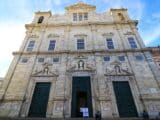
Works and rebuilding: it began as a chapel, enlarged in the 18th century and renovated in 1870. The Augustinians rebuilt and decorated the church (carving and gilding). Plans from c.1710–1712 show a T-shaped nave (approx. 20 m × 8 m) and three altars. The frontispiece received Rococo openings, possibly in 1778; the tower was erected around 1780. The convent was enlarged to form an irregular cloister.
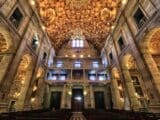
Art and decoration: carvings, gilding and paintings completed in the late 18th century (final decoration in 1797). Ceiling with quadratura painting (St. Augustine and Augustinian saints) and several canvases attributed, without definitive proof, to José Joaquim da Rocha and/or Veríssimo de Souza Freitas. The ornamentation reveals a mixture of Rococo and Neoclassicism.
Image of Our Lady of Palma: tradition says that it came from Portugal. The current image is late Baroque (18th century) and replaced the original; there were documented restorations in the early 19th century.
Functions and uses: the complex served as a hospice, seminary (1834–1837), Provincial Lyceum, courthouse and, since 1954, has housed the Faculty of Philosophy. Today it is part of the administration of the Catholic University of Salvador (UCSal) and the church remains in liturgical use.
Conflicts and ownership: the Augustinians’ property was confiscated in the 19th century; with Independence (1822–1823), the friars returned to Portugal. In 1829, ownership passed to the Brotherhood of Senhor Bom Jesus da Cruz, which promoted works such as marble cladding and new bells.
Collection and conservation: Baroque images (18th century), paintings of uncertain authorship and subject to interventions and restorations. The church was listed by IPHAN in 1938 and is a strictly preserved area according to municipal legislation.
Historical note: plaques and traditions mention episodes of war (1625/1638), but these dates do not coincide with the documented existence of the complex.
Address: Praça Ana Nery, s/n, Mouraria, Salvador — BA.


History of the Church and Convent of Nossa Senhora da Palma
A little history
The construction of the church of Nossa Senhora da Palma began at the end of the 17th century.
In 1693, the temple was donated by Jerônimo Pereira da Cruz, a member of the family of Francisco da Cruz Arrais, to the Discalced Augustinian friars.
Francisco da Cruz Arrais
Friar Agostinho de Santa Maria recounts: “There was a citizen in the city of Bahia named Francisco da Cruz Arraes, who had a very special devotion to Our Lady and to the title of Palma. […] This noble citizen, with his devotion to Our Lady, had an image of her made in Lisbon, to which he gave the same title of Palma, and this was in the year 1630. He placed it in a chapel dedicated to Saint Joseph the Patriarch, and here began the veneration and devotion to this Holy Image.”
They adapted it to their needs and set about building outbuildings next to a hospice for the missionaries of the order. Enlarged in the 18th century, the church underwent a major expansion during the renovation of 1870.
Origins and controversies about dates and founders
According to Carlos Ott, Francisco da Cruz Arrais was a goldsmith and was the one who created, in 1630, the devotion to Nossa Senhora da Palma, inherited by his children.
At that time, and still in 1652, he lived with his family in a rented house belonging to the Santa Casa, located behind the chancel of the old cathedral.
Francisco da Cruz Arrais, referred to by the author above, was not mentioned by Marieta Alves, who studied in depth the marks and actions of gold and silver goldsmiths in Salvador.
On the left wall as one enters the church, there is a tombstone with inscriptions from the brotherhood of Senhor Bom Jesus da Cruz dating from the late 19th century. According to these inscriptions, construction of the church began in 1630, due to a promise made by Bernardino da Cruz Arrais.
The tombstone does not guarantee the veracity of the facts. Some authors admit that devotion to Our Lady of Palma began in 1670, disagreeing with the date of the beginning of construction forty years earlier, as recorded.
According to Carlos Ott, these dates contradict both the inscription from the end of the 19th century and what Friar Agostinho de Santa Maria wrote in his Santuário Mariano (Marian Shrine) in 1722.
There is also disagreement regarding the name of the founder, Francisco da Cruz Arrais, father of Ensign Bernardo da Cruz Arrais. Afrânio Peixoto stated that Ensign Bernardo da Cruz Arrais vowed to build the chapel, but it was his brother, Doctor Ventura da Cruz Arrais, who fulfilled the promise, a fact that would have taken place in 1630.
What are the true dates and founders? The question remains to be clarified. It can be argued, however, that the most accurate information would be that provided by Friar Agostinho de Santa Maria, as he lived closer to the events and based his work on Bahia on information provided by his archbishop, Dom Sebastião Monteiro da Vide.
Rebuilding by the Augustinians and decoration
Beginning as a simple chapel in the 17th century, the church was rebuilt by the Augustinians, missionaries from the island of São Tomé and the lands of the African coast.
They promoted the decoration of the church, both in carving and gilding, and installed the two side altars, which are different in style from the others.
According to Maria José Freitas, they are the work of the carver and painter Veríssimo de Souza Freitas, who only finished them in 1795.
In reality, Veríssimo was only a painter and may have whitewashed and gilded the walls in addition to painting the ceiling. The carving, which a painter would not have done, is certainly the work of another, unknown artist.
The image of Our Lady of Palma
Tradition has it, and this is confirmed by Friar Agostinho de Santa Maria, that the image of Our Lady of Palma on the high altar came from Portugal.
There are no records of when it was made, nor, of course, of its authorship. Some believe it dates from before 1720.
However, the only documented record is a payment of four thousand reis in the year 1802 to Bento Sabino dos Reis for the creation of an arm for Our Lady of Palma.
This means that, at the beginning of the 19th century, the image already required restoration.
However, the current image is certainly not the original 17th-century one, as it has late Baroque characteristics from the second half of the 18th century. This piece replaced the original, probably the same one that had its arm restored by the aforementioned sculptor.
Frei Agostinho de Santa Maria reported that the image was adorned ‘with a mantle, which is very rich, precious and embroidered with gold’.
It was fashionable among the faithful to present the Virgin Mary with rich mantles, such as the countless ones mentioned throughout the history of the church in Bahia.
The mantles were used mainly for the images to be carried through the streets in festive processions. The current image is not suitable for this type of attire.
Family history linked to devotion
The same Friar Agostinho de Santa Maria said that the sons of Francisco da Cruz Arrais continued their father’s devotion. There were three sons.
The second of them, Ensign Bernardo da Cruz Arrais, suspecting he was ill, told his brothers that he had had a dream. This dream suggested that he would recover his health if he built a church for Nossa Senhora da Palma.
The brothers then made a promise, with a vow to build the new church.
They bought the land and soon began construction, and the ensign recovered his health. The same author recounts that the three brothers, along with other devotees, contributed to the construction of the church.
Once the work was completed ‘with all perfection,’ the image of Our Lady of Palma was carried to it in procession.
This transfer took place in the year 1670. The patronage passed to Jerônimo Pereira da Cruz, who donated the church to the Discalced Augustinians in 1693.
The towers and the consistory had not yet been built, only the sacristy.
The donation to the Augustinians was confirmed by a royal letter dated 18 March 1694, with the recommendation that they build the hospice, because the site and the plans were good.
The neighbours of the church donated the land for the construction of the religious accommodation. Eleven cells, dining rooms and a kitchen were built.
Once the work was completed, the hospice was occupied by Friar João das Neves, Friar João de Deus, Friar Jerônimo da Assunção, and the lay brother Friar José dos Anjos.
The building functioned as a hospice for some time, since in 1759, José Antônio Caldas reported that only six religious men lived in the house.
Plans, dimensions and documentary evidence
The Overseas Historical Archive contains two plans signed by Miguel Pereira da Costa, one dated around 1710 and the other around 1712. There are slight differences between them, such as the design of the pulpit and the sacristy lavatory.
Robert Smith stated that on 14 September 1711 the church had already been built, reproducing the 1710 plan.
As it was common practice for the plan not to precede the work, Robert Smith is correct in stating that the construction was complete.
The plan indicates that the church was 20 metres long by 8 metres wide, with a single entrance door and three altars.
It had a T-shaped layout, which continued to characterise the building even after the renovations.
On the other hand, the reference to the date 1712 is well-founded, as in that year the master masons Manuel Antunes Lima, who participated in the construction of Lapa, João Antunes dos Reis and Manoel Gomes da Silva were appointed to assess the price of the masonry work on the church of Palma, by order of the engineer Miguel Pereira da Costa.
Expansions in the 18th century and architectural alterations
The three entrance spans, opened in the frontispiece, with their Rococo cushion doors, possibly date from 1778. During the works described below, five altars were added to the sides of the nave.
It is said that, prior to this renovation, the convent had been converted by the government into a military hospital, later returning to the possession of the Augustinians, thanks to the efforts of Friar Bento da Trindade.
The pyramid-shaped tiled tower was not included in the plans drawn up by Lieutenant Engineer Pereira da Costa, having been erected by the Augustinians only in 1780.
For this reason, it is not mentioned in the description of the church resulting from the inspection carried out by the City Council officials in 1778, with the aim of authorising the construction of the current convent, at the request of the same religious order.
Once the work was authorised, the front wing of the convent was added to the existing buildings, forming an irregular cloister with a rectangular base.
The irregularity is evident in the interior by the number and size of the arches, which were adapted to the old construction.
Due to this addition, the nave was lengthened and the sacristy and consistory were subdivided. The building also gained side corridors on the ground floor and upper floor, in addition to the tribunes.
The staircase connecting the ground floor to the first floor, on one side of this cloister, is of recent construction. The entire work is in masonry, mostly without stonework.
The stones – generally sandstone – were reserved only for the entrance doors, decorated with Rococo motifs on their frontispieces. More modest, the convent had windows and doors adorned with wooden window sills and stucco surrounds and pediments.
Conflicts, confiscation of property and changes of ownership
The Augustinians remained in the church and convent of Palma for less than a century.
Their property was confiscated and handed over to the archbishopric for the establishment of a seminary. With the independence of Brazil, the friars were accused of sympathising with the Portuguese and returned to Portugal in 1822-1823.
From then on, the church passed into the hands of the Brotherhood of Senhor Bom Jesus da Cruz, whose ownership was confirmed by the Archbishop of Bahia, Dom Romualdo Antônio de Seixas, on 7 March 1829.
Installed in the Palma complex, the Brotherhood of Senhor Bom Jesus da Cruz covered the presbytery and its stairs with marble.
Brotherhood of Senhor Bom Jesus da Cruz
In a document from 1887, Francisco Salgueiro reported that on 19 March 1721, this capital was struck by major hurricanes, with countless hailstones falling on it, which, although they caused no damage, spread consternation among all classes.
Several people resorted to divine mercy through acts of penance. Among them was a brown-skinned man, dressed in penitential habits and embracing a cross, who joined other people and walked through the streets in procession, later retreating to the chapel of Nossa Senhora da Ajuda. There, the devotion of the Way of the Cross was established every Friday during Lent.
The devotion continued in this chapel until, after a few years, it was transferred to the Hospício da Palma, adopting the title of Bom Jesus da Cruz. In 1751, the institution took on the character of a brotherhood, wearing white capes and purple robes, becoming fully regular in 1764, when King Dom José placed the brotherhoods of Brazil under his protection, as administrator of the Order of Christ.
He also had new bells made, on one of which he inscribed the testimony of his contribution: ‘Confraternity of Senhor da Cruz in the administration of 1876. Foundry of Manoel de Vargas Leal in Bahia.’
Later civil and educational uses
Before and after the brotherhood, the complex hosted the Bahia seminary from 1834 to 1837, when it moved to the church and convent of Santa Teresa.
From then on, it housed the newly created Provincial Lyceum, which was soon transferred to Praça da Piedade. One of the wings also housed the courthouse.
The convent was abandoned for some time until it temporarily housed the nuns of São Raimundo.
Since 1954, the convent has been used on a temporary basis by the Faculty of Philosophy. Founded in 1951, the faculty occupied the Archdiocesan Palace of Salvador in 1952.
The following year, it was no longer possible to use the building, which compromised the smooth running of the course. The intention was then to occupy the Manor House or, as it was called, the Unhão farm, but it was in a state of complete abandonment.
As a result, Brother Gonzaga Regis requested that Rodrigo de Melo Franco de Andrade and the Minister of Education, Clóvis Salgado, expropriate the Palma property to house the college, promising to take charge of its conservation, in accordance with the requirements of IPHAN.
To this end, between 1952 and 1953, stabilisation works were carried out inside the church and sacristy, and its façade was restored.
In 1954, the college moved into the convent.
Today, the building is one of the administrative headquarters of the rectory of the Catholic University of Salvador (UCSal). The church is still used for worship, under the parish of Santíssimo Sacramento e Santana.
Tombstone of the Geographical and Historical Institute of Bahia
Most authors indicate 1670 as the year when religious services began at the site.
There is no agreement on the use of the hospice by defenders of the land against the Dutch, as is presumed to have happened with all other convents in the city.
Despite this, the Geographical and Historical Institute of Bahia (IGHB) placed a tombstone on the frontispiece of the church alluding to the Spanish troops who defended Bahia, engraving: “In April 1625, in the fight against the Dutch, a battery was erected on this site under the orders of Dom João de Orellana Antônio Muniz Barreto and Tristão de Mendonça, and from April to May 1638, Heitor P. de la Calche, which was fortified again when Nassau invaded – IGHB, 1938.” On the date indicated, however, the convent and church did not yet exist.
What to visit — Church and interior decoration
The interior decoration of the temple was undertaken after 1785 by Friar Bento da Trindade, who had already promoted the expansion of the front wing of the convent in the 1780s.
The members of the brotherhood of Senhor Bom Jesus da Cruz assisted in the decoration, bearing the costs of the carving work on the altar reserved for their worship. They commissioned the carver Manoel Ferreira to make four candlesticks for this altar.
The other altars, carvings, paintings and gilding were paid for by the religious themselves, with the help of donations from the faithful and benefactors from the surrounding area.
The side altars, the frames of the paintings that adorn the walls of the high altar and the upper part of the side doors of the chancel, in Rococo style, were made by anonymous carpenters and carvers.
Only the two side altars differ from the others in terms of style and ornamentation.
Paintings and attributed authors
The painting that can be seen just inside the entrance, under the choir, reproduces a theme that was recurrent in Brazil, also appearing on the ceiling of the entrance to the convent of São Francisco and on the ceiling of the nave of Conceição da Praia.
It is a composition featuring the Virgin Mary, the Holy Trinity and the four continents, represented by characters wearing garments or adornments typical of their cultures.
It is the work of an unknown artist. One of the most striking works in the small church is the painting on its ceiling.
Its central figures are Saint Augustine and the Augustinian saints, in a quadratura painting.
The work has been attributed to José Joaquim da Rocha, to whom authors generally attribute the authorship of almost all the perspective ceiling paintings in Salvador. There is no evidence to prove his involvement in this work.
Some authors compare the painting on this ceiling to that on the ceiling of the church of the Lapa convent, attributing it to Veríssimo de Souza Freitas, a painter who lived near the church of Palma.
Art historian Carlos Ott attributed the ceiling design to José Joaquim da Rocha, comparing the figures with those of the Santa Casa de Misericórdia, and the painting to Veríssimo de Souza Freitas.
However, he does not categorically confirm Veríssimo’s authorship in the case of the Palma church, only in the painting of the Lapa ceiling.
The similarities between works, which were very common since copying was the norm at the time, do not justify attributions of authorship.
Furthermore, comparison is not the best method for identifying paintings or sculptures, since all of them have undergone interventions, small or large, such as the one carried out between 1879 and 1885.
The results of this last intervention could be seen especially in 1949, when the IPHAN of Rio de Janeiro, with the permission of the primate archbishop, Dom Augusto Álvaro da Silva, commissioned Edson Motta to restore 27 canvases, which were returned the following year, already restored.
Carlos Ott himself said that in some paintings, such as the one under the choir, a third or fourth coat of paint can be seen.
He suggested that the restorer or restorers did not know how to preserve the characteristic style of the painter he considered to be the author, José Joaquim da Rocha.
However, he also attributed to this painter the panels on the high altar – the one on the right representing the Divine Shepherdess, and the one on the left, Judith and Holofernes – followed by scenes from the life of Jesus (Adoration of the Child Jesus, Circumcision of the Child Jesus and Presentation of the Child Jesus in the Temple) and the Holy Family.
There is absolutely no proof of the authorship of these works. Some other paintings are obscured due to the oxidation of the varnish, and do not allow for perfect reading or identification.
Paintings on the walls of the nave
On the walls of the nave, on the left side, are paintings depicting the Baptism of Augustine by Ambrose and the Consecration of Augustine as Bishop, also officiated by Ambrose.
On the opposite side, you can see Ambrose denying communion to Emperor Theodosius. The other panel on the same side depicts the Madonna appearing to a Hermit.
The painting on the left side of the transept arch of the nave depicts the Immaculate Conception, and the one on the right side depicts Christ with the Cross. Carlos Ott attributed all the paintings to the same master, José Joaquim da Rocha, based on a mention found in the Livro de Termos dos Irmãos (1785-1831) , dated 31 August 1795, to the ‘great benefits he has always done and continues to do for our Brotherhood, always showing commendable zeal for everything that increases the worship of the Lord himself,’ which does not mean that he extended his actions in favour of the Augustinians free of charge.
He also based his work on an anonymous manuscript, dated 1860, held in the National Library.
This document was published by Ott himself in a magazine on national historical and artistic heritage, which also attributed the authorship to the same master painter.
Before Carlos Ott, the chronicler Manuel Querino had attributed most of the paintings in Palma, especially the panels, to Veríssimo de Souza Freitas, probably because the painter lived in the vicinity of the complex and was buried in its church. He is the same painter indicated by Marieta Alves.
Completion of the decoration and subsequent renovations
The interior decoration of the church was only completed in 1797. Soon after, another renovation was carried out, in the neoclassical style. This explains why, among the Rococo altars and pulpits, there are two side altars in a different style, showing the transition from Rococo to Neoclassical.
According to Maria José Freitas, they possibly date from 1803, when the high altar was renovated and replaced by the current one, also in a mixed style, between Rococo and Neoclassical, as shown by the combination of the baldachin with the columns and the presence of seraphim.
Notable images and sculptures
Some images in the Baroque style, from the second half of the 18th century, are noteworthy, especially that of Our Lady of Palma herself, which is said to have come from Portugal, as well as those flanking the altar, that of St. Thomas Aquinas and that of St. Augustine, the latter attributed to the sculptor Bento Sabino dos Reis.
The left side altar houses the image of Our Lady of the Conception made of polychrome wood, with Baroque characteristics, but with the mantle already painted with motifs dating from the 19th century.
According to records, this image was donated by the Santa Casa de Misericórdia and transported by the brotherhood of São Cosme and São Damião to Palma.
The sacristy, next to the church, is now bare, as the images have been removed. It contains only the arcazes, with the Crucified Christ in the centre and the panels.
On the other side of the church, there is a room identical to the sacristy, which served as a consistory in the time of the Augustinians.
Listing and protection
The church was listed by IPHAN, under no. 130 of the Book of Fine Arts, fl. 23, on 17 June 1938, and by IPAC no. BR 32007-1.0-026. The church site is considered a strict preservation area (GP-1) under Article 113 of Municipal Law No. 2,403 of 23 August 1972.

Publicações Relacionadas
Rio Vermelho is Salvador’s trendiest and most bohemian neighbourhood
Ponta de Humaitá — Lighthouse, church and the best sunset in Salvador
Pelourinho: what to do in Salvador’s Historic Centre
Discover the 23 beaches of Salvador — A complete guide and tips
7-day itinerary in Salvador and the surrounding area: Pelourinho, the islands and Praia do Forte
Bahia Maritime Museum: History of Navigation at the Barra Lighthouse
4 Must-See Museums in Salvador: Art, History and Culture
History of the Cathedral Basilica of Salvador
Cathedral Basilica of Salvador — History, Sacred Art and Collection
Where to Stay in Salvador for Your Best Experience

The most visited churches in Salvador — itinerary and tips

Discover the Magnificence Fort of Nossa Senhora de Monte Serrat

Solar do Unhão & MAM-BA — History, Architecture and a Visit

Tourist attractions in the Gamboa neighbourhood in Salvador BA

History and sights of Avenida Contorno in Salvador BA

Palaces in Salvador to visit and learn about Brazil's history

Basílica Santuário Nossa Senhora da Conceição da Praia — history and architecture

Church and Convent of Santa Clara do Desterro and its History in Salvador

Convent and Church of Santa Teresa and the UFBA Museum of Sacred Art in Salvador

Bahia Art Museum (MAB): Learn about its history and collection

The best beaches near Salvador (distance, facilities and tips)
Lacerda Elevator — history, construction and visits

Fort of Nossa Senhora de Monte Serrat History

Santo Antônio da Barra Fort — history, Barra Lighthouse and the Nautical Museu

History of São Marcelo Fort — Salvador, Bahia

Church of Nossa Senhora dos Mares (Salvador) — History and Architecture

Church of the Third Order of St Francis — History, Art and Baroque Architecture

Discover the reasons for a holiday in Salvador, Bahia

Churches of Salvador: Architectural and Historical Treasures
Churches in Salvador (BA) — a guide: history, architecture and itinerary

39 Museums in Salvador: Discover the history and culture of Bahia

Parks and Squares in Salvador for Leisure Activities

A History of the Forts and Lighthouses of Salvador (Bahia)

Places of interest in Salvador — A comprehensive guide

Tourist attractions for children in Salvador: Fun and learning

Find out how to celebrate Carnival in Salvador, Bahia
This post is also on:
 Português
  English
  Deutsch
  Español
  Français