Senhor do Bonfim ribbons: history and meaning
The Senhor do Bonfim ribbons are amulets of faith and tradition, with a long and rich history, especially associated with the city of Salvador, in Bahia, and the Church of Nosso Senhor do Bonfim.

Origin and practice
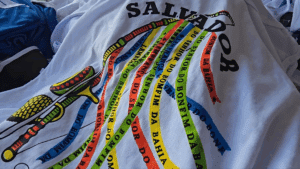
Senhor do Bonfim ribbons are known for their bright colours and the practice of tying them around the wrist or elsewhere while making a wish.
The original ribbons were created in 1809 and disappeared in the early 1950s.
Bonfim measure
Known as the Bonfim Measure, it takes its name from the fact that it measures exactly 47 centimetres, the length of the right arm of the statue of Jesus Christ, Lord of Bonfim, placed on the main altar of the most famous church in Bahia. The image was made in Setúbal, Portugal, in the 18th century.
The “measure” was made of silk, with the design and name of the saint embroidered by hand and finished in gold or silver ink.
Use and meaning
It was worn around the neck as a necklace, from which medals and holy cards were hung, acting as currency: when paying a promise, the faithful carried a photograph or a small wax sculpture representing the part of the body healed by the saint (ex-voto). As a souvenir, they were given one of these ribbons, symbolising the church itself.
Evolution of the bracelet
It is not known when the transition to the current wristband took place, but it is a fact that the new wristband was already being sold on the streets of Salvador in the mid-1960s, when it was adopted by the Bahian hippies as part of their clothing.
Some attribute its creation to Manuel Antônio da Silva Serva.
Video about the history of Senhor do Bonfim ribbons

História das Fitinhas do Senhor do Bonfim01:07

Curiosidades sobre as Fitinhas do Senhor do Bonfim00:50

História das Fitas do Senhor do Bonfim
Senhor do Bonfim Ribbons
Here is a summary of the history and meaning of the Senhor do Bonfim ribbons.
1. Origin and history
Beginnings in the 19th century
- Senhor do Bonfim ribbons date back to the 19th century, around 1809, in Salvador, Bahia. Initially, they were not ribbons but replicas of a medallion called “medida do Bonfim” or “medida do Senhor do Bonfim”.
- This medallion was about 47 cm long, which was the size of the right arm of the image of Nosso Senhor do Bonfim, a representation of Jesus Christ venerated in the Church of Nosso Senhor do Bonfim in Salvador. The image was brought from Portugal and installed in the church in 1754.
Evolution to ribbons
- Over time, the original medallion was replaced by ribbons made of cotton or silk. These ribbons were embroidered with the name “Nosso Senhor do Bonfim da Bahia” and became popular with the faithful and visitors.
- The ribbons were sold to the faithful as souvenirs or devotional gifts to take home or to wear personally as a sign of devotion and to ask for the intercession of Our Lord of Bonfim.
2. Meaning and traditions
Use of ribbons
- The tradition of wearing ribbons involves tying them around the wrist or another part of the body, such as the ankles, or even around objects such as crosses and religious statues.
- When tying the ribbon, it is customary to make three knots, representing three wishes or requests. Each knot should be made with a wish in mind. It is believed that when the ribbon wears out and breaks naturally, the wishes will be granted.
Colours and symbolism
The ribbons are available in different colours and each colour can have a meaning or be associated with a specific wish, such as love, health, peace, success and others. For example, white usually represents peace and protection, while red can symbolise passion and strength.
The Senhor do Bonfim ribbon has a side that few people know about: each colour symbolises an orixá.
- Dark green for Oxossi
- Light blue for Iemanjá
- Yellow for Oxum
Regardless of the colour, the band has a symbolic, aesthetic and spiritual representation typical of Bahia’s African roots.
Link with religious syncretism
- The ribbons of Senhor do Bonfim are also a symbol of the religious syncretism characteristic of Bahia, where elements of Catholicism and Afro-Brazilian religions such as Candomblé mix. For many practitioners of Afro-Brazilian religions, the image of Nosso Senhor do Bonfim is associated with Oxalá, one of the most important deities (orixás) in Candomblé.
Feast of Senhor do Bonfim
- Devotion to Senhor do Bonfim culminates in the famous Lavagem do Bonfim, a popular religious festival held every year on the second Thursday of January. During the event, women in traditional costume carry pots of perfumed water and wash the steps of the Church of Bonfim in a ritual of purification and blessing. Ribbons are widely distributed and worn by participants during the festival.
3. Popularity and expansion
Tourism and globalisation
- Senhor do Bonfim ribbons have become a symbol of Salvador and Bahia, and are highly sought after by tourists and visitors. They are sold not only in the church of Senhor do Bonfim, but also in handicraft markets and shops throughout the city.
- The popularity of fitinhas has spread beyond Brazil’s borders and can now be found in other countries, brought by Brazilian tourists and expatriates, becoming a global symbol of faith and good luck.
4. Cultural significance
An expression of faith and tradition
- More than just an accessory, Senhor do Bonfim ribbons are an expression of faith, hope and a cultural tradition that reflects the diversity and richness of Brazil’s religious and cultural heritage.
Symbol of resilience and hope
- The ribbons also symbolise the resilience and faith of the Bahian people, especially in difficult times, and are a constant reminder that hope and devotion can bring comfort and strength.
The three requests
- In popular tradition, the Senhor do Bonfim ribbon is wrapped around the wrist and tied with three knots. Each knot is preceded by a silent wish, which must be kept secret until the ribbon breaks naturally.
5. Interesting facts
- The ribbons are traditionally made in a length of 47 cm, the same as the original arm of the image of Senhor do Bonfim.
- In the beginning, the ribbons were made of silk and embroidered with gold or silver thread. Nowadays they are more commonly made of polyester, which makes them more affordable.
6. Summary
The ribbons of Senhor do Bonfim, with a history dating back to the 19th century, are much more than just souvenirs. They have a deep religious and cultural significance, being a manifestation of faith and hope that unites people of different faiths and backgrounds. This simple yet powerful amulet continues to be a symbol of devotion, love and a collective desire for well-being and protection.
Bahia.ws is the largest tourist guide for Bahia and Salvador.
Publicações Relacionadas
Tourist Attractions in Pelourinho and the Historic Centre of Salvador
Most Visited Churches in Salvador de Bahia Revealed
Palaces in Salvador to visit and learn about Brazil's history
Discover the Magnificence of Nossa Senhora de Monte Serrat Fort
Discover the 23 beautiful beaches of Salvador, Bahia
Church of the Third Order of St Francis History
History of the Founding of Salvador, Bahia - History of Brazil
Interesting places to visit in Salvador
Parks and Squares in Salvador for Leisure Activities
History of the Church of São Pedro dos Clérigos in Salvador
History and sights of Avenida Contorno in Salvador BA
Nossa Senhora dos Mares Church: Gothic Architecture
Fort of Nossa Senhora de Monte Serrat History
Ponta de Humaitá: A Gem in Salvador Bahia
7 Day Itinerary in Salvador and Surroundings Guide
Church and Convent of Nossa Senhora da Palma in Salvador, Bahia
Prostitution, sex, massage parlours and nightclubs in Salvador
Discover the reasons for a holiday in Salvador, Bahia
39 Museums in Salvador: Discover the history and culture of Bahia
Tourist attractions in the Gamboa neighbourhood in Salvador BA
Fort of Santo Antônio da Barra and Its Rich History
Tourist attractions for children in Salvador: fun and learning
Convent and Church of Santa Teresa and its History
Journey into the Sacred Art of Catedral Basílica de Salvador
Secret History of Salvador, Bahia - History of Brazil
Basílica de Nossa Senhora da Conceição da Praia: História
Where to Stay in Salvador for Your Best Experience
Solar do Unhão and the Museum of Modern Art in Salvador BA
History of the Church of Nosso Senhor do Bonfim in Salvador
Tourist Attractions and Architectural Heritage of Salvador, Bahia
History of the forts and lighthouses of Salvador, Bahia
Rio Vermelho Neighbourhood in Salvador's Nightlife
Churches of Salvador: Architectural and Historical Treasures
Bahia Art Museum (MAB): Learn about its history and collection
Find out how to celebrate Carnival in Salvador, Bahia
Learn about the history of the construction of the Lacerda Lift
This post is also on:
Português
English
Deutsch
Español
Français