Tourism in Salvador: A unique experience
A visit to Salvador, the capital of Bahia, offers a unique experience that combines history, culture, nature and a rich Afro-Brazilian heritage.
A living museum
Salvador is a true living museum, reflecting Brazil’s rich history and cultural diversity. A symbol of the mixing of faiths and ethnicities, the Bahian culture is characterised by its contagious joy and a people who only need sunshine to be happy.

Cultural identity
Bahia’s strong cultural identity is evident in its vibrant cuisine, historic architecture and unique artistic expressions. The charm of Salvador lies in the harmony between the historic centre and the shops of Pelourinho with the modern neighbourhoods and beautiful natural scenery, dotted with paradise beaches and coconut groves.
Parties and hospitality
The city offers an abundance of parties, high-quality restaurants and sunny days, promising an memorable trip. The people of Bahia are known for their hospitality and the city’s hotel infrastructure is well prepared to welcome tourists from all over the world.
Historical heritage
Salvador is known as the “Land of All Saints, Joy and Enchantment”. As Brazil’s first capital and a World Heritage Site, its streets and squares have been celebrated by great names in music and literature. Since its foundation, the city has attracted international attention, not only for its strategic location, but also for its exuberant natural wealth.
Historic fortifications
The presence of a defensive line of forts, built in the early centuries to protect against invasions by indigenous peoples, the French, the English and the Dutch, testifies to its strategic importance. At the end of the 17th century, Salvador had 14 forts, of which 11 still exist and are considered important historical heritage sites.
Cultural heritage
Salvador breathes history, with a vast cultural and historical heritage that is one of the city’s greatest legacies, attracting visitors from all over the world.
Historic buildings such as mansions, chapels, churches and manor houses make Salvador one of the cities that best preserves its cultural heritage. Among its most important monuments are the Cathedral Basilica, the Church of Nosso Senhor do Bonfim, a symbol of the Bahian faith, and the Church of Santo Antônio da Barra.
Mysticism and architecture
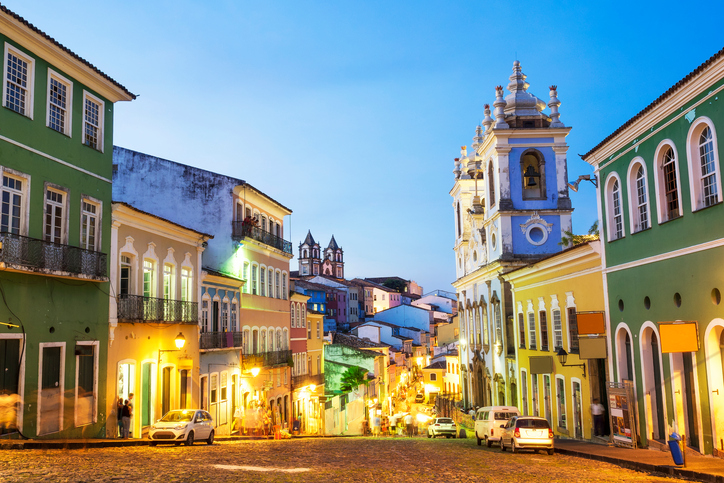
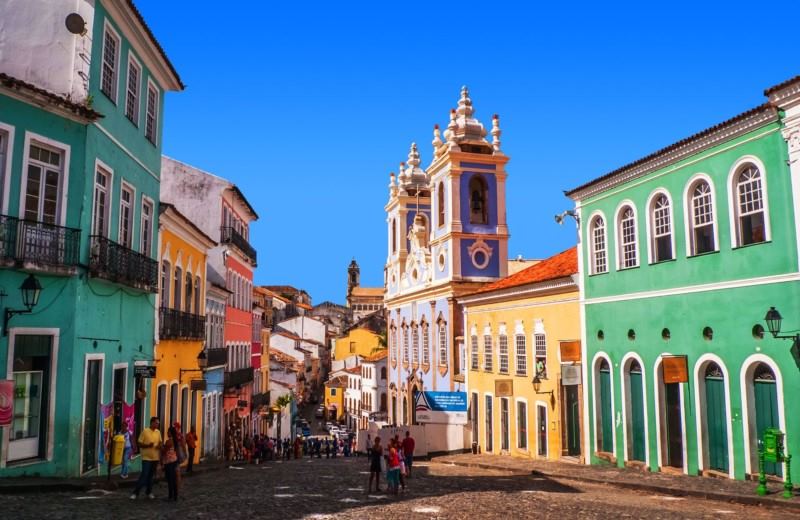
These and other religious buildings reflect the strong Catholicism present in Salvador, which, mixed with the practices and deities of Candomblé, gives the city an air of mystery and magic. The narrow, winding streets of Pelourinho are fascinating, with museums of sacred and popular art and buildings from the 17th to 19th centuries.
Must see attractions
The imposing Fort of Monte Serrat and the famous Mercado Modelo, full of local handicrafts, are must-sees.
Don’t forget the Elevador Lacerda, which connects the Cidade Alta with the Cidade Baixa, the Fundação Casa de Jorge Amado, which celebrates Bahian culture and literature, and the beautiful beaches and islands that make up Salvador’s coastline.
BOTTOM LINE
Salvador da Bahia is all this and more. To visit this city is to immerse yourself in a continuous symphony of parties, to experience the contagious joy of the Bahian people and to enjoy a unique daily life. Salvador is a trip full of adventure, history, culture and, above all, pleasure.
Videos about places of interest in Salvador, Bahia
7 Passeios IMPERDÍVEIS em Salvador06:50

Barra e Pelourinho em Salvador da Bahia02:33

Rio Vermelho em Salvador da Bahia14:11
Salvador da Bahia - Guia Turístico33:11
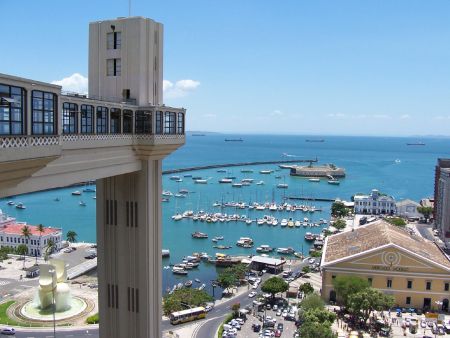
Elevador Lacerda em Salvador05:30
Places of interest in Salvador, Bahia
- Pillory
- Barra Lighthouse
- Lacerda lift
- Model Market
- Abaeté Lagoon
- Church of Senhor do Bonfim
- Fort of Monte Serrat
- Humaitá Point
- Bay of All Saints
- Ribeira Beach
- Bahian Cuisine
1. Pillory
Few places in Salvador are as emblematic as Pelourinho. Located in the historic centre of the Bahian capital and part of the UNESCO World Heritage Site, it is notable for its colonial Portuguese baroque houses.

The name dates back to the days of slavery. Pelourinho means the stone column that stood in the middle of squares to punish slaves.
Discover also the Attractions of the Historic Centre of Salvador, Bahia
2. Barra Lighthouse
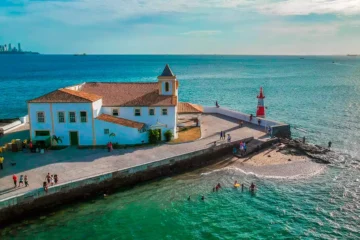
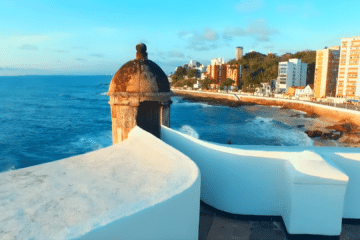
The Barra Lighthouse, also known as the Santo Antônio Lighthouse, is one of Salvador’s most important landmarks. In addition to its external beauty, it also provides access to the Nautical Museum.

The 22 metre high tower was built in the 17th century to guide ships arriving in the city, which was once one of South America’s main ports.
3. Lacerda Elevator
The Lacerda Elevator is one of Salvador’s most popular tourist attractions, despite its practical use for the local population. The world’s first urban lift takes residents from the lower to the upper part of the city.

The attraction is the view from the top.
Learn more about the foundation and history of Salvador, Bahia.
4. Model Market
Located in the Lower City, the Mercado Modelo is considered the largest handicraft market in the country. It has more than 260 shops selling typical Bahian products, as well as restaurants and bars.

The building is listed by the National Institute of Historical and Artistic Heritage (Iphan). Built in 1861, it was the third customs house of Salvador. It also hosts various artistic and cultural events.
5. Abaeté Lagoon
The Abaeté Lagoon is 10 kilometres from the city centre, but it is a well-known spot.

Here tourists will find calm waters, white sand and coconut trees to relax under. The lagoon is part of a nature reserve.
6. Church of Senhor do Bonfim
Famous throughout Brazil, the Church of Senhor do Bonfim became famous for the Senhor do Bonfim ribbons and the annual washing of its staircases.

This cultural monument, with neoclassical architecture and a rococo façade, was built between 1745 and 1754 to house the image of Senhor Bom Jesus do Bonfim, brought from Lisbon. Pope Pius XI raised the church to the status of a basilica in 1927.
See also Religious tourism in Salvador, Bahia
See also Churches of Salvador, Bahia
7. Fort of Monte Serrat
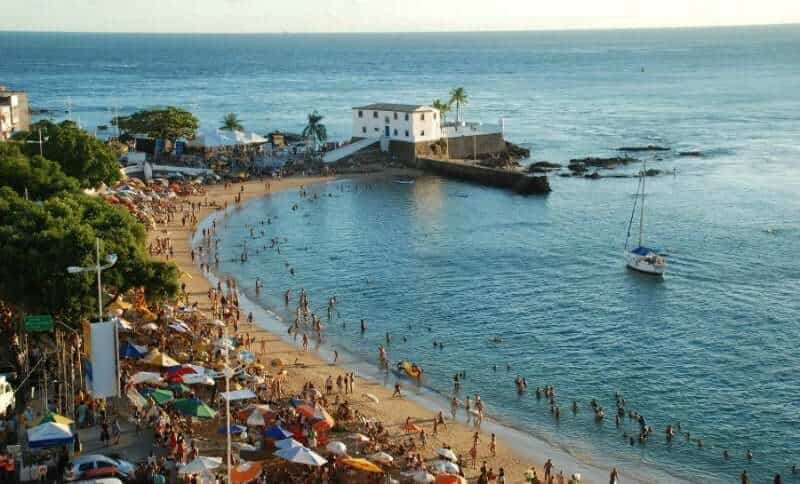
The Fort of Monte Serrat was first built as a small fort between 1538 and 1587, and renovated in 1602 to increase its defences. It was known as the Fort of São Felipe until its name was changed in the 19th century.

It is a beautiful tourist attraction steeped in history, as it was occupied by the Dutch in 1638 and was home to Prince Maurício de Nassau. The fort houses the Arms Museum.
Read more about the History of the Forts and Lighthouses of Salvador
8. Humaitá Point
Close to Monte Serrat Fort, Ponta do Humaitá is known for its panoramic views of Baía de Todos os Santos and the city, and for being one of the best places to watch the sunset.

The architecture of the town is characterised by 19th century houses, a lighthouse from the beginning of the last century, a convent and the church of Monte Serrat.
9. Bay of All Saints
The Bay of All Saints is the largest bay in Brazil. It was sighted on 1 November 1501 during the expedition of Amerigo Vespucci and named after the date on which All Saints’ Day is celebrated.

In Amerigo Vespucci’s description, it was a large and beautiful bay, and it still attracts the attention of those who visit Salvador for the first time. It has calm, clear waters, Atlantic Forest, extensive mangroves, sandbanks and coral reefs.
Read more about the History and features of the Bay of All Saints.
10. Ribeira Beach
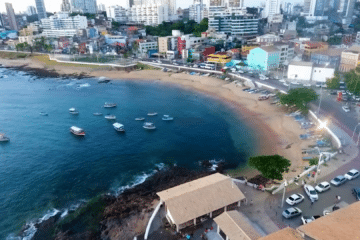
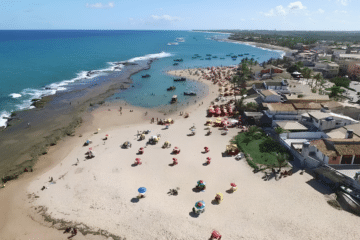
One of the most charming and bohemian spots in Salvador, Ribeira Beach is bathed by the Bay of All Saints and offers beautiful views of colonial mansions and islands.

This is one of the city’s most popular locations for sailors, due to its calm waters, which is why it was once a well-known fishing village.
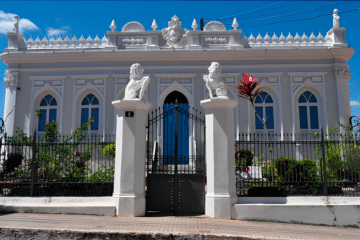
The most popular stretch of sand is next to the architectural complex formed by the Archbishop’s Summer Palace and the Church of Nossa Senhora da Penha, with a good selection of beach huts offering food, drinks, deck chairs and parasols.
For fun, beachgoers play beach soccer and volleyball. This beach is also often used for competitions and water sports such as rowing and canoeing. The whole coastline tends to get crowded at weekends, so if you want peace and quiet, go during the week.
Ribeira is known for its bohemian lifestyle, with several waterfront bars, concerts and cultural festivals such as the Mercado Iaô promoted by singer Margareth Menezes, and the city’s most famous ice cream parlour, Sorveteria da Ribeira.
See also Beaches of Salvador, Bahia.
11. Bahian Cuisine – Tabuleiro de Sabores (Flavour Tray)
Bahian cuisine is a chapter in the history of Salvador. The mixture of rich and unique eating habits is the result of mixing the knowledge of three ethnic groups.
Manioc and corn were cultivated by the natives, who made pirão (a thick porridge) and fermented drinks to accompany fish and domestic animals.
With the arrival of the Portuguese, the natives were introduced to cod, sardines and fine sweets, while the black population contributed the unmistakable flavours of chilli peppers and palm oil.
Bahia’s food festival dates back to the 16th century, when slaves arrived in the state from various regions of Africa.
Gradually, the black women, who were bought in the markets near the Model Market, learned what was already being consumed and adapted the dishes of the orixás to the tastes of the sinhás.
Thus was born caruru, an adaptation of amalá, a delicacy that included the food of the orixás (deities), which, with the addition of dried shrimp, peanuts and chestnuts, became one of the most famous dishes in Bahian cuisine.
The famous shrimp bobó and munguzá dishes underwent the same process.
Leftover olive oil was transformed into pure farofa or mixed with fried plantains. Coconut milk was used to flavour moqueca, stews and escabeches, while bagasse, mixed with sugar cane molasses or rapadura, quickly became a delicious cocada.
But not all dishes were influenced by Africa. At a time when the best cuts of meat were reserved for the masters, the inhabitants of the slave quarters were left with only the carcass.
It was thanks to the creativity and necessity of the enslaved that the succulent feijoada, sarapatel and mocotó were created, famous delicacies that also have the special touch of palm oil.
Today, the Bahian menu includes more than 50 different types of dishes, many of them typical of the slave quarters, whose fame is mainly due to delicacies such as acarajé, mocotó and crab and oyster escaldados, among others, sold on the beaches, in popular markets and in the famous street stalls.
However, the people of Bahia and Salvador, one of the largest cities in the Northeast, do not live on traditional food alone, and restaurants serving international cuisine and regional Brazilian dishes, such as those from Rio Grande do Sul and Minas Gerais, complete this attractive gastronomic offer.
Bahia.ws is the largest tourist guide for Bahia, Salvador and the Northeast.

Publicações Relacionadas
7-day itinerary in Salvador and the surrounding area: Pelourinho, the islands and Praia do Forte
History and Heritage of Itaparica Island — Bay of Todos os Santos
Convent and Church of Santa Teresa and the UFBA Museum of Sacred Art in Salvador
Canavieiras: A Hidden Gem in Bahia's Coastline
Paulo Afonso's Beautiful Waterfalls and Canyons
Pelourinho: what to do in Salvador’s Historic Centre
The 3 most paradisiacal beaches in Bahia
A History of the Forts and Lighthouses of Salvador (Bahia)
South Coast of Bahia: Discover Stunning Beaches
Towns and the Abrolhos Archipelago — The southernmost tip of Bahia
Solar do Unhão & MAM-BA — History, Architecture and a Visit
São Jorge Parish Church in Ilhéus — history, architecture and religious art
Discovery Route in Bahia: History, Culture and Tourism
Igatu: Explore the 19th-Century Stone Houses
Mining in the Chapada Diamantina History Explained
Praia do Forte, Bahia: The Complete Travel Guide
What to do on Boipeba Island - Tourist Guide - videos
Historic Towns in Bahia: A Journey Through Time
Discover the Magnificence Fort of Nossa Senhora de Monte Serrat
How to get to Fumaça Waterfall in Chapada Diamantina
History of Cocoa: From Aztecs to Modern Use
Church of São Pedro dos Clérigos — History, architecture and religious art
Lagoa Encantada in Ilhéus: A Preserved Natural Paradise
Sempre-Viva: Symbol of Preservation in the Chapada Diamantina
Imbassaí Beach: Discover the Best of Bahia
Ecotourism in Bahia: discover village of Santo André
Maré Island (Bay of Todos os Santos) — beaches, culture and how to get there
Basílica Santuário Nossa Senhora da Conceição da Praia — history and architecture
The highest and most beautiful waterfalls in Chapada Diamantina
Todos os Santos Bay — Nature, History and Water-based Tourism
Baixio: Between lagoons, dunes and the charm of a village surrounded by nature
Rafting in Taboquinhas: The Ultimate Adventure Guide
Tourist Attractions and Documentaries about Chapada Diamantina
Trail to Buracão Waterfall in Chapada Diamantina
Skydiving in Bahia: An Unforgettable Experience
Vila de Barra Grande na Bahia: Guia Completo para Turistas
This post is also on:
 Português
  English
  Deutsch
  Español
  Français