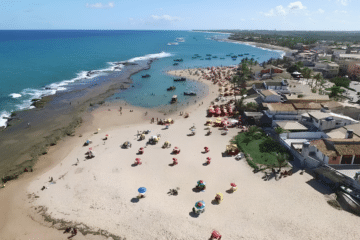
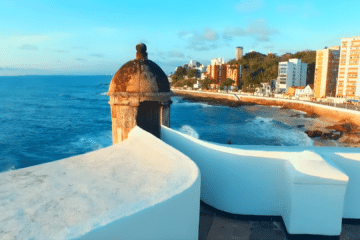
The history of the founding of Salvador, Bahia, began as a fortified city, or at least that was the intention of King João III of Portugal. As the capital or “head” of Brazil, its defence was a constant concern.
The prominence of the fortifications in the landscape of the city of Salvador undoubtedly represents the tactical and strategic necessity of their location on high ground, with a privileged view of the surrounding areas.

The history of Salvador began with its foundation in 1549 as the capital of Brazil (it remained so until 1763, when the seat of the Viceroyalty was transferred to Rio de Janeiro).
The city of Salvador was the scene of the most important events of the first three centuries of our colonial history.
The main Atlantic port for ships sailing around the world on the Spice Route to the East, it prospered first from the export of sugar produced in the mills of the Baiano Recôncavo (the geographical area around the Bay of All Saints) and later from trade between the colony and Portugal.
The history of Salvador began in 1501, when the first expedition to explore the country, led by Pedro Álvares Cabral, came across a large and beautiful bay – named Baía de Todos os Santos (Bay of All Saints) by the navigator Américo Vespúcio, because it was discovered on 1 November.
See also the tourist attractions in the historic centre of Salvador, Pelourinho.
Videos about the foundation and history of Salvador, Bahia

História de Salvador da Bahia22:29

Salvador 450 anos de história

A história da primeira capital do Brasil, Salvador11:30

Fundação de Salvador na Praça Tomé de Souza07:32

História completa de Salvador da Bahia01:57:14
Fundação e a História de Salvador da Bahia
The great gulf then became a point of reference for navigators, becoming one of the busiest ports of the American continent.

Some of the historical records of Salvador at that time relate facts relevant to the history of the city of Salvador, Bahia, such as the legend of the Portuguese shipwreck survivor Diogo Álvares, who in 1509 was welcomed by the Tupinambá tribe, who lived on the coast of the lands that would become Salvador.
Called Caramuru, Diogo Álvares married the daughter of the chief Taparica, the Indian Paraguaçu, who was baptised in 1528 in France with the name Catarina Álvares.
Caramuru played a fundamental role in the construction of the city, ordered by the King of Portugal, Dom João III, who appointed Captain Thomé de Souza as the first Governor-General of Brazil.
Why did Diogo Álvares play a fundamental role in the founding of Salvador?Diogo Álvares, known as Caramuru, played a fundamental role in the foundation of Salvador because he was an important intermediary between the Portuguese colonisers and the local indigenous population, especially the Tupinambás.
His knowledge of the indigenous language and customs, acquired after being taken in by the Tupinambás following a shipwreck in 1509, enabled a peaceful and productive coexistence between the two groups.
Caramuru married Paraguaçu, the daughter of the chief Taparica, and gained great influence among the natives.
This was crucial when Captain Thomé de Souza arrived in 1549 with the mission of founding Salvador, as Caramuru facilitated contact between the Portuguese and the natives, helping to avoid conflict and consolidate the Portuguese presence in the region.
Diogo Álvares also played an important role in preparing and organising the local forces, supporting the establishment of Salvador as the first capital of Brazil and strengthening Portuguese rule over the new colony.
The fleet, led by the ship Conceição, carried more than a thousand people in six vessels: the ships Conceição, Salvador and Ajuda, two caravels and a brigantine. After a 56-day voyage, the fleet was greeted with a feast by Caramuru and the Tupinambás.
Thomé de Souza remained in office until July 1553 and returned to Lisbon a month later to be replaced by Governor-General D. Duarte da Costa.
With the arrival of African slaves at the end of the 16th century, the city prospered thanks to the economic influence of the port activities and sugar production in the Recôncavo.

In 1583, Salvador had two squares, three streets and around 1,600 inhabitants.
The wealth of the capital attracted the attention of foreigners, who organised expeditions to conquer it. Looting and bombardment by privateers in the port of Salvador were frequent in the late 16th century and early 17th century.
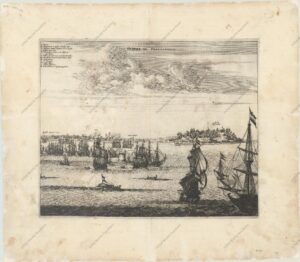
With the union of the Portuguese and Spanish crowns in 1580, foreign maritime interests were thwarted, and when the peace treaty between Spain and the Netherlands expired, the West India Company (formed by Jewish and European merchant capital) attacked Salvador in May 1624, where it remained until April 1625, when its soldiers were expelled by a fleet of 40 ships sent by Spain.

In 1638, another invasion attempt (this time led by Maurício de Nassau) failed. Salvador remained the capital of Portuguese America until 1763, when the viceroyalty was transferred to Rio de Janeiro.

However, as the capital of the province of Bahia, the city retained its political and economic importance and in 1808 welcomed the Portuguese royal family (fleeing Napoleon’s troops).
At that time, Prince Regent João VI opened the ports to friendly nations and founded the Medical-Surgical School of Bahia in Terreiro de Jesus (Pelourinho), which became the first medical school in Brazil.
The libertarian spirit of the people of Salvador gave rise to several protest movements, notably the Conjuração dos Alfaiates (Tailors’ Conspiracy), in which a group of rebels, dissatisfied with Portuguese rule, attempted to found the República Bahiense (Bahian Republic).
Even after the proclamation of Brazilian independence in 1823, Bahia remained occupied by Portuguese troops under Brigadier Madeira de Mello.

See the street chairs going up Ladeira da Conceição, carried by slaves.
The wall that protects the slope of Praça do Theatro was begun in 1846. Look at Hildebrandt’s panorama of 1844, which shows that it did not yet exist. Note the old Custom House. This site was filled in in 1858 to make way for the new Custom House, now the Mercado Modelo.
Even after the Proclamation of Independence, patriotic militias entered the city through the Estrada das Boiadas, now Rua Lima e Silva, in the Liberdade neighbourhood.
The date became a civic reference point for the people of Bahia, celebrated annually with intense popular participation.

History of the foundation of Salvador, Bahia
Bahia.ws is the largest tourist and travel guide for Bahia and Salvador.

Publicações Relacionadas
Solar do Unhão & MAM-BA — History, Architecture and a Visit
Main islands of Todos os Santos Bay | Visitor’s Guide
Caraíva: A rustic and unspoilt paradise in the south of Bahia
Chapada Diamantina: A Complete Guide to Attractions and Itineraries
Tourist Attractions in Bahia: main attractions, beaches and cities
Trekking in the Pati Valley in Chapada Diamantina
History, the Festival of Nossa Senhora das Candeias and Tourist Attractions
Belmonte's Rich History and Cultural Heritage
Imbassaí Beach: Discover the Best of Bahia
Bahia Maritime Museum: History of Navigation at the Barra Lighthouse
Mangue Seco: The Last Beach on the North Coast of Bahia
Salvador’s Historic Centre, Pelourinho, Baroque churches and museum
Ecotourism at Timeantube Lagoon, Praia do Forte
Cachoeira (BA) — National Monument and Historical Trail
Ilhéus (BA) — Beaches, Cocoa Plantations and Cultural Itinerary
Massarandupió Naturist Beach in Bahia
Ponta de Corumbau — an unspoilt paradise on the southern coast of Bahia
Municipality of Una: A Beach Paradise Awaits
Canavieiras: A Hidden Gem in Bahia's Coastline
Descobrimento National Park in Bahia: A Natural Heritage Site
Guide to Trancoso (BA) — what to do, beaches and inns
Subaúma Beach: The Perfect Escape in Bahia
Main Towns and Villages in the Chapada Diamantina Region
Dive Sites of Chapada Diamantina: A Guide
Places to visit on the south coast of Bahia
Lacerda Elevator — history, construction and visits
Porto Seguro (BA) — History, Beaches, Tours and Practical Tips
Waterfalls of Chapada Diamantina: A Guide for Adventurers
Valença: The Gateway to Morro de São Paulo
Morro de São Paulo: Beach Guide and How to Get There
Complete Guide to Visiting Arraial d'Ajuda in Bahia
Discover the Magnificence Fort of Nossa Senhora de Monte Serrat
Todos-os-Santos Bay (Bahia) — History, geography and conservation
Bom Jesus dos Passos Island: A Complete Guide (Beaches, Church and How to Get There)
Rio de Contas: Learn about the history of how the city was founded
Tourist Areas in Bahia - Tourist Guide
This post is also on:
 Português
  English
  Deutsch
  Español
  Français