Northeastern Brazilian music

Northeastern Brazilian Music: Rhythms, Composers and Cultural Heritage

1. Rhythms and musical genres of the Northeast

Baião, Xote, Xaxado and Côco

  • Luiz Gonzaga (Pernambuco) is considered the forerunner of baião, the rhythm that became the basis of forró. In addition to him, other artists such as Dominguinhos, Sivuca, Jackson do Pandeiro and Waldonys contributed significantly to the popularisation and development of these styles. Together with xote, xaxado and côco, baião forms the backbone of forró, one of the most representative musical styles of the Northeast.
  • Jackson do Pandeiro, for example, is known for his ability to mix baião with other northeastern rhythms such as xaxado and côco to create a unique sound.

Frevo

  • Originating in the states of Pernambuco and Paraíba, frevo is a fast-paced rhythm whose steps are reminiscent of capoeira and is closely linked to carnival. Artists such as Alceu Valença, Elba Ramalho and Geraldo Azevedo have helped to define this genre, which has gained national and international renown.
  • The Grande Encontro, with Alceu Valença, Elba Ramalho, Geraldo Azevedo and Zé Ramalho, is one of the most remarkable performances of this genre.

Tropicalism

  • Tropicalism, a movement that began in the 1960s, is a milestone in Brazilian music, strongly influenced by the anthropophagic movement. Created by artists such as Caetano Veloso and Gilberto Gil, Tropicalism mixed elements of Brazilian music with international influences, creating a revolutionary sound for the time.
  • Tom Zé and Os Mutantes were also part of the movement, which sought to break down the barriers of Brazilian popular music and integrate national culture with foreign influences.

Axé music

  • In the 1980s, Luiz Caldas pioneered the creation of the Axé Music genre, which mixed elements of frevo, bossa nova, rock and other styles. The movement gained momentum with artists such as Daniela Mercury, Chiclete com Banana, Olodum and Timbalada.
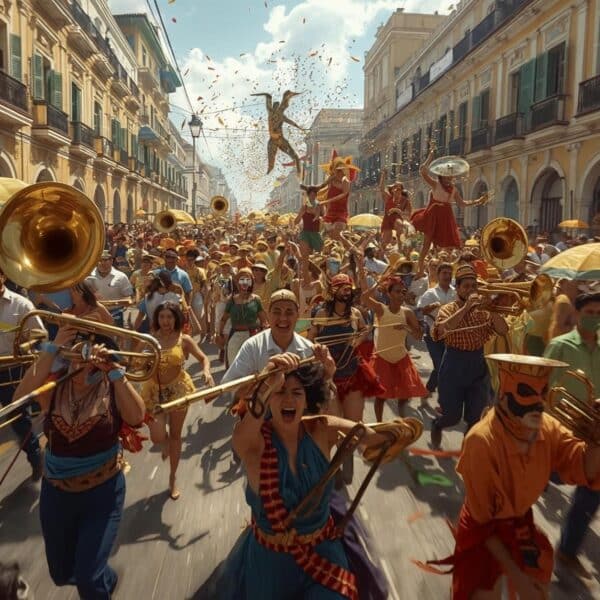
  • Axé became one of the main rhythms of the Salvador Carnival, replacing Frevo at many parties and performances. It helped make the Bahian Carnival one of the biggest in the world, attracting tourists from all over the world.

Mangue Beat

  • Mangue Beat emerged in Pernambuco in the 1990s, a fusion of rock, hip-hop, maracatu and electronic music. This cultural movement was created by Chico Science and the band Nação Zumbi, who innovated by mixing the tradition of maracatu with more modern sounds.
  • Mangue Beat not only influenced music, but also had a major impact on the cultural and artistic scene in Recife and throughout the Northeast.

2. Artists and regional contributions

Ivete Sangalo

  • Ivete Sangalo is undoubtedly one of the biggest stars in Brazilian music today. Not only is she Brazil’s most popular artist, but she also has international recognition. Ivete is the sales leader in the Brazilian music market and her ability to attract fans is phenomenal, as evidenced by her historic performance at Rock in Rio Lisboa in 2004, where she broke attendance records.
  • In addition to her musical career, Ivete owns the company Caco de Telha, which promotes major events in Brazil, including concerts by international artists such as Beyoncé and Cirque du Soleil.

João Gilberto

  • João Gilberto is widely regarded as the creator of the Bossa Nova style, which has become one of the most famous and respected Brazilian rhythms in the world. Along with Antonio Carlos Jobim, Vinicius de Moraes and Luiz Bonfá, João Gilberto formed the quartet responsible for bringing Bossa Nova to the world stage, especially after their performance at Carnegie Hall in 1962.

Raul Seixas

  • Born in Bahia, Raul Seixas was one of the central figures of Brazilian rock. His innovative music and deeply philosophical lyrics stood out especially in the context of Jovem Guarda. Raul was also a pioneer in introducing mystical and existential themes into Brazilian rock.
  • Pitty, also from Bahia, is another very successful artist in contemporary Brazilian rock, who has been gaining prominence since the 2000s.

Reginaldo Rossi and Waldick Soriano

  • Reginaldo Rossi and Waldick Soriano are the main exponents of brega in Brazil. This genre, characterised by romantic lyrics and simple melodies, has a loyal following in the Northeast and throughout Brazil.

3. Other highlights and musical diversity

Repente and Cego Aderaldo

  • Repente is a genre of popular Northeastern poetry that involves improvised rhymes, one of the main icons of which is Cego Aderaldo, who stood out for his ability to improvise verses quickly and creatively.

Tribo de Jah and reggae in Maranhão

  • Tribo de Jah is one of the most important reggae bands in Maranhão and Brazil, with international recognition. Maranhão is also a great stronghold of the tambor de crioula, one of the region’s most traditional cultural manifestations.