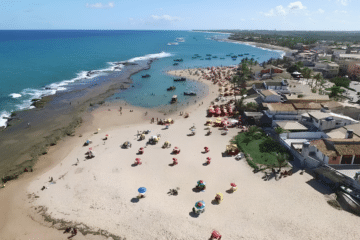
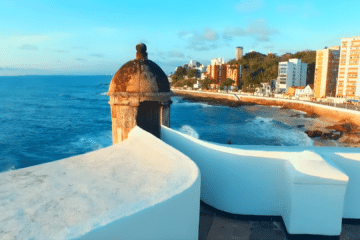
The Salvadorian Carnival is now the largest folk festival in the world. During the six days of carnival, around 2 million revelers parade along the routes known as Batatinha, Dodô and Osmar. But it wasn’t always so.

The evolution of carnival
Until the end of the 19th century, the petit bourgeoisie and the elite enjoyed themselves in parades and clubs, with masked balls to the sound of the marchinhas. The titles of the circuits pay tribute to the great names of Bahia’s carnival.
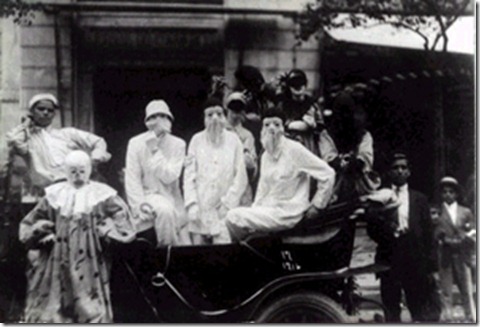
História do Carnaval de Salvador
“These are fitting tributes to Dodô and Osmar, creators of the Trio Elétrico, and to Batatinha, one of the great names of Bahian samba, proof that samba comes from here,” says historian Manuel Passos. He also advocates a tribute to Orlando Campos, creator of the Trio Tapajós. “Between 1963 and 1979, when Dodô and Osmar were apart, it was the Trio Tapajós that kept the carnival alive in Bahia. That is why I think he still deserves a tribute,” he says.
The context of the Folia de Momo
In the Baixa dos Sapateiros, the black party was animated by the groups Embaixada Africana and Pândegos D’África. The turning point for the Folia de Momo came in 1950, with the creation of the 2010 prizewinner: the Trio Elétrico.
The impact of the creation of the electric trio
The creation of the Trio Elétrico had a profound and transformative impact on the Salvador Carnival:
- Changing the Dynamics of the Festival: The trio elétrico introduced a new format to Carnival, bringing music and entertainment directly to the streets and creating a more immersive and participatory experience for revelers.
- Increased popularity: This innovation attracted a larger and more diverse audience, increasing participation in the carnival. With the opportunity to dance and have fun on the move, the carnival took on a new dimension.
- New rhythms and musical styles: The electric trio allowed the spread of new musical genres, such as axé, which became synonymous with the Bahian Carnival. Artists and bands were able to perform in a more dynamic way, contributing to the musical diversity of the festival.
- Growth of blocos: The structure of the Trio Elétrico encouraged the formation of new blocos, both traditional and alternative, which became part of the official carnival programme. This created a variety of options for revellers to choose from, with different styles and rhythms.
- Economy and tourism: The success of the Trio Elétrico in the Carnival also had a positive economic impact on Salvador, attracting tourists from different parts of Brazil and the world. This led to a significant increase in local revenues and promoted the city as a tourist destination.
- Culture and identity: The Trio Elétrico has become a symbol of Bahian culture, helping to consolidate the Salvador Carnival as one of the largest and most vibrant popular festivals in the world. It has strengthened the cultural identity of Bahia and the appreciation of samba and axé as artistic expressions.
The arrival of the liveliest car at the party, with electric guitars and people in a frenzy, created the first party circuit, the Osmar, between Campo Grande and Chile Street. “It was a unique circuit and everything was concentrated there. There were meeting points for young people and trios,” explains the historian.
The carnival routes
In the early 1980s, the second circuit was born, known as Barra-Ondina, but officially called Dodô. The restoration and elevation of Pelô to World Heritage status led to the emergence of the last of the party circuits, in the streets of the historic centre, called Batatinha.
“A fitting tribute to one of the biggest names in Bahian samba, Batatinha is proof that samba is Bahian,” says Passos.
Choosing one of the three circuits means adopting different schedules and musical genres. For Passos, the Bahian carnival has always been a stage for mixing all rhythms. “Everything is allowed. Once, at 6pm, the Ave Maria was played over an electric trio, with everyone in silence. It was one of the most beautiful scenes I have ever seen,” he says.
Carnival routes
Osmar
Most of the alternative blocos can be found in this area, especially until Carnival Sunday. Afro blocos such as Malê Debalê, Munzenza, Bankoma, Ilê Aiyê and Cortejo Afro, as well as children’s blocos also pass through this area. From Sunday, the more traditional blocos, with a focus on axé music, begin to make their way around the circuit. Ivete Sangalo, Claudia Leitte, Banda Eva and the trio of Rei Momo entertain the crowds between Campo Grande and Praça da Sé.
Dodô
The vast majority of the elite blocks follow this route. “The emergence of the Dodô circuit caused the elite to move there, leaving the Osmar circuit somewhat neglected,” says historian Manuel Passos. Asa de Águia, Timbalada, Cheiro de Amor, Ivete Sangalo and the queen of Axé, Daniela Mercury, take the Barra-Ondina route. This year, Moraes Moreira will also perform to celebrate the trio’s 60th anniversary. Pepeu Gomes, Rei Momo, will also be welcoming guests to this circuit.
Small potatoes
The independents concentrate on the historical route of the festival. Levada do Jegue, Filhos e Filhas de Gandhy, Corisco and Carnapelô are some of the main groups that parade through the streets of Pelourinho.
For Manuel Passos, the division of Bahia’s carnival into circuits has given the festivities a new look, especially with the creation of the most popular circuit, Barra-Ondina. “We need to find ways to restore the Osmar circuit to what it was before, as the meeting point it has always been,” he adds.
Bahia.ws is the largest tourism and travel guide for Bahia and Salvador.

Publicações Relacionadas

History of Frevo: Memory, Urban Space and Identit
The History of Frevo: Origins, Evolution, Rhythms and Style

Jackson do Pandeiro: The King of Rhythm and his Music
The History of Forró: Origins and Development
History of Bossa Nova - When Bossa Nova conquered the world

João Gilberto: The Father of Bossa Nova

Alcione: The Journey of a Music Icon

Alceu Valença: A Journey Through His Music

Elba Ramalho: A Journey Through Music History

Carlinhos Brown: Biography of a Percussion Legend

Gal Costa: Biography of a Musical Icon
Biography of Dominguinhos, the accomplished accordionist
Forró Pé-de-Serrra: The Heart of Brazilian Music
The Evolution of Forró: A Musical Journey
Luiz Gonzaga's Impact on Brazilian Music Culture
Gilberto Gil: The Icon of World Music Today

Musical Style and History of Samba de Roda

Ivete Sangalo: The Biography of a Music Legend
Olodum pays tribute to Michael Jackson in Pelourinho, Salvador
Dorival Caymmi and His Musical Legacy

Caetano Veloso and His Impact on Brazilian Culture

Daniela Mercury: Queen of Axé Music in Brazil

Maria Bethânia: A Legend in Brazilian Music History

Simone Bittencourt: The Journey of a Brazilian Music Star
Novos Baianos: A Journey Through Brazilian Music

The evolution of carnival: traditions and stories

Morais Moreira's Evolution from os Novos Baianos
Carmen Miranda: Icon of Brazilian Music History

Biography of Raul Seixas: Life and Musical Career
This post is also on:
 Português
  English
  Deutsch
  Español
  Français