Discover the cultural richness of the samba de roda: Origins, Instruments and Intangible Heritage
Samba de Roda is a more primitive musical variant of the samba, which originated in the Brazilian state of Bahia in the 17th century, probably in the 19th century. This traditional Afro-Brazilian musical style is associated with a dance, which in turn is associated with capoeira.

Instruments and training
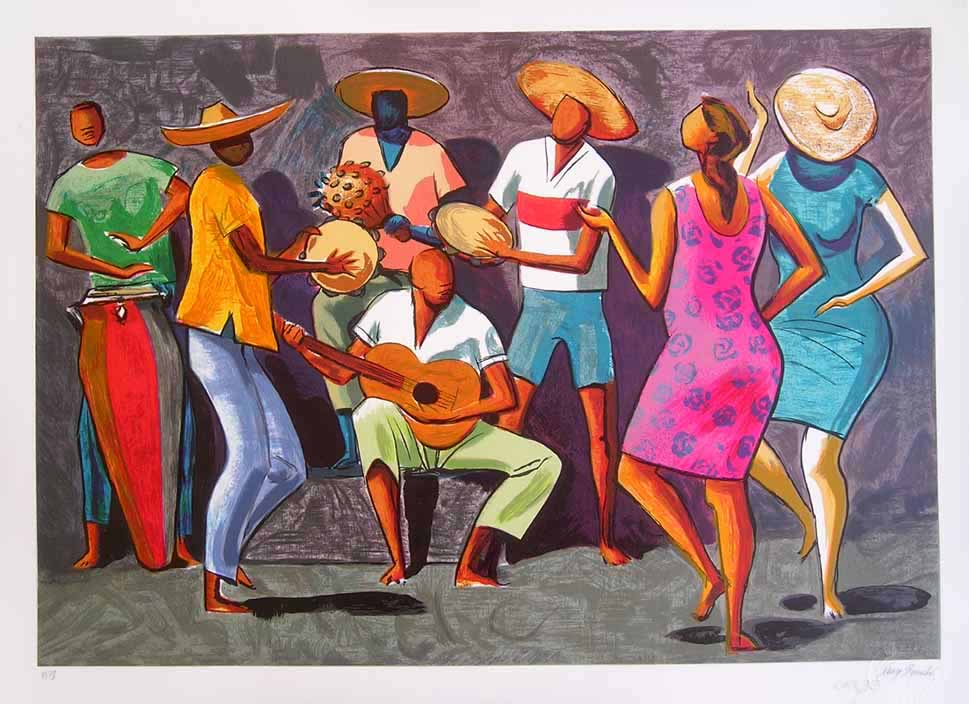
It is played by a group of pandeiro (tambourines), atabaque (drums), berimbau (three-stringed instrument), viola (violin), chocalho (rattle), triangle, cymbals, ganza, reco-reco and agogô, accompanied mainly by singing and clapping. Samba de roda is one of the many traditions brought to Brazil by African slaves. It is a variant of samba that is part of a popular Brazilian musical style that combines various songs, instruments, poetry and dances.
Estilo e História do Samba de Roda
Origin and cultural heritage
Samba de roda originated in Bahia in the 17th century and was brought to Brazil with the arrival of Angolan slaves. Today it is considered part of the cultural heritage of Afro-Brazilian culture. At present, this artistic expression is present throughout Brazil, and is most popular in the Recôncavo Baiano, a region where African slaves arrived.
Worth knowing about the Samba de Roda
- In 2003, it was included in the Register of Expressions.
- In 2005, it became part of the Intangible Heritage of Humanity, considered by UNESCO as a Masterpiece of Oral and Intangible Heritage.
- In 2013, it was declared a Cultural Heritage of Brazil by the National Institute of Historical and Artistic Heritage (IPHAN).
Samba de roda consists of a circle of people clapping their hands and a group of musicians playing the various instruments mentioned above.
1. Intangible heritage
Samba de Roda in the Recôncavo Baiano is a mixture of music, dance, poetry and partying. Present throughout the state of Bahia, samba is mainly practised in the Recôncavo region. However, the rhythm has spread to other parts of the country, especially Pernambuco and Rio de Janeiro.
Rio de Janeiro, already a federal district, became known as the world capital of Brazilian samba. It was in this city that samba developed, acquiring artistic diversity and establishing itself as a movement of social value.
Cultural influences
Samba de roda is said to have been inspired by an African rhythm, the semba, which was formed from references to various African tribal rhythms. The cultural diversity, even within the black race in Brazil, was remarkable, as slave owners chose their slaves at random, separating and mixing different African types.
This mixture changed the social environment of the blacks and had a decisive influence on the development of Brazilian samba, creating musical forms in a diverse social context. Samba de roda is also very similar to jongo.
2. Derived styles
With the modernisation and urbanisation of the samba de roda, several names emerged. In 1916, the first samba was recorded, “Pelo Telefone”, by the singer and composer Donga. Over time, other artists contributed to the genre, such as Ataulfo Alves, Pixinguinha, Noel Rosa, Cartola and Nelson Cavaquinho.
The most controversial of the rhythms derived from samba was bossa nova in the 1950s. Created by artists such as Antônio Carlos Jobim and João Gilberto, bossa nova has been accused of distancing itself from the natural evolution of samba by mixing its rhythm with influences from jazz.
Defenders of bossa nova argue that despite its distance from the reality of Rio’s favelas, the genre contributed to the enrichment of Brazilian music and the recognition of samba abroad.
3. Contemporaneity
In its contemporary form, samba de roda is present in the works of Bahian composers such as Dorival Caymmi, João Gilberto and Caetano Veloso. In the 1980s, samba was represented by names such as Zeca Pagodinho and Dudu Nobre.
From the late 1990s, Pagodinho began to decline, but whenever a genre loses popularity, new forms of production emerge, maintaining samba as the main form of Brazilian musical harmony, even as it changes with new influences. Recently, samba reggae has emerged, innovating with the development of the guitar as a substitute for the cavaquinho.
4. A little history
Samba de roda began around 1860 as an expression of the culture of the Africans who came to Brazil. Historical research indicates that it was one of the foundations of the samba carioca. This cultural expression is divided into two characteristic groups: samba chula and samba corrido.
In samba chula, the participants do not dance while the singers recite. The dance begins after the recitation, when one person at a time dances in the centre of the circle. In the samba corrido, everyone dances while two soloists and the choir sing in turn.
Samba de roda is linked to the worship of orixás and caboclos, capoeira and olive oil-based cuisine. Portuguese culture is also present through the viola, the tambourine and the language used in the songs.
It has been considered by IPHAN as Intangible Heritage. The application for inclusion in the Livro do Tombo was submitted on 4 October 2004 and registered as Intangible Heritage on 25 November 2005. This status will benefit popular culture, especially that of the Recôncavo Baiano, the birthplace of the samba de roda.
There are recordings of the samba de roda in the voice of Dona Edith do Prato, a native of Santo Amaro da Purificação and a friend of Dona Canô. Dona Edith played music by tapping a fork on a plate, which gave her her nickname. The CD Vozes da Purificação contains samba de roda songs, most of which are in the public domain, sung by Dona Edith and the choir.
Another singer who has achieved success with samba de roda is Mariene de Castro, whose CD Abre Caminhos, featuring songs by Roque Ferreira and other composers, demonstrates her deep musical knowledge. Mariene has sung with Daniela Mercury, Beth Carvalho and others.
Bahia.ws is the largest tourism and travel guide for Bahia and Salvador.

Publicações Relacionadas
History of Frevo: Memory, Urban Space and Identit
The History of Frevo: Origins, Evolution, Rhythms and Style

Jackson do Pandeiro: The King of Rhythm and his Music
The History of Forró: Origins and Development
History of Bossa Nova - When Bossa Nova conquered the world

João Gilberto: The Father of Bossa Nova
Alcione: The Journey of a Music Icon

Alceu Valença: A Journey Through His Music

Elba Ramalho: A Journey Through Music History

Carlinhos Brown: Biography of a Percussion Legend
Gal Costa: Biography of a Musical Icon
Biography of Dominguinhos, the accomplished accordionist
Forró Pé-de-Serrra: The Heart of Brazilian Music
The Evolution of Forró: A Musical Journey
Luiz Gonzaga's Impact on Brazilian Music Culture
Gilberto Gil: The Icon of World Music Today

Ivete Sangalo: The Biography of a Music Legend

History of Carnival in Salvador, Bahia
Olodum pays tribute to Michael Jackson in Pelourinho, Salvador
Dorival Caymmi and His Musical Legacy
Caetano Veloso and His Impact on Brazilian Culture

Daniela Mercury: Queen of Axé Music in Brazil

Maria Bethânia: A Legend in Brazilian Music History
Simone Bittencourt: The Journey of a Brazilian Music Star
Novos Baianos: A Journey Through Brazilian Music

The evolution of carnival: traditions and stories

Morais Moreira's Evolution from os Novos Baianos
Carmen Miranda: Icon of Brazilian Music History

Biography of Raul Seixas: Life and Musical Career
This post is also on:
 Português
  English
  Deutsch
  Español
  Français