Travel guides for Bahia, Alagoas, Ceará and the whole of the North-East of Brazil: beaches, ready-made itineraries, culture and accommodation tips. Get inspired and plan your trip.
Sharing the Discovered Lands
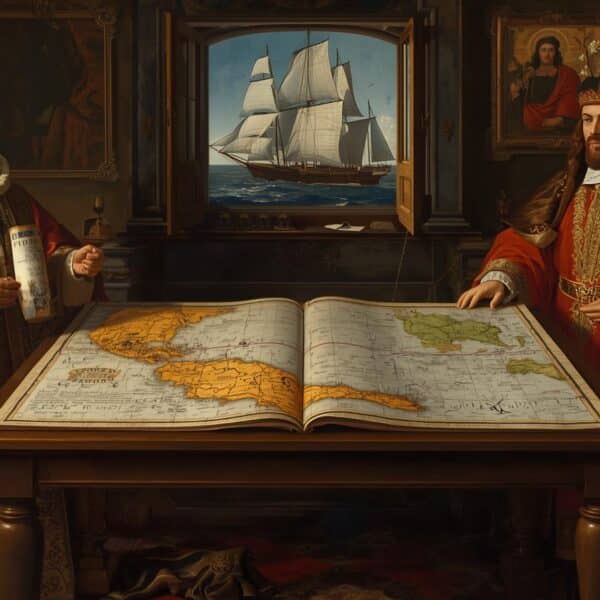
Sharing of Discovered Lands – Treaty of Tordesillas
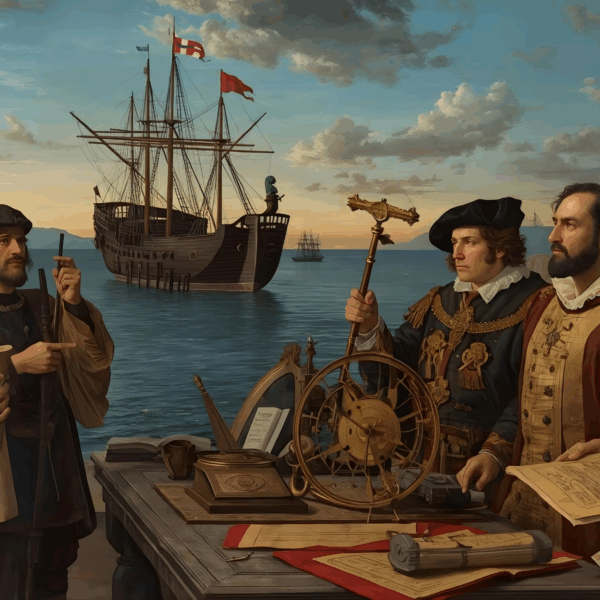
The Sharing of Discovered Lands was a central process in the political and religious organisation of overseas exploration in the 15th and 16th centuries. These chapters present the instruments and decisions that defined borders, legitimised conquests and shaped the western colonial map.
The Division of the Newly Discovered Lands – Treaty of Tordesillas.
1. Demarcation of the Tordesillas Meridian
Presents the origin and geographical logic of the imaginary line drawn to divide the areas of influence between Portugal and Castile, the methods of calculation, the cartographic controversies and the immediate impacts on navigation and Atlantic exploration.
2. Treaty of Tordesillas (1494)
Analyses the diplomatic agreement that formalised the proposed division: political context, main terms, negotiations between the crowns, and practical consequences for navigation, colonisation, and territorial disputes.
3. The Bull of Alexander VI
Examines the papal bulls as instruments of religious and political legitimacy: the pontiff’s motivations, the content of the bulls, and their role in reinforcing Iberian claims over the newly discovered lands.
4. Ratifications and recognitions by the Holy See
Addresses the Church’s subsequent confirmations of Portuguese expansion — decrees, concordats, and ratifications — and how these acts consolidated (or contested) Portuguese rights over overseas territories.
5. Purpose of the chapters
Throughout these texts, we will relate documents, geopolitical interests, and practical impacts on populations, navigation, and the formation of colonial empires.
Attempts to define the meridian of the Treaty of Tordesillas. 1. The context and structure of the Treaty. The Treaty of Tordesillas stipulated that the demarcation of the 370 leagues west of Cape Verde would be carried out by pilots, astrologers and sailors from both parties. Within ten months of […]
The Treaty of Tordesillas (1494) divided overseas territories. 1. Context King John II protested to the Roman Curia and neighbouring kings who benefited from the bulls issued by Alexander VI. He sent agents to Spain to propose a new dividing line for the overseas territories that was less harmful than […]
The bulls of Alexander VI and the dispute between Spain and Portugal over the new lands (1493). This text explains the papal bulls issued by Alexander VI in 1493, particularly Inter caetera, Eximie devotionis and Dudum siquidem, and their influence on the dispute between Spain and Portugal over the newly […]
1 — Ratifications of Portuguese expansion by the Holy See 1. Context and authority of the Holy See In the Middle Ages and early Modern Age, the Holy See occupied a position superior to other Christian nations. As a supranational authority, its moral influence was recognised and reaffirmed — including […]