A listed neoclassical building in Ilhéus, a symbol of the heyday of the cocoa industry. Find out when it was built, what to see and how to organise your visit.

Quick summary
- Style: Neoclassical
- Foundation stone: 20 January 1898
- Opening: 22 December 1907
- Current use: Town Hall / Museum (check opening times before visiting)
- Approximate area: 1,060 m²
History
The Paranaguá Palace was built in the late 19th century and opened in the early 20th century in Praça J. J. Seabra — the highest point in the historic centre of Ilhéus. The name pays tribute to the Marquis of Paranaguá, who was responsible for granting São Jorge dos Ilhéus city status in 1881.
Architecture and interior design
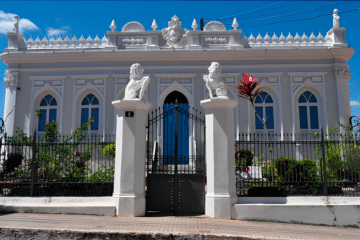
A neoclassical-style building with a rectangular, two-storey floor plan organised around a central vestibule and an imperial staircase. The interior decoration and paintings are attributed to the Italian artist Oreste Sarcelli. The original lighting was acetylene gas, supplied by the Vita brothers.
Renovations and uses over time
The building underwent major refurbishments in the early decades of the 20th century — between 1912 and 1916, and again in 1923 — when sanitary facilities were installed, the wooden floors were replaced with concrete slabs, and the roof was altered. It originally housed municipal government offices, administrative departments, a prison and a medical centre; it currently serves as an administrative headquarters and hosts museum exhibitions on various occasions (please check for guided tours).
Places of interest
- Main façade and four architectural fronts.
- Internal staircase and grand hall with paintings.
- A neoclassical marble statue depicting Sappho (the Greek poet) in the square opposite.
Tips for visitors
- Take a stroll around Praça J. J. Seabra to take photos of the façade and the statue of Sappho.
- Combine your visit with other attractions in the historic centre (the cathedral, the city beaches and houses associated with Jorge Amado).
- Please check opening times and whether internal visits are permitted with the Town Hall or the Capitania Museum before you go — access may be restricted as it is an administrative headquarters.

Publicações Relacionadas
Arembepe: beaches (Piruí, Praia do Canto), Hippie Village and the Tamar Project

São Jorge Parish Church in Ilhéus — history, architecture and religious art

History of the Convent and Church of Nossa Senhora da Piedade in Ilhéus

São Sebastião Cathedral (Ilhéus) — History, architecture and tourism
The 15 Most Visited and Well-Known Beaches in Bahia
The 3 most paradisiacal beaches in Bahia

Skydiving, Paragliding and Ballooning in Bahia

Historic Towns in Bahia: A Journey Through Time
Places to visit on the south coast of Bahia

História da Arte - Caracteristicas, Aspectos e Periodos
Tourist Attractions in Bahia: main attractions, beaches and cities

Subaúma, Bahia: where it is, things to do and where to stay

Massarandupió Naturist Beach, Bahia: Rules and Access
Beaches on the South Coast of Bahia: 10 Best and Tips
Towns and the Abrolhos Archipelago — The southernmost tip of Bahia

Baixio: Between lagoons, dunes and the charm of a village surrounded by nature
Best Beaches in Bahia: Your Guide to Paradise
Salinas da Margarida (BA) — Beaches, Attractions and a Complete Guide

Guarajuba Beach, Bahia: Natural Pools and Tips

Barra do Cahy: Brazil's first beach - history and nature

Garcez Beach: Discover Paradise in Jaguaripe

Barreiras: An Ecological Paradise in Bahia
Catabrigas Waterfall — A natural haven in Ibirajá, Itanhém (BA)

Serra Grande: Your Guide to Bahia's Paradise
Corumbau, Bahia: Ponta de Corumbau, beaches, map, how to go

Taipu de Fora: Discovering Natural Pools

Iguaí: A Guide to Waterfalls and Relaxation
Morro de São Paulo: Map, Beaches & How to Get There (2026)
Tourism in São Francisco do Conde (BA) — Tips and Attractions

Todos-os-Santos Bay (Bahia) — History, geography and conservation
Todos os Santos Bay — Nature, History and Water-based Tourism
Bay of Todos os Santos: nature, history and cultur

Rafting in Taboquinhas: The Ultimate Adventure Guide
Abseiling Sites in Bahia: Top Locations to Explore

Diving Spots in Bahia: Discover Underwater Treasures
Paragliding at Pitinga Beach in Arraial d'Ajuda
This post is also on:
 Português
  English
  Deutsch
  Español
  Français