The Massarandupió Beach is located in the Bahian municipality of Entre Rios, on the Costa dos Coqueiros.
Massarandupió is one of the few Brazilian beaches where the practice of naturism is officially regulated.

Naturism in Brazil
Brazil currently has seven official naturist beaches, recognised by the Brazilian Naturist Federation (FBrN):
- Massarandupió (Bahia)
- Abricó (Rio de Janeiro)
- Olho de Boi (Rio de Janeiro)
- Tambaba (Paraíba)
- Barra Seca (Espírito Santo)
- Galheta (Santa Catarina)
- Pinho Beach (Santa Catarina)
Naturism is more than nudism: it’s a philosophy of life that promotes respect for nature, for one’s neighbours, for living in the open air, for natural food and for well-being of body and mind.
Video of Massarandupió Beach

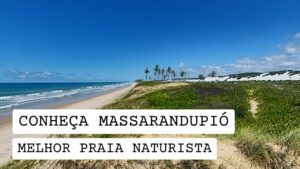

Massarandupió naturist beach
The Massarandupió beach is divided into two parts: one open to the general public and the other reserved for naturism, which is signposted and regulated. To reach the naturist area, you have to walk 20 minutes along the sand from the car park next to the coconut trees.

Visitors to Massarandupió will find a quiet village with restaurants, holiday homes, markets and craft shops.
It is possible to make a day trip from Salvador or from nearby beaches such as Imbassaí, Itacimirim, Guarajuba, Subaúma, Port de Sauípe, Conde, Baixio and Praia do Forte.
During the high season (especially in summer and at weekends), there are guards to ensure that the rules are respected and that visitors feel comfortable. There is also an acclimatisation area for those who are in a group and wish to acclimatise before committing fully to naturist practice.
The Entre Rios City Council prohibits the construction of buildings within 300 metres of the naturist strip, guaranteeing the preservation of the environment and the privacy of those who visit the area. There are a few beach huts in both areas.
How to get there
Massarandupió Beach is located about 93 kilometres from Salvador. From the Salvador International Airport you can take the BA-099 (Estrada do Coco/Linha Verde). After passing the entrance to Port de Sauípe, a sign will indicate the entrance to Massarandupió, along a dirt road of approximately 10 kilometres. The journey takes about 1 hour and 35 minutes by car.
The area has a natural landscape with dunes, coconut trees, a clean beach and a river that flows into the sea. Bathing is permitted along the entire length of the beach, but nudism is only permitted within a 2 km strip. Outside this area, nudity is considered an obscene act and can result in legal penalties.

Publicações Relacionadas
Chapada Diamantina's architectural style and influences
Todos os Santos Bay — Nature, History and Water-based Tourism
Rafting in Taboquinhas: The Ultimate Adventure Guide
Abseiling Sites in Bahia: Top Locations to Explore
Paragliding at Pitinga Beach in Arraial d'Ajuda
Discover the reasons for a holiday in Salvador, Bahia
Cultura dos Índios Pataxós na Costa do Descobrimento
Enchanted fountain in Chapada Diamantina: How to get there
Itaparica Island — Complete Guide: History, Beaches and Tips
Bom Jesus da Lapa Sanctuary: A Complete Visitor’s Guide
The Municipality of Conde, Bahia: Beaches and a Comprehensive History
The Secret History of Salvador, Bahia: Caramuru and the City’s Early Day
Tourist Attractions on the Rio de Contas in Itacaré, Bahia
Maré Island (Bay of Todos os Santos) — beaches, culture and how to get there
Ventura Village: A Rich History of Diamonds
Caravelas (BA) — Complete Guide: Beaches, History and Abrolhos
City of Camamu: Rich History by the Bay
Barreiras: Where Carnival Meets Adventure Tourism
Pelourinho: what to do in Salvador’s Historic Centre
Madre de Deus Island (BA) — Beaches, Islands and Tourism in the Recôncavo
São Jorge Parish Church in Ilhéus — history, architecture and religious art
Trekking - Popular trails in Chapada Diamantina
The highest and most beautiful waterfalls in Chapada Diamantina
Guarajuba Beach: A Paradise on the North Coast of Bahia
South Coast of Bahia: Discover Stunning Beaches
Whale Coast (BA) — Complete guide: Abrolhos, beaches and whale-watching
Porto Seguro (BA) — History, Beaches, Tours and Practical Tips
Mangue Seco: The Last Beach on the North Coast of Bahia
Chocolate Road and trails of the Cocoa Coast - video
Lagoa Encantada in Ilhéus: A Preserved Natural Paradise
Origin and History of Capoeira in Brazil Explained
Church and Convent of Santa Clara do Desterro and its History in Salvador
Palaces in Salvador to visit and learn about Brazil's history
Best Beaches in Bahia: Your Guide to Paradise
Places to visit on the south coast of Bahia
Salvador’s Historic Centre, Pelourinho, Baroque churches and museum
This post is also on:
 Português
  English
  Deutsch
  Español
  Français