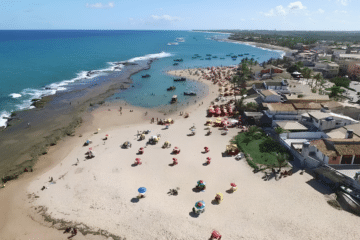
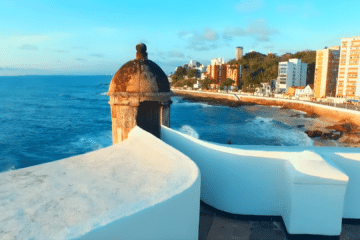
Barra do Cahy is located in the municipality of Prado, on the Costa das Baleias, in the extreme south of Bahia. The region is known for its unspoiled natural beauty, paradisiacal beaches and historical significance.
It is also part of the historic region known as the Coast of Discovery, due to its role in the landing of Pedro Álvares Cabral’s squadron in 1500.
In other words, geographically it’s on the Costa das Baleias, but historically it’s part of the Costa do Descobrimento.

Besides the city of Prado, which has 84 kilometres of lush beaches, the district of Cumuruxatiba and the parish of Corumbau stand out.
The municipalities bordering Prado are Alcobaça, Itamaraju, Porto Seguro and Veredo.
Barra do Cahy is 18 kilometres from Cumuruxatiba and is a paradise destination with a beach of crystal clear waters where the Cahy River meets the sea. The landscape is characterised by imposing cliffs and lush coconut palms, creating a stunning setting.
From the sea at Barra do Cahy you can see Monte Pascoal, which is about 62 kilometres from Porto Seguro.
According to historical records, this was the first piece of land discovered by Pedro Álvares Cabral’s squadron in 1500, making the region a landmark in Brazilian history.
Video – Why is Barra do Cahy the first beach in Brazil?

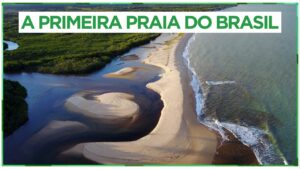
Por que Barra do Cahy, na Bahia, é a primeira praia do Brasil?
Barra do Cahy - Drone

Barra do Cahy - Reportagem02:44

Barra do Cahy - Drone03:51
Barra do Cahy beach

Barra do Cahy Beach has been given the official title of “Brazil’s First Beach” in recognition of the fact that it was one of the first places the Portuguese landed.
According to historians, it was here that the Portuguese made their first contact with the Tupiniquin Indians, one of the most significant moments in the discovery of Brazil.
Cabral’s landing at Praia do Cahy
Praia do Cahy is considered the greatest symbol of the Discovery Coast, as its mouth was the landing place for Pedro Álvares Cabral’s squadron on 22 April 1500.
The landing was led by Nicolau Coelho, one of the captains of the fleet, who made the first contact with the Tupiniquin Indians.
From this point, the Portuguese discovered the Monte Pascoal, located in what is now the Monte Pascoal National Park.
The crew remained moored on the shores of the Carapeba Coral Reef for 40 hours until the morning of 24 April. During this time they explored the region, observing the natural riches and the indigenous people.
The mouth of the Cahy River was named by the Portuguese crew in reference to the nightfall on April 22nd 1500, the exact moment of their arrival. Monte Pascoal, on the other hand, was named by the Portuguese navigators in honour of Easter Week.
After this first stop, Cabral’s squadron spent another 40 hours in Porto Seguro, where they found a safe anchorage, and then headed for the Mulho do Mutari, in Coroa Vermelha, where the Portuguese stayed for six days before continuing their journey.
With its rich history and natural beauty, Barra do Cahy is one of the most important destinations on the Discovery Coast, offering an experience that combines leisure and culture.
Cahy River
The Cahy River is one of the great natural attractions of the region. Its springs are located in the Descobrimento and Monte Pascoal National Parks, guaranteeing extremely clean and uncontaminated waters.
One of the most recommended excursions is snorkelling in the waters of the Cahy River, which offers a unique experience of contact with nature and the history of the region.
Due to its well-preserved natural features, it is believed that the river retains aspects similar to those of the time of discovery.
Bahia.ws – Tourist Guide to Salvador, Bahia and the Northeast

Publicações Relacionadas
History of the Founding of Salvador, Bahia - History of Brazil
Ecological tourism in Morro do Chapéu
Discover the reasons for a holiday in Salvador, Bahia
Bahia Art Museum (MAB): Learn about its history and collection
Igatu: Explore the 19th-Century Stone Houses
The History of Lençóis in the Chapada Diamantina — Origins, the Diamond Cycle and Heritage
Camaçari: Industry, History and Natural Beauty
Waterfalls of Chapada Diamantina: A Guide for Adventurers
Sempre-Viva: Symbol of Preservation in the Chapada Diamantina
A History of the Forts and Lighthouses of Salvador (Bahia)
Tourist Information about Chapada Diamantina
Jandaíra: Discover the charm of Mangue Seco
Places of interest in Salvador — A comprehensive guide
Cumuruxatiba (Prado, BA) — Guide to beaches, excursions and whale watching
Costa do Sauípe, Bahia: Resorts and Tourist Guide
Basílica Santuário Nossa Senhora da Conceição da Praia — history and architecture
Tourist attractions in the Gamboa neighbourhood in Salvador BA
São Desidório: Explore Caves and Biodiversity
Madre de Deus Island (BA) — Beaches, Islands and Tourism in the Recôncavo
Alameda do Sol — Vila da Praia do Forte (BA) | Things to do
Trekking - Route through the Chapada Diamantina in 7 days
Tourist Regions of Bahia: Discover the diversity of the state
Praia do Forte, Bahia: The Complete Travel Guide
Itaparica Island — Complete Guide: History, Beaches and Tips
Alcobaça, Bahia: A Comprehensive Guide to Beaches and History
Discover the São Francisco River Valley Region - Tourist Guide
History, the Festival of Nossa Senhora das Candeias and Tourist Attractions
Church of São Pedro dos Clérigos — History, architecture and religious art
Ilhéus: A Journey Through Bahia's Rich History
Pelourinho: what to do in Salvador’s Historic Centre
Prostitution, sex, massage parlours and nightclubs in Salvador
Orchids of the Chapada Diamantina in Bahia
Convent and Church of Santa Teresa and the UFBA Museum of Sacred Art in Salvador
Belmonte's Rich History and Cultural Heritage
The best beaches near Salvador (distance, facilities and tips)
Solar do Unhão & MAM-BA — History, Architecture and a Visit
This post is also on:
 Português
  English
  Deutsch
  Español
  Français