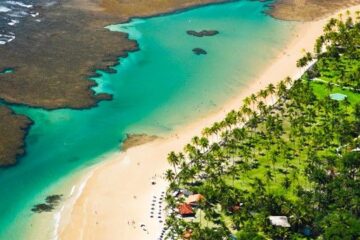
The Monte Pascoal National Park is located in the extreme south of Bahia, between the cities of Porto Seguro and Prado, and covers an area of 22,383 hectares.
Its natural area offers a great variety of landscapes and unique scenic beauties, such as the Beach of Aldeia de Barra Velha, with crystal clear waters and preserved restinga vegetation, mangroves, restinga forests and the rainy beaches of the Caraíva and Corumbau rivers, as well as the Mussununga fields.

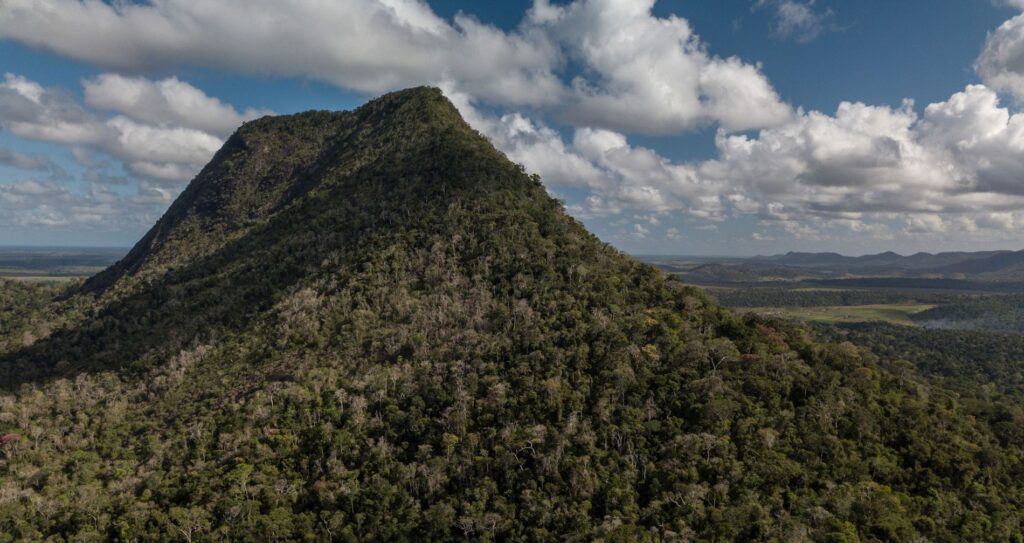
Mount Pascoal, with its peak at 356 metres above sea level, guarantees a 360º panoramic view of the region, as well as an enchanting area of Atlantic rainforest, more specifically the Ombrofila Densa forest, with trees up to 40 metres high and evergreen leaves in a humid climate.
With every kilometre you travel, the Mount Pascoal becomes more imposing, giving you the feeling of seeing in the distance the first piece of land on a still unknown continent during the discovery of Brazil.
Just outside the gate, you can see that the park is going through a period of transition, as the Pataxó Indians have occupied practically all the boundaries of the unit, claiming ownership of the land once occupied by their ancestors.

There is a process underway in Brasilia which, according to the director of the unit, may give the Indians ownership of the area, which would mean losing the title to the Monte Pascoal National Park, one of the oldest in Brazil, created in 1961.
There are about 13 villages inside the park, some with electricity, others with generators and some still without electricity.
The largest of these, Aldeia de Barra Velha, has a good infrastructure, including a school, computers, leisure area and other facilities.
See the map of Costa do Descobrimento
Videos “Monte Pascoal National Park” and “Pataxó Indians

Parque Nacional Monte Pascoal14:03
Parque Nacional Histórico Monte Pascoal
Índios Pataxós e a terra do descobrimento25:16
Monte National Park in Bahia
The Monte Pascoal National Park is of great importance in the history of Brazil, as it was the first piece of land seen by the Portuguese during the “Discovery of Brazil” in 1500.
Located in the south of Bahia, the park preserves an area of Atlantic Rainforest and is home to the Pataxó Indigenous Community, who have inhabited the region for centuries. In addition to its ecological importance, Monte Pascoal is a symbol of the arrival of the colonisers and the resistance of the indigenous people.
Today, the park combines environmental conservation with the cultural and historical revival of Brazil.
1. Main tourist attractions
1. Climbing Mount Pascoal
- The main attraction of the park is the climb up Mount Pascoal itself. Although a good level of fitness is required, especially for the steep final stretch, the reward is a spectacular view from the top. From there you can see the sea, the neighbouring hills and the dense forest in an impressive panorama. If you’re lucky, you might see the aerial ballet of the King Vultures as they fly around the hill in search of thermal currents.
Trails in the Atlantic Rainforest
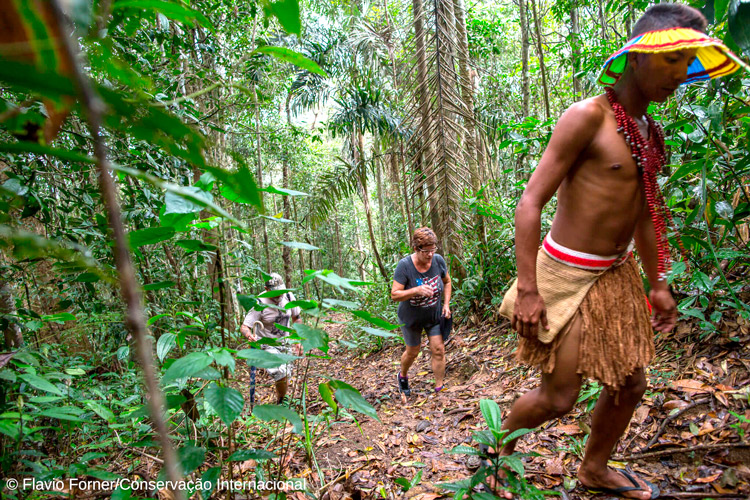
- The trails around the hill allow visitors to walk through the dense vegetation of the Atlantic Rainforest, accompanied by native guides. Although the local fauna is rather scarce due to hunting, there is still a chance to see animals typical of the region. Large trees such as the jequitibá, jacarandá da Bahia, pequi, paraju and joerana are abundant and impressive in their size and grandeur.
Visitor Centre
- Located at the foot of Mount Pascoal, the Visitor Centre offers an insight into the activities and handicrafts of the region’s Indians. The centre is a point of interest for those wishing to learn more about the local indigenous culture.
2. Indigenous community
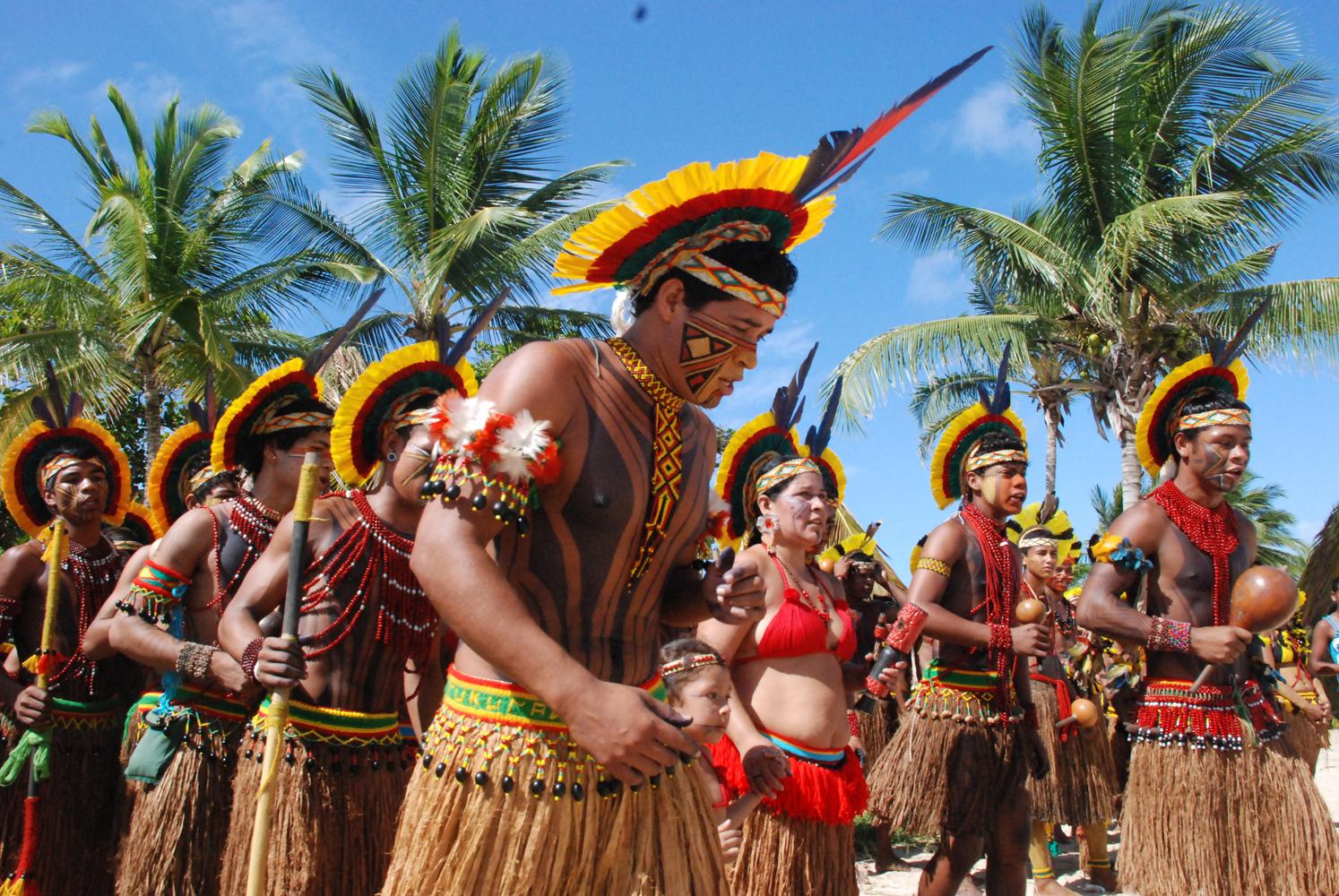
The Tupinambás Indians occupied these lands long before Portuguese colonisation, but in the 16th century the Pataxó community began to settle in the region, where they remain today.
They survive mainly by visiting the park, subsistence farming (manioc, cassava, bananas, jackfruit) and raising free-range chickens, It is these indigenous people who manage tourism in the Monte Pascoal National and Historical Park, thanks to the community’s involvement in community-based ecotourism, developed in partnership with the federal government.
Ibama has now established a partnership with the Indians, bringing benefits to the unit such as fire-fighting carried out by a PrevFogo team made up entirely of indigenous people.

I accompanied one of these battles, took pictures and, after a few hours in the middle of a huge fire, I was covered in ash, my clothes and equipment full of soot.
I was able to see for myself the hard work that goes into almost all of Brazil’s parks.
On the other hand, the excessive and uncontrolled exploitation of hardwood by the Indians for handicrafts needs to be reviewed so that it doesn’t cause irreversible damage to the region.
Handicrafts are the main source of income for many indigenous families in the villages. It is therefore essential to take steps to ensure the sustainability and conservation of the ecosystems that have existed since the time of discovery.
It comes from the village of Barra Velha (known as Aldeia Mãe), an indigenous area of the Monte Pascoal, the Pataxó are spread over several villages in the municipalities of Prado, Itamaraju, Santa Cruz Cabrália and Port Seguro. Always warriors, the Pataxó have struggled since the Portuguese invasion around 1500 to establish themselves in a place and preserve their history, culture, language, customs and traditions, which have been lost over time.
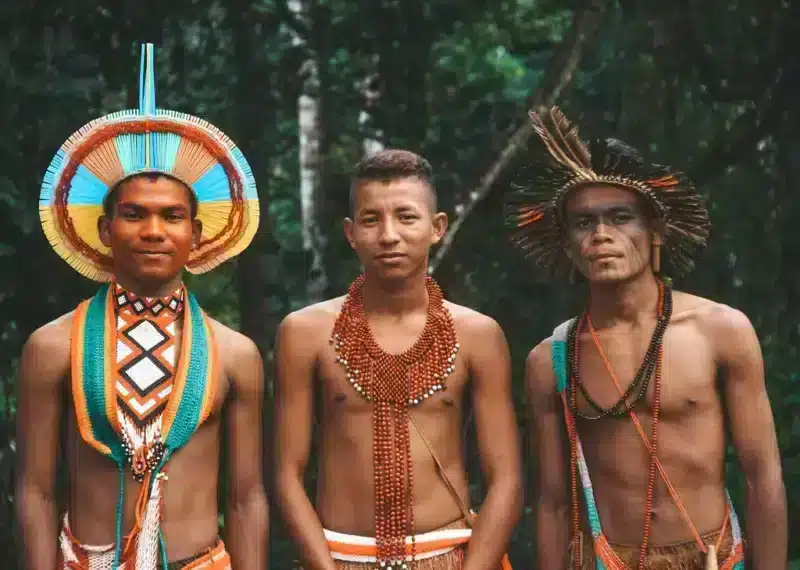
In the past, the Pataxó were forcibly brought together with the Maxacalis and Botocudos tribes in a village from which they could not leave. “In 1861 the people were forcibly settled in Bom Jardim, now the Barra Velha Reserve, near Monte Pascoal.
Later there was a big massacre and many Indians fled to avoid being killed,” says Nitynawã Pataxó, chief of his tribe.
The 1951 massacre, known to older Indians as the “Fire of ’51”, took place in the village of Barra Velha and is a painful part of Pataxó history. According to reports, the violence was caused by the state’s military police. Girls were raped and men were beaten. Many Pataxós were forced into slavery for lack of other options.
Eight years earlier, the government had created the Monte Pascoal National Monument Park, forcing the Indians off their land and dispersing the Pataxó people into small settlements.
“Many decided to hide in the forest to preserve their culture,” explains Nitynawã. The community maintains its rituals, such as the full moon, marriage and baptism, and is trying to recover the Patxohã language. “We’ve already catalogued more than two thousand words and compiled a dictionary, but it’s within the community because we need the approval of the elders,” says Nitynawã.
As well as singing and dancing rituals (especially the Awê), and traditional medicine based on plants (roots, vines, leaves, seeds, bark and resins), Preserving the language is one of the tasks Nitynawã carries out with her sisters, Jandaya and Nayara, in the bilingual school set up in the Jaqueira Reserve.
In 1998, the year the Jaqueira Reserve was created, the Coroa Vermelha Indigenous Land, located in the south of Bahia, was also recognised. It covers an area of 1,493 hectares in the municipalities of Santa Cruz Cabrália and Port Seguro and is reserved for the enjoyment of the Pataxó people.
Tourism has become an economic alternative for the Pataxó, complementing fishing, handicrafts and the cultivation of piassava. “To live and preserve the forest and the people, we opened our land to tourism in 2000. Agriculture is more for our own consumption, and we haven’t killed animals for a long time.
Today we have jaguars and ocelots. We are working on this environmental awareness, because without it we wouldn’t have any animals,” concludes Nitynawã.
The Monte Pascoal National Park is an area of great ecological and historical importance, located in the south of Bahia. Its main tourist attractions are concentrated near the gatehouse, where visitors are allowed access.
3. Access to the Park
Access to the park is via the BR-101 motorway, 76 km from Eunápolis or 16 km from Itamaraju. Turn right at the junction and continue on the tarmac for 14 km to the park gate.
4. Conservation and sustainability
Even with the possibility of the park no longer being managed by IBAMA, there is hope that the indigenous people of the region will become aware of the fragility of the local ecosystems.
The park is home to one of the last stretches of Atlantic Forest in the south of Bahia, and its conservation is crucial both for its historical value and to ensure the livelihood and future of future generations.
Bahia.ws is the largest tourist guide to Bahia, Salvador and the Northeast.

Publicações Relacionadas
Ibicoara: An Unmissable Tourist Destination
Places to visit on the south coast of Bahia
Things to do in Lençóis in the Chapada Diamantina — 15 attractions
Ilha dos Frades — History, beaches and tourist attractions
Arembepe: beaches (Piruí, Praia do Canto), Hippie Village and the Tamar Project
Lauro de Freitas — A comprehensive guide to beaches, culture and leisure
Ponta de Corumbau — an unspoilt paradise on the southern coast of Bahia
Main Towns and Villages in the Chapada Diamantina Region
Rafting in Taboquinhas: The Ultimate Adventure Guide
Cachoeira (BA) — National Monument and Historical Trail
7-day itinerary in Salvador and the surrounding area: Pelourinho, the islands and Praia do Forte
Iraquara is also known as the "city of caves"
Trail to Buracão Waterfall in Chapada Diamantina
Ilhéus: A Journey Through Bahia's Rich History
Trekking - Route through the Chapada Diamantina in 7 days
History of grape and wine production in the São Francisco Valley
Mining in the Chapada Diamantina History Explained
Santa Cruz Cabrália in Bahia — beaches, history and things to do
Marimbus Pantanal: Adventure in Chapada Diamantina
Complete Guide to Visiting Arraial d'Ajuda in Bahia
Wine Tourism in the São Francisco Valley Guide
Belmonte's Rich History and Cultural Heritage
Cathedral Basilica of Salvador — History, Sacred Art and Collection
Alameda do Sol — Vila da Praia do Forte (BA) | Things to do
Things to Do in Piatã, Bahia: The Highest Town in the North-East
Cairu Archipelago: A Guide to Its Enchantment
Church of Nossa Senhora dos Mares (Salvador) — History and Architecture
História da Arte - Caracteristicas, Aspectos e Periodos
Beaches and Waterfalls of Itacaré: A Hidden Gem
History and sights of Avenida Contorno in Salvador BA
Tinharé Archipelago: Discover Hidden Island Gems
Coast of Discovery: Bahia's Historical Treasures
Baixio: Between lagoons, dunes and the charm of a village surrounded by nature
Enchanted fountain in Chapada Diamantina: How to get there
Discover the Magnificence Fort of Nossa Senhora de Monte Serrat
Discover the 23 beaches of Salvador — A complete guide and tips
This post is also on:
 Português
  English
  Deutsch
  Español
  Français