Discover the fascination of the Enchanted Fountain: A natural spectacle of beauty and mystery
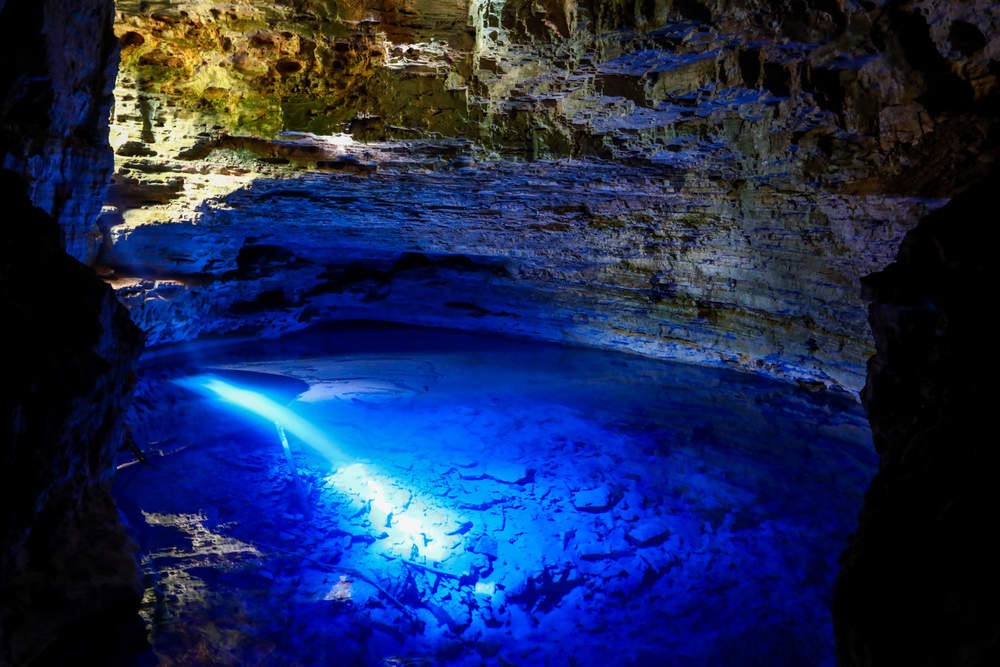
The Enchanted Well is a spectacle of nature all year round, especially in winter. During this time, a ray of sunlight falls on the surface of the fountain through an opening at the top of the cave, illuminating the water and making it even bluer.
This impressive phenomenon is located 150 kilometres from Lençóis.
Experience the visit
Knowing where the rock ends and the water begins is an unsettling but unavoidable exercise when visiting Poço Encantado. Not even its 65 metre depth can hide the rocks and fallen logs at the bottom of this extremely crystalline lagoon.

The magic of light
The magic of its intense, transparent, blue colour is due to the purity of the water. But it is the sun’s rays, entering the fountain through a natural skylight, that become the protagonists of the show. As it passes over the rock, the sun enchants by illuminating the water.
Best time to visit
As with any show, there is a set date and time for temping. In winter, the sun reaches the ideal position to enter the well.
That’s why the best time to visit is from April to September, from 9.30 to 14.00. The months of June and July (from 10am to 12pm) are when the rays are most intense.
As well as changing and intensifying the colour of the lagoon, the sun’s rays turn the fountain into a mirror onto which images of the ceiling are projected. To understand which is which, note the difference in colour: the dark blue part corresponds to the bottom of the pond, while the lighter part is the reflection of the ceiling.
The moon and the well
From December to February (from 10.30pm to 2am) the sun gives way to the moon. On full moon nights, a silvery ray enters the well.
Aquatic life
The 110 metre long and 70 metre wide lagoon is inhabited by a very rare fish: the albino catfish.
Blind, the albino catfish is guided by its three antennae. With an average length of 4.5 cm, this fish feeds on debris found in the cave, such as organic matter, bat droppings and insects.
Similar species have been found in other Brazilian caves, such as Poço Azul (Nova Redenção – BA), Lapa Doce (Iraquara – BA) and those in Petar (São Paulo – SP).

Map of Chapada Diamantina trails and attractions
Video about Igatu, Poço Azul and Poço Encantado

Igatu, Poço Azul e Poço Encantado13:59
Poço Encantado na Chapada Diamantina03:58
Poço Encantado - Chapada Diamantina - Saiba Tudo00:59
Enchanted fountain in Chapada Diamantina
1. Origin
Formed from limestone rock, the Well Cave was excavated by the movement of water from an underground river. As the water level dropped over the years, the upper part of the galleries dried out and part of the ceiling collapsed, forming a sinkhole. Today this passage serves as an access to the Poço Encantado.
Until 1990 it was possible to bathe in the fountain, but as the water circulation is slow, diving was forbidden to avoid the accumulation of sun cream and sweat.
2. The story
According to Legend, the Enchanted Well was discovered in 1940 by a boy called Gustavo. When he saw a crack in the rock while hunting, he thought it was a jaguar’s lair.
Later, he and his friends returned to the crevice and climbed down with a rope. When he reached the bottom, he threw a stone down and discovered that what looked like sand was actually a calcareous cream under which was an extremely blue fountain.
The cave is listed by the Ibama (Brazilian Institute for the Environment and Renewable Natural Resources).
3. Location and access
Poço Encantado is located in Itaité (44 km southeast of Andaraí). To get there, take the BA-142 motorway for 20 km to the road to Itaité. A sign indicates the entrance to the fountain, which is about 17 km from here.
Poço Encantado is located outside the Chapada Diamantina National Park, on a private property. Although it is very common to start the tour from Lençóis, the town is far from the attraction and the journey will be very tiring.
The ideal option is to take a overnight trip closer to Itaetê, where the Poço Encantado is located. If you’re travelling by car, Mucugê and Igatu are good options for accommodation.
A trip to Poço Encantado is usually combined with a visit to Poço Azul, which has a similar light phenomenon and allows tourists to float in the water.
As the fountain is usually very crowded, it’s best to arrive early to avoid missing the entrance to the Radius.
Access to the Poço Encantado is of medium difficulty. After descending a long flight of steps to the mouth of the cave, visitors face a steep section where they must walk slowly, holding on to ropes. The guides light the way with lamps, but head torches are welcome.
4. What are the differences between Poço Encantado and Poço Azul in Chapada Diamantina?
Poço Encantado and Poço Azul are two of the most iconic destinations in Chapada Diamantina, and although both boast crystal clear waters and natural beauty, they have different characteristics that make each unique.
Location
- Poço Encantado: Located in the municipality of Itaetê, in the south of Chapada Diamantina.
- Poço Azul: Located in the municipality of Nova Redenção, about 60 kilometres from Poço Encantado.
Distinctive features
| Looks | Enchanted Well | Blue Well |
|---|---|---|
| Size | Larger and deeper. | Smaller but with more accessible waters for floating. |
| Water colour | Intense, crystalline blue with excellent transparency. | Translucent blue with similar crystalline hues. |
| Experience | Observation only; no swimming or snorkelling allowed. | Snorkelling and life jackets permitted. |
| Geological formation | Closed environment with a large submerged cave. | More open and lit formations. |
| Sunlight | The beam of light takes place from April to September and creates a magical spectacle. | The light beam takes place from February to October at certain times. |
How to get there
Enchanted Well
- Access is more restricted and involves a short walk up narrow stairs and a descent to the cave entrance.
- It can be a little challenging for people with reduced mobility.
Blue Fountain
- Easier to access, with easy trails and good visitor infrastructure.
- Ideal for families and those with limited walking experience.
Which one to choose?
- Choose the Enchanted Well if you’re looking for a more mystical and impressive setting, even if you can’t swim.
- Choose the Blue Well if you want to swim and float in crystal clear waters, with an interactive experience and stunning visuals.
Both wells can be visited on the same day, depending on your plans, as they are relatively close to each other. It’s worth visiting both to get the best of Chapada Diamantina!
Parish of Itaetê in Bahia
The origins of the city of Itaetê date back to around the end of the 19th century, from a small settlement called Tamanduá on the banks of the Paraguaçu river.
In the early years of the last century, a branch line of the Railway was built to Tamanduá, which gradually developed the town.
However, it was the muleteers who made Itaetê an important commercial centre, acting as a support point for troops coming to the railway station from various locations in the High Sertão and the diamond mines.
The municipality of Itaetê was created by Law No. 1,497 of 25 September 1961, signed by the governor at the time, Juracy Magalhães. The municipality was established on 7th April 1963, when the 1st Council and the 1st Mayor, Mr Valdemar Ferraro, were sworn in. The territory of the new parish was separated from Andaraí.
The name Itaetê is of Tupy-Guarani origin and means“Pedra Dura” or “Duríssima“.
Location
Itaetê is located in the Chapada Diamantina Meridional Micro-Region.
How to get there
From Salvador, you can get to Itaetê by taking the BR 324 to Feira de Santana, then the BR 116 and BR 245 just before the town of Milagres, passing through Iaçú and Marcionílio Souza.
Another option is to take the BR 242 to Itaberaba, then continue to Iaçú and Marcionílio Souza, or take the BR 242 to the BA 142, passing through Andaraí.
Bahia.ws is the largest travel and tourism guide for Bahia and Salvador.
Chapada Diamantina Tourist Guide

Publicações Relacionadas
Correntina: Discovering the Heart of Bahia
Cathedral Basilica of Salvador — History, Sacred Art and Collection
Paranaguá Palace — History, architecture and visiting information | Ilhéus (BA)
Porto Seguro's nightlife: Where to have fun
Skydiving, Paragliding and Ballooning in Bahia
Chocolate Road and trails of the Cocoa Coast - video
Mining in the Chapada Diamantina History Explained
History of the settlement of Chapada Diamantina
4 Must-See Museums in Salvador: Art, History and Culture
Costa do Sauípe: Discover Paradise in Bahia
Rio Vermelho is Salvador’s trendiest and most bohemian neighbourhood
Beaches and Waterfalls of Itacaré: A Hidden Gem
Solar do Unhão & MAM-BA — History, Architecture and a Visit
Ecotourism in Bahia: discover village of Santo André
History of São Marcelo Fort — Salvador, Bahia
São Desidório: Explore Caves and Biodiversity
Palmeiras: A Gateway to Chapada Diamantina
Bahia Art Museum (MAB): Learn about its history and collection
Discover the reasons for a holiday in Salvador, Bahia
Campo Formoso: Explore Caves and Emerald Trade
Ponta de Humaitá — Lighthouse, church and the best sunset in Salvador
A History of the Forts and Lighthouses of Salvador (Bahia)
Ilhéus: A Journey Through Bahia's Rich History
Camamu Bay — A Hidden Paradise in Bahia
Ibicoara: An Unmissable Tourist Destination
Lapão Cave: The Ultimate Adventure Experience
Maré Island (Bay of Todos os Santos) — beaches, culture and how to get there
Find out how to celebrate Carnival in Salvador, Bahia
Serra Grande: Your Guide to Bahia's Paradise
Things to Do in Rio de Contas (Bahia): A Complete Guide
Prado (BA) — Beaches, Cliffs and Whale Watching | Whale Coast
History of the Church of Nosso Senhor do Bonfim in Salvador
Cairu Archipelago: A Guide to Its Enchantment
Tourist attractions for children in Salvador: Fun and learning
Caraíva: A rustic and unspoilt paradise in the south of Bahia
Churches in Salvador (BA) — a guide: history, architecture and itinerary
This post is also on:
 Português
  English
  Deutsch
  Español
  Français