Published on · Updated on
Lauro de Freitas (BA): beaches, attractions and map
Lauro de Freitas lies in the Salvador Metropolitan Region, just north of the Bahian capital, right next to Salvador International Airport. Besides the beaches of Ipitanga, Vilas do Atlântico and Buraquinho, the city also has history, a good range of hotels and restaurants, and boat trips along the Joanes River. That is why it is a practical base for anyone who arrives by plane and wants to stay close to the sea.
- Location: Salvador Metropolitan Region, between Salvador and Camaçari, at the start of the Estrada do Coco.
- Population: 203,331 inhabitants in the 2022 Census; the latest IBGE estimate, however, exceeds 220,000.
- Area: about 58 km².
- Distances: next to the airport and about 30 km from the historic center of Salvador.
- Beaches: Ipitanga, Vilas do Atlântico and Buraquinho.
- Highlights: Terminal Turístico Mãe Mirinha do Portão and the Igreja Matriz de Santo Amaro de Ipitanga.

Where Lauro de Freitas is located, plus map
In short, the municipality lies on the coast north of Salvador. To the south, it borders the capital near Stella Maris and the airport; to the north, it borders Camaçari. Thus, it is the starting point of the Estrada do Coco (BA-099), the “Coconut Road”, which leads to the beaches of the Costa dos Coqueiros.
See the map of the Costa dos Coqueiros
A little history
Before becoming a city, the place was the district of Santo Amaro de Ipitanga, which belonged to Salvador. In 1962, however, a state law created the municipality, separating it from the capital; it was formally installed on April 7, 1963. In fact, the name honors Lauro Farani Pedreira de Freitas, a candidate for governor of Bahia who died in a plane crash in 1950.
Videos about the attractions of Lauro de Freitas


LAURO DE FREITAS VISTA DE CIMA03:44

Lauro de Freitas Ontem e Hoje.01:45

Praia de Ipitanga em Lauro Freitas01:08

Praia de Villas do Atlantico em Lauro de Freitas

Praia de Buraquinho em Lauro Freitas01:41
Tourist attractions in Lauro de Freitas
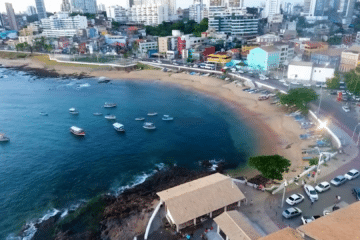
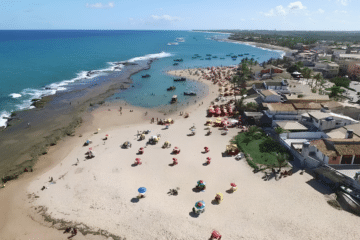
- Beaches: Ipitanga, with natural pools, surfing and nightlife; Vilas do Atlântico, with a promenade and cycle path; and finally Buraquinho, at the mouth of the Joanes River.
- Terminal Turístico Mãe Mirinha do Portão: a pier for boat trips, a stage for performances, and restaurants.
- Historical heritage: the Igreja Matriz de Santo Amaro de Ipitanga, linked to the Jesuit presence in the region.
- Leisure and sports: a go-kart track, sailing, surfing and windsurfing, as well as events at the Jockey Clube da Bahia.
- Nature and fishing: the Joanes and Ipitanga rivers are good for fishing and for trips in small boats.

Beaches of Lauro de Freitas
Although the coastline is short, it brings together three very different beaches; therefore, it is worth visiting all of them.
Ipitanga Beach
First, Ipitanga is an urban beach on the border with Salvador, and it is very popular with young people. In addition to bars and restaurants along the waterfront, it has natural pools formed by the reefs at low tide. At high tide, on the other hand, the waves attract surfers.


Vilas do Atlântico Beach
Next, in front of the neighborhood of the same name, Vilas beach has full facilities nearby, with banks, restaurants and shops. In addition, the promenade, the cycle path and the coconut grove make it a great option for walks and family outings.

Buraquinho Beach
At the mouth of the Joanes River, Buraquinho Beach forms natural pools at low tide. It is also a good place to rent kayaks and paddle on the river. On the open-sea stretches, however, the waves are strong and therefore better suited to surfing.

Terminal Turístico Mãe Mirinha do Portão
On the banks of the Joanes River, the terminal is a cultural space with a boat pier, a stage for performances, restaurants and a garden. In fact, its name honors the ialorixá (Candomblé priestess) Mãe Mirinha do Portão, an important figure of candomblé in the region. Boat trips along the river depart from here; that is why it is a great late-afternoon outing.
Igreja Matriz de Santo Amaro de Ipitanga
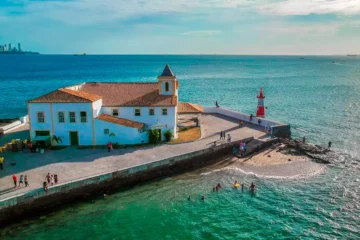
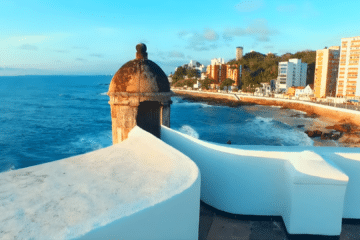
Finally, the Igreja Matriz de Santo Amaro de Ipitanga is the city’s main historical landmark. According to local tradition, it was founded by the Jesuits in 1608. Thus, it marks the Portuguese colonization and the formation of the old parish that gave rise to the municipality.

How to get there and get around
Because the airport is right on the border, Lauro de Freitas is one of the easiest cities to reach in Bahia. Moreover, the city has hotels, guesthouses and vacation rentals, especially in Vilas do Atlântico.
- By plane: Salvador International Airport is just a few minutes from Ipitanga and Vilas do Atlântico.
- From Salvador: via Avenida Paralela or along the coast, it is about 30 km to the historic center.
- Metro and bus: Line 2 of the metro runs to Aeroporto station; from there, metropolitan buses continue to the city.
- Car and ride-hailing apps: taxis and ride-hailing cars are convenient; however, a car makes it easier to extend your trip to the beaches along the Estrada do Coco.
Practical tips
- Best time to visit: from September to March, because it rains less and the sea is better for water sports.
- Itinerary: combine the beaches with the boat trip on the Joanes River and a visit to the Terminal Mãe Mirinha.
- Combine with: the beaches of Salvador and the best beaches near Salvador.
Frequently asked questions about Lauro de Freitas
Where is Lauro de Freitas?
It lies in the Salvador Metropolitan Region, north of the capital, between Salvador and Camaçari.
In addition, it is right next to Salvador International Airport.
What are the tourist attractions of Lauro de Freitas?
The highlights are the beaches of Ipitanga, Vilas do Atlântico and Buraquinho, the Terminal Mãe Mirinha do Portão and the Igreja de Santo Amaro de Ipitanga.
A boat trip along the Joanes River is also well worth it.
Does Lauro de Freitas have beaches?
Yes, there are three: Ipitanga, Vilas do Atlântico and Buraquinho.
At low tide, in fact, Ipitanga and Buraquinho form natural pools.
How far is it to Salvador?
The city borders Salvador; it is about 30 km to the historic center.
That is why you can stay there and still explore the capital.
How do you get around the city?
The most practical option is to use a car, taxi or ride-hailing app.
However, there are also metropolitan buses connected to the metro’s Aeroporto station.

Publicações Relacionadas
Arembepe: beaches (Piruí, Praia do Canto), Hippie Village and the Tamar Project

Paranaguá Palace — History, architecture and visiting information | Ilhéus (BA)

São Jorge Parish Church in Ilhéus — history, architecture and religious art

History of the Convent and Church of Nossa Senhora da Piedade in Ilhéus

São Sebastião Cathedral (Ilhéus) — History, architecture and tourism
The 15 Most Visited and Well-Known Beaches in Bahia
The 3 most paradisiacal beaches in Bahia

Skydiving, Paragliding and Ballooning in Bahia

Historic Towns in Bahia: A Journey Through Time
Places to visit on the south coast of Bahia

História da Arte - Caracteristicas, Aspectos e Periodos
Tourist Attractions in Bahia: main attractions, beaches and cities

Subaúma, Bahia: where it is, things to do and where to stay

Massarandupió Naturist Beach, Bahia: Rules and Access
Beaches on the South Coast of Bahia: 10 Best and Tips
Towns and the Abrolhos Archipelago — The southernmost tip of Bahia

Baixio: Between lagoons, dunes and the charm of a village surrounded by nature
Best Beaches in Bahia: Your Guide to Paradise
Salinas da Margarida & Barra do Paraguaçu: beach guide

Guarajuba Beach, Bahia: Natural Pools and Tips

Barra do Cahy: Brazil's first beach - history and nature

Garcez Beach: Discover Paradise in Jaguaripe

Rio de Ondas, Barreiras: Acaba Vida and Redondo waterfalls
Catabrigas Waterfall — A natural haven in Ibirajá, Itanhém (BA)

Serra Grande: Your Guide to Bahia's Paradise
Corumbau, Bahia: Ponta de Corumbau, beaches, map, how to go

Taipu de Fora: Discovering Natural Pools

Iguaí (BA): attractions, waterfalls, map and history
Morro de São Paulo: Map, Beaches & How to Get There (2026)
Tourism in São Francisco do Conde (BA) — Tips and Attractions

Bay of All Saints, Bahia: history, islands and Recôncavo
Todos os Santos Bay — Nature, History and Water-based Tourism
Bay of Todos os Santos: nature, history and cultur

Rafting in Taboquinhas: The Ultimate Adventure Guide

Abseiling Sites in Bahia: Top Locations to Explore