Kitesurfing in Trancoso, Bahia: The evolution of an extreme sport in natural beauty
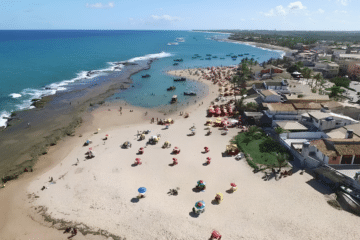
Trancoso is the ideal place to practise various sports, such as mountain biking and kite surfing, attracting many visitors. Situated in an area of natural beauty, Trancoso was discovered by hippies in the 1970s and, despite its development, has preserved its natural riches.

Adventure and tranquillity
For those looking for quiet or adventure, Trancoso is perfect. Kitesurfing uses the force of the wind to pull a board across the water with a kite, combining elements of surfing, windsurfing and wakeboarding.
Surfers and windsurfers can take advantage of the sea conditions, while wakeboarders have an alternative when the wind is blowing.
Watch a video about kitesurfing in Trancoso, Bahia

Kitesurf em Trancoso na Bahia
Origin of kitesurfing
The origins of kitesurfing date back to the 13th century when the Chinese used kites for various purposes. However, the development of modern kitesurfing began in the 1970s and 1980s. The concept of kitesurfing was patented by Gijsbertus Adrianus Panhuise in 1977.
Later, in the 1980s, French brothers Bruno and Dominique Legaignoux created the first inflatable kite, revolutionising the sport by allowing kites to be launched on the water.
The first kitesurfing world championship took place in Hawaii in 1998, consolidating the sport as a competitive practice.
Kitesurfing in Brazil
In 1999, Swiss David Varilek brought a kite to Brazil and helped popularise the sport in Trancoso.
The creation of the Brazilian Kitesurfing Federation and the organisation of national championships were fundamental to the growth of kitesurfing in Brazil, which is now one of the main places for training and competition.
Learning to kitesurf
Learning to kitesurf requires space, water, wind, swimming ability and peace of mind, as well as the right equipment. Safety is paramount and it’s essential to follow rules such as keeping a safe distance from other riders, wearing a life jacket and checking wind and water conditions before going out.
Manoeuvres and versatility
Imagine gliding across the sea using only the power of the wind, performing manoeuvres that mix styles from different water sports. The kite can also be used to power carts, skates, snowboards and snow skis.
Evolution and regulation
Today, kitesurfing has diversified into different disciplines such as freestyle, wave riding and racing. Technological innovations continue to improve equipment, making it lighter and safer.
The sport is now regulated by bodies such as the International Kiteboarding Association (IKA) and the Global Kitesports Association (GKA), which ensure safety and organisation of competitions. Kitesurfing is now a global sport with competitions and events all over the world.

Publicações Relacionadas
Arembepe: beaches (Piruí, Praia do Canto), Hippie Village and the Tamar Project

Paranaguá Palace — History, architecture and visiting information | Ilhéus (BA)

São Jorge Parish Church in Ilhéus — history, architecture and religious art

History of the Convent and Church of Nossa Senhora da Piedade in Ilhéus

São Sebastião Cathedral (Ilhéus) — History, architecture and tourism
The 15 Most Visited and Well-Known Beaches in Bahia
The 3 most paradisiacal beaches in Bahia

Skydiving, Paragliding and Ballooning in Bahia

Historic Towns in Bahia: A Journey Through Time
Places to visit on the south coast of Bahia

História da Arte - Caracteristicas, Aspectos e Periodos

Tourist Attractions in Bahia: main attractions, beaches and cities

Subaúma, Bahia: where it is, things to do and where to stay
Massarandupió Naturist Beach, Bahia: Rules and Access
Beaches on the South Coast of Bahia: 10 Best and Tips
Towns and the Abrolhos Archipelago — The southernmost tip of Bahia

Baixio: Between lagoons, dunes and the charm of a village surrounded by nature
Best Beaches in Bahia: Your Guide to Paradise
Salinas da Margarida (BA) — Beaches, Attractions and a Complete Guide

Guarajuba Beach, Bahia: Natural Pools and Tips

Barra do Cahy: Brazil's first beach - history and nature

Garcez Beach: Discover Paradise in Jaguaripe

Barreiras: An Ecological Paradise in Bahia
Catabrigas Waterfall — A natural haven in Ibirajá, Itanhém (BA)

Serra Grande: Your Guide to Bahia's Paradise
Corumbau, Bahia: Ponta de Corumbau, beaches, map, how to go

Taipu de Fora: Discovering Natural Pools

Iguaí: A Guide to Waterfalls and Relaxation
Morro de São Paulo: Map, Beaches & How to Get There (2026)
Tourism in São Francisco do Conde (BA) — Tips and Attractions

Todos-os-Santos Bay (Bahia) — History, geography and conservation
Todos os Santos Bay — Nature, History and Water-based Tourism
Bay of Todos os Santos: nature, history and cultur

Rafting in Taboquinhas: The Ultimate Adventure Guide
Abseiling Sites in Bahia: Top Locations to Explore

Diving Spots in Bahia: Discover Underwater Treasures
This post is also on:
 Português
  English
  Deutsch
  Español
  Français