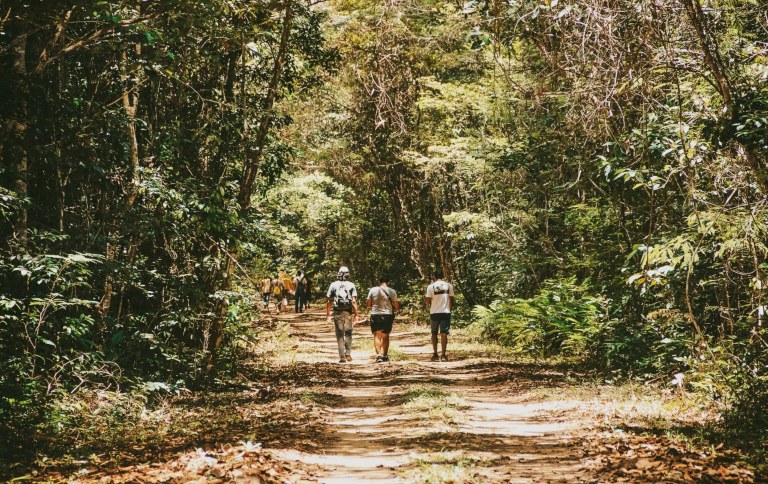
The Descobrimento National Park is located in the extreme south of Bahia, in one of the last remaining areas of Atlantic Forest in the state.
The region, which has been heavily impacted by loggers and hunters, still retains a large area of intact forest, which is essential for the preservation of the rich local biodiversity.
World Heritage Site and Biosphere Reserve
The park is part of the Discovery Coast Natural World Heritage Site, recognised by UNESCO, and part of the Biosphere Reserve.
The area includes the headwaters of the Cahy River, at the mouth of which Pedro Álvares Cabral‘s fleet anchored during the discovery of Brazil.
Video about Descobrimento National Park

Parque Nacional do Descobrimento na Bahia
Geographical features
The relief of the park consists of coastal tablelands of the Barreiras Formation, at an altitude of about 100 metres. The predominant soil is sandy loam and the relief is largely flat.
Although the vegetation has been affected by selective logging, the park has well-preserved native flora. There are also areas of mussununga, a rare and specialised vegetation that is often confused with other types of vegetation, such as ombrophilous forests and restinga trees.
See the map of Costa do Descobrimento
Flora and Fauna
The park’s flora includes impressive trees such as the jacarandá-da-bahia, the braúna, the imbiruçu and other species typical of the Atlantic Rainforest. The park is also one of the last reserves of the rue plant, which is endemic to the region and used to make troughs and pestles.
The fauna is one of the park’s greatest attractions. A 2001 survey recorded 47 bird species, 44 of which are endemic to the Atlantic Rainforest.
These include the Chauã Parrot (symbol of the park), the Macuco, the Royal Hawk and the critically endangered Southern Curassow.
The park is also home to 34 species of medium and large mammals, including the tapir, the jaguar and the susuarana. New species of anuran amphibians have also been identified, adding to the knowledge of local biodiversity.
Potential for research and ecotourism
Although the park is not yet open to the public, environmental education and scientific research activities are carried out under the supervision of park staff.
Much of the region’s biodiversity is still little known, providing a unique opportunity for researchers interested in conservation biology.
Climate and access
The climate of the region is humid tropical, with high temperatures and high humidity throughout the year, with no defined dry season.
Access to the park is via the BR-101 motorway to Itamaraju and then the BA-489 motorway to Prado, where the park’s administrative centre is located. Tourist and environmental information is available there, as well as educational material on environmental issues.
Infrastructure and accommodation
The park’s infrastructure is basic, with a field office at the entrance and an outpost near the village of Cumuruxatiba, inhabited by the Pataxó indigenous people. The nearby towns of Itamaraju and Prado offer good accommodation and food.

Publicações Relacionadas
Beaches and Waterfalls of Itacaré: A Hidden Gem
Picos das Almas, Itobira and Barbado Trekking Guide
4 Must-See Museums in Salvador: Art, History and Culture
Complete Guide to Visiting Arraial d'Ajuda in Bahia
Mata de São João and Praia do Forte: A Complete Guide
Tourist Attractions in Bahia: main attractions, beaches and cities
Tourist Attractions on the Discovery Coast in Bahia
Main islands of Todos os Santos Bay | Visitor’s Guide
Where to Stay in Salvador for Your Best Experience
The Tamar Project and turtle conservation
Places of interest in Salvador — A comprehensive guide
Cairu Archipelago: A Guide to Its Enchantment
Bay of Todos os Santos: nature, history and cultur
Blue Fountain in Chapada Diamantina: a complete guide
Discovery Route in Bahia: History, Culture and Tourism
Palaces in Salvador to visit and learn about Brazil's history
Cocoa farms attract tourists to Bahia - Chocolate Road
Monte Pascoal National Park: Pataxó culture and Brazilian history
Tourist Attractions and Documentaries about Chapada Diamantina
Sempre-Viva: Symbol of Preservation in the Chapada Diamantina
Camamu Bay — A Hidden Paradise in Bahia
Discover the 23 beaches of Salvador — A complete guide and tips
Caraíva: A rustic and unspoilt paradise in the south of Bahia
Santo Amaro da Purificação — History, Culture and Tourism in the Recôncavo Baiano
Lauro de Freitas — A comprehensive guide to beaches, culture and leisure
Waterfalls and trails in the Capão Valley: Complete Guide
Places to visit on the south coast of Bahia
Salvador’s Historic Centre, Pelourinho, Baroque churches and museum
Churches of Salvador: Architectural and Historical Treasures
Discovering Brazil - Porto Seguro is the beginning of Brazil
Praia do Forte, Bahia: The Complete Travel Guide
The most visited churches in Salvador — itinerary and tips
History of the Senhor do Bonfim Ribbons — Origin, Meaning and Traditions
Guide to Trancoso (BA) — what to do, beaches and inns
Rafting in Taboquinhas: The Ultimate Adventure Guide
Wine Tourism in the São Francisco Valley Guide
This post is also on:
 Português
  English
  Deutsch
  Español
  Français