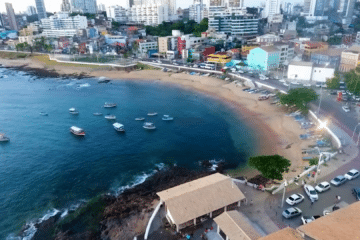
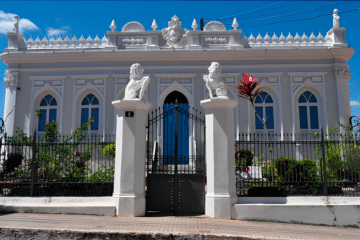
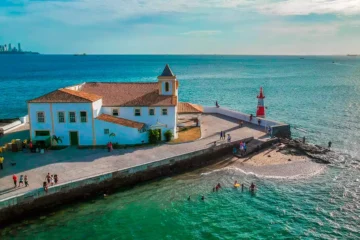
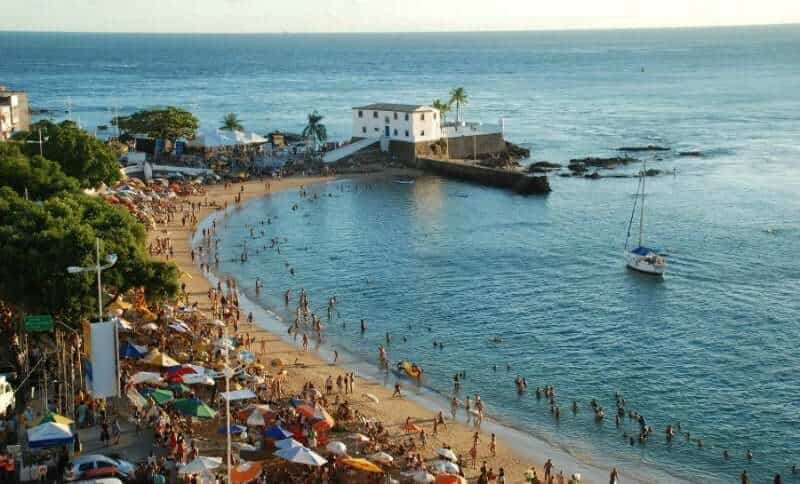
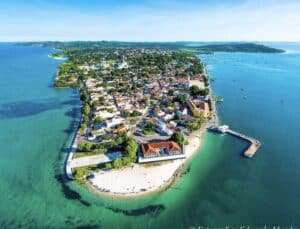
- Where it is: in the Baía de Todos os Santos, across from Salvador.
- Municipalities: Itaparica (historic center) and Vera Cruz (most of the beaches).
- How to get there: ferry-boat to Bom Despacho (about 1 hour) or speedboat to Mar Grande (about 40 minutes).
- Highlights: Forte de São Lourenço, Fonte da Bica, Ponta de Areia, Mar Grande and Cacha-Pregos.
- Best time to go: from September to March, when there is less rain.

The two municipalities of Itaparica Island
1. Itaparica – a historical focus
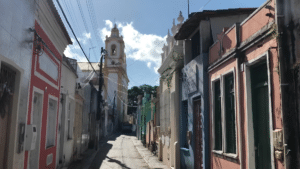
- Its historic center has colonial houses, churches and the Forte de São Lourenço, all listed by IPHAN (Brazil’s National Historic and Artistic Heritage Institute).
- It also has cultural attractions, such as the Fonte da Bica, the Centro Artesanal and guided tours.
- In addition, it is home to the ferry-boat terminal in Bom Despacho.
- For this reason, it attracts tourists interested in culture as well as day-trippers.
2. Vera Cruz – a focus on beaches and summer holidays
- On the other hand, it is home to Mar Grande, Barra Grande, Cacha-Pregos and most of the island’s beaches.
- It also offers boat trips, ecotourism in the mangroves and water sports.
- Meanwhile, the most common access is by the speedboats that arrive at Mar Grande.
- As a result, it mainly welcomes families, summer vacationers and water sports enthusiasts.
In short, the municipality of Itaparica stands out for its historical heritage, whereas Vera Cruz concentrates the beaches, the holiday infrastructure and nautical tourism.
How to get to Itaparica Island
- Ferry-boat: it leaves from the São Joaquim terminal in Salvador and goes to Bom Despacho, on the island. In addition, the crossing takes about 1 hour and carries cars.
- Speedboats: they leave from the Terminal Náutico, near the Mercado Modelo, and go to Mar Grande. In general, the trip is faster, taking about 40 minutes.
- By land: the island is also connected to the mainland by the Ponte do Funil, in the south, which carries the BA-001 highway.
On public holidays and in summer, however, the ferry lines can last more than a few hours. So arrive early, or buy your ticket in advance when that option is available.

A brief history
Before the Portuguese arrived, the island was inhabited by Tupinambá peoples. Then, in 1556, it became the Captaincy of Itaparica and Tamarandiva. After that, it lived off sugarcane, cattle and whaling, and in 1823 it played a decisive role in the Independence of Bahia.
Therefore, to learn more, read our post about the history and heritage of Itaparica Island.
Videos about Itaparica Island and its history


Centro Histórico da Ilha de Itaparica10:31
7 Melhores praias de Vera Cruz22:57
Praia da Penha na Ilha de Itaparica04:04
Guia de Turismo da ILHA DE ITAPARICA - Dicas13:18
O BRASIL COMEÇOU NA ILHA DE ITAPARICA11:40

História da Ilha de Itaparica
Ilha de Itaparica - Dicas de Viagem07:23
Ilha de Itaparica - Documentário26:02
Main attractions
Vila de Itaparica – Historic Center
The main town holds the island’s principal historic ensemble, listed by IPHAN in 1980, with churches, a fort and colonial mansions.

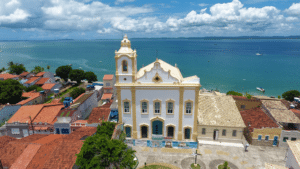
Churches and religious heritage
The highlights are the Igreja de São Lourenço, from the 17th century, and the Igreja Matriz do Santíssimo Sacramento. In addition, both preserve Baroque elements, panels and tiles typical of colonial sacred art.
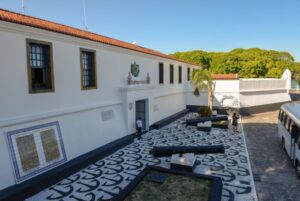
Forte de São Lourenço
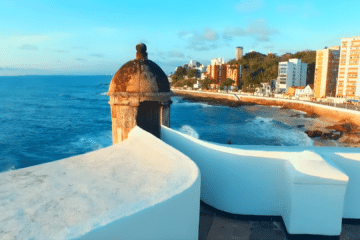
Near the historic center, the Forte de São Lourenço was built in 1711. Later, on January 7, 1823, it was the stage of the Battle of Itaparica. Today, it is a landmark of coastal defense and offers a beautiful view of the waterfront.
Centro Artesanal
Housed in a traditional manor house on the central square, the center brings together local artisans, lacework and wooden pieces. For this reason, it is ideal for buying souvenirs and getting to know the local culture.
Fonte da Bica
Built in 1842, the Fonte da Bica is traditionally regarded as a mineral water spring. Thus, over time, it became the symbol of the town and, since 2020, it has been part of the municipality’s cultural heritage. In addition, popular tradition attributes therapeutic properties to the water, as the local inscription says: “Água fina, faz véia virá menina” (“Fine water turns an old woman into a girl”).


Main beaches of Itaparica Island
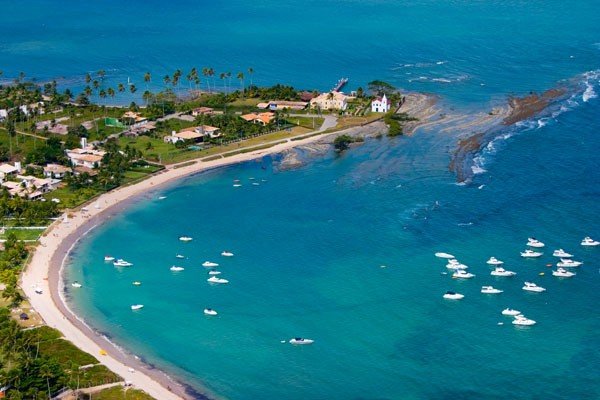
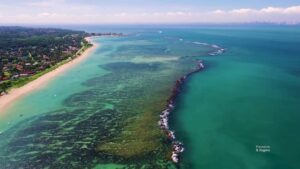
The island has dozens of beaches, and many of them are protected by reefs that form natural pools. For this reason, they are ideal for swimming, stand up paddle, kayaking and diving.
Beaches in the municipality of Itaparica
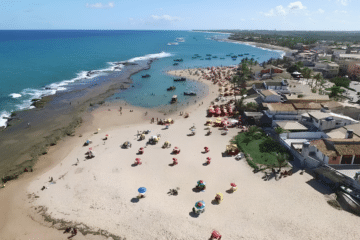
- Praia do Forte – a calm cove with reef-protected waters, light sand and a view of the Forte de São Lourenço.
- Ponta de Areia – calm waters, beach kiosks and boat traffic. In addition, it is one of the most popular beaches on the island.
- Amoreiras – first of all, it has a waterfront shaded by tropical almond trees.
- Manguinhos – holiday homes and a calm sea.
- Porto dos Santos – surrounded by Atlantic Forest, it has trails leading to freshwater springs.
- Gameleira – finally, it is good for fishing and water sports.
Beaches in Vera Cruz
- Mar Grande – the main speedboat port, with the best tourist infrastructure on the island.
- Penha and Barra Grande – beaches with holiday homes and beach kiosks.
- Coroa, Barra do Pote and Conceição – by contrast, these are smaller beaches, good for those seeking peace and quiet.
- Tairu, Aratuba and Berlinque – holiday beaches that get busier in summer.
- Cacha-Pregos – lastly, it lies at the southern tip, near the Ponte do Funil, with mangroves and boat trips.


Recommended activities
- Boat trips to natural pools and to other islands in the Baía de Todos os Santos.
- There are also short trails and birdwatching in the mangroves.
- Then, visit the historical heritage sites and the town’s cultural spaces.
- In addition, it is worth trying the local cuisine based on fish and seafood.
- Finally, rent kayaks, bicycles and boards to explore the waterfront.
Where to stay
There are guesthouses, campsites and holiday homes on the most popular beaches, such as Mar Grande, Ponta de Areia and Cacha-Pregos. In high season, however, book in advance.
When to visit
The best time runs from September to March, when it rains less and the sea is calmer. By contrast, rain is more frequent from April to July.
In summer and on public holidays, however, the island gets more crowded and the ferry lines grow longer. Therefore, those seeking tranquility should prefer weekdays.
Practical tips
- Bring sunscreen, insect repellent and water, since some beaches have little infrastructure.
- Before you leave, check the ferry and speedboat schedules, especially on public holidays and weekends.
- In addition, for trails and boat trips, choose local guides, who know the region well.
- Finally, respect the environmental protection areas and the mangroves.
Frequently asked questions about Itaparica Island
How do I get to Itaparica Island from Salvador?
There are two options: the ferry-boat, from São Joaquim to Bom Despacho (about 1 hour), and the speedboats, from the Terminal Náutico to Mar Grande (about 40 minutes).
If you are leaving Salvador by car, the option is the ferry; by land, however, access is via the Ponte do Funil, in the south of the island.
What is the best time to visit?
From September to March, because it rains less and there are more tours.
However, avoid days of heavy rain for activities at sea.
What are the best beaches on the island?
In short, the most popular ones include Ponta de Areia, Praia do Forte, Mar Grande, Barra Grande and Cacha-Pregos.
In addition, many beaches have natural pools at low tide.
How do I get around the island?
Taxis, vans, local buses, rental cars and bicycles are the most common options.
There are also many tours that are done by boat.
Can you visit the Fonte da Bica?
Yes. After all, it is located in the center of the town of Itaparica and is easy to reach.
In addition, it is known for its history and for the tradition surrounding its waters.
Do I need to hire a guide for beaches and trails?
Yes, for trails and mangroves a local guide is recommended for safety reasons.
For the urban beaches, on the other hand, a guide is not necessary.

Publicações Relacionadas
Arembepe: beaches (Piruí, Praia do Canto), Hippie Village and the Tamar Project

Paranaguá Palace — History, architecture and visiting information | Ilhéus (BA)

São Jorge Parish Church in Ilhéus — history, architecture and religious art

History of the Convent and Church of Nossa Senhora da Piedade in Ilhéus

São Sebastião Cathedral (Ilhéus) — History, architecture and tourism
The 15 Most Visited and Well-Known Beaches in Bahia
The 3 most paradisiacal beaches in Bahia

Skydiving, Paragliding and Ballooning in Bahia

Historic Towns in Bahia: A Journey Through Time
Places to visit on the south coast of Bahia

História da Arte - Caracteristicas, Aspectos e Periodos
Tourist Attractions in Bahia: main attractions, beaches and cities

Subaúma, Bahia: where it is, things to do and where to stay

Massarandupió Naturist Beach, Bahia: Rules and Access
Beaches on the South Coast of Bahia: 10 Best and Tips
Towns and the Abrolhos Archipelago — The southernmost tip of Bahia

Baixio: Between lagoons, dunes and the charm of a village surrounded by nature
Best Beaches in Bahia: Your Guide to Paradise
Salinas da Margarida (BA) — Beaches, Attractions and a Complete Guide

Guarajuba Beach, Bahia: Natural Pools and Tips

Barra do Cahy: Brazil's first beach - history and nature

Garcez Beach: Discover Paradise in Jaguaripe

Barreiras: An Ecological Paradise in Bahia
Catabrigas Waterfall — A natural haven in Ibirajá, Itanhém (BA)

Serra Grande: Your Guide to Bahia's Paradise
Corumbau, Bahia: Ponta de Corumbau, beaches, map, how to go

Taipu de Fora: Discovering Natural Pools

Iguaí: A Guide to Waterfalls and Relaxation
Morro de São Paulo: Map, Beaches & How to Get There (2026)
Tourism in São Francisco do Conde (BA) — Tips and Attractions

Todos-os-Santos Bay (Bahia) — History, geography and conservation
Todos os Santos Bay — Nature, History and Water-based Tourism
Bay of Todos os Santos: nature, history and cultur

Rafting in Taboquinhas: The Ultimate Adventure Guide

Abseiling Sites in Bahia: Top Locations to Explore

Diving Spots in Bahia: Discover Underwater Treasures
This post is also on:
 Português
  English
  Deutsch
  Español
  Français