Chapada Diamantina, in the heart of Bahia, enchants visitors with its breathtaking landscapes, waterfalls, caves and trails.
The destination offers extreme adventures and moments of serenity. To learn more, the documentaries about Chapada Diamantina reveal its tourist attractions, cultural richness, history and natural beauty.
Waterfalls, springs, valleys and caves amidst a rich biodiversity create the perfect setting for jeep tours, hiking, extreme sports and trails in Chapada Diamantina – on foot, horseback or bicycle.
The Chapada Diamantina National Park, created in 1985, covers an area of 1,520 km² and is the main protected area in the Chapada, which covers 38,000 km² of savannah, Atlantic forest and caatinga.
The municipality of Lençóis, 412 km from Salvador, is the main tourist centre of the Chapada Diamantina.
The city of Salvador is the starting point for various programmes in the region and has a wide range of restaurants and tourist agencies.
The bus journey between Salvador and Lençóis takes about six hours. The flight takes 45 minutes. Since April 2009, Trip Airlines has been flying between the two cities on Saturdays.
For travellers seeking isolation and tranquillity, the village of Vale do Capão is a very interesting option, with good guesthouses and alternative communities.
The village, in the municipality of Palmeiras, is the starting point for the main trails of Chapada Diamantina, such as Fumaça, Vale do Pati, Lençóis, Andaraí, Gerais do Rio Preto, Gerais do Vieira and Gerais da Fumaça.
Both Lençóis and Vale do Capão offer accommodation to suit all tastes and budgets, from sophisticated hotels to campsites and hostels.
The town of Mucugê and the village of Igatu, located close to the attractions of the Chapada, also appeal to travellers seeking more peace and quiet. Listed by IPHAN (National Institute of Historic and Artistic Heritage), Igatu was an important diamond production centre and all the buildings in the village are made of stone.
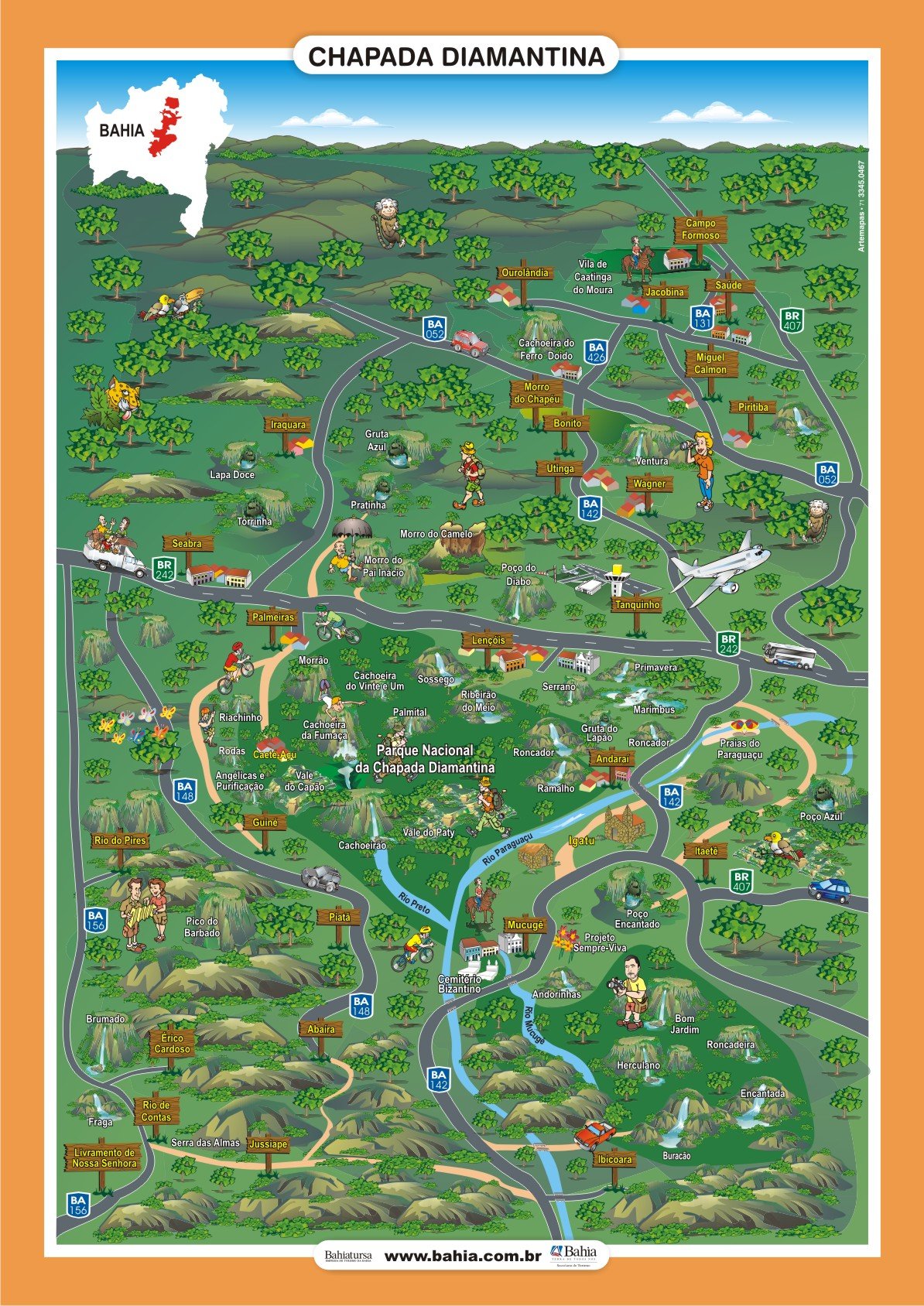
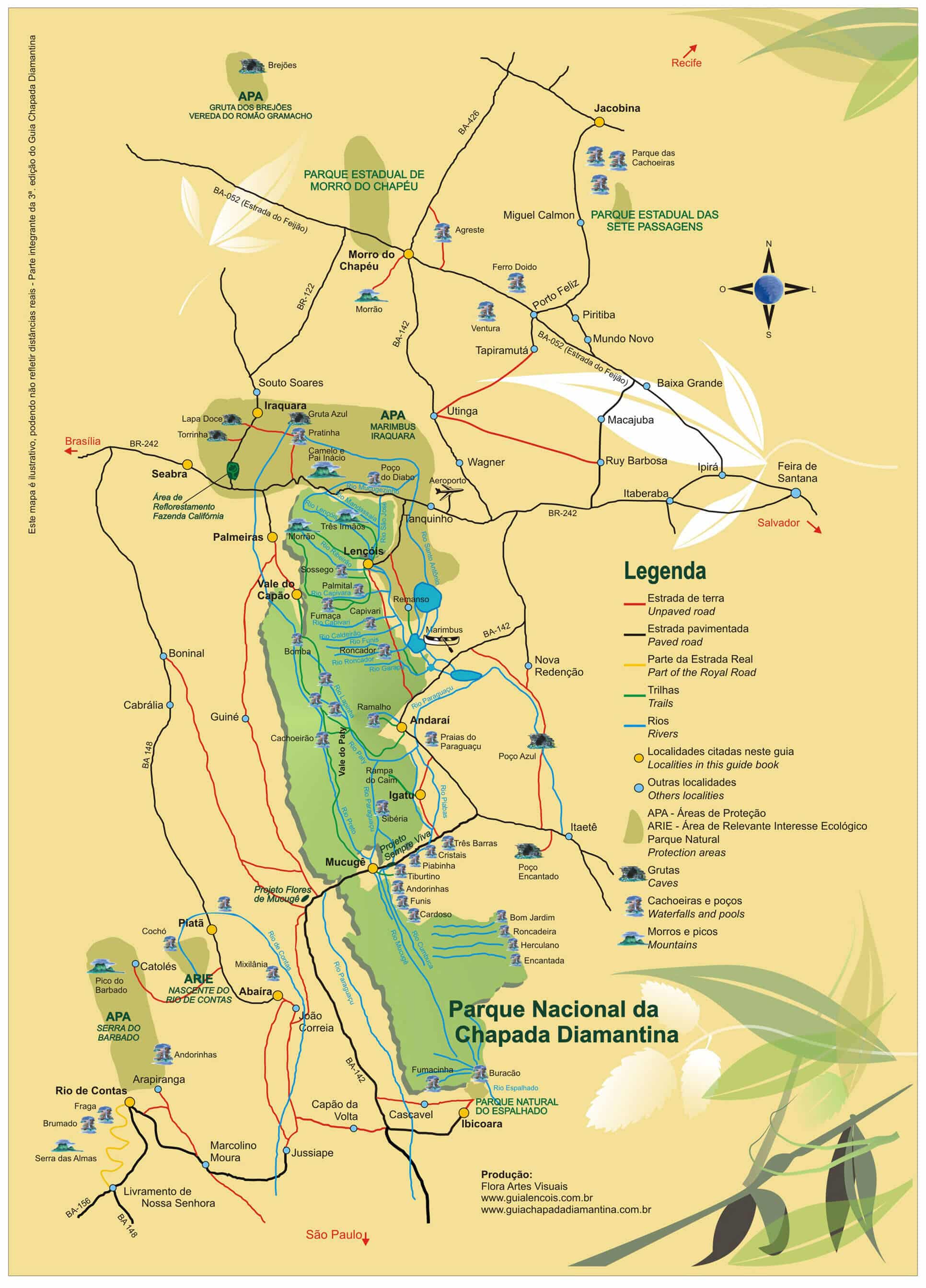
See the map of Chapada Diamantina
Map of trails and tourist attractions in Chapada Diamantina
Videos: Documentaries about Chapada Diamantina
Watch several documentaries about Chapada Diamantina and discover the tourist attractions, breathtaking landscapes, fascinating stories and unforgettable adventures of this unique destination.

Sul da Chapada Diamantina - parte 109:48

Sul da Chapada Diamantina - parte 209:34

Sul da Chapada Diamantina - parte 314:22

Sul da Chapada Diamantina - parte 408:40

Norte da Chapada Diamantina - parte 115:21

Norte da Chapada Diamantina - parte 210:38

Norte da Chapada Diamantina - parte 310:28

Norte da Chapada Diamantina - parte 408:50

Chapada Diamantina - Resumo09:48

Chapada Diamantina - Documentário02:01:46
Attractions in Chapada Diamantina
A must for lovers of ecotourism, travellers to the region are impressed not only by its natural beauty, but also by the awareness and sense of conservation of its inhabitants, such as guides and innkeepers.
1. Footpaths
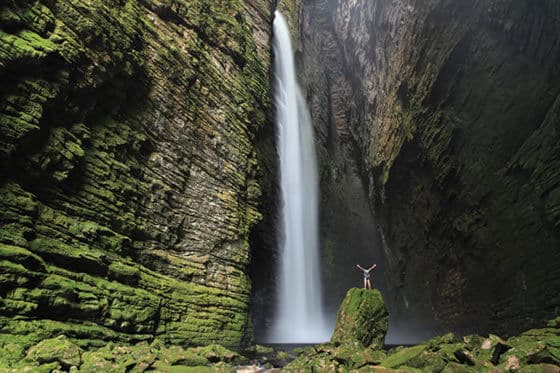
Near Vale do Capão is Cachoeira da Fumaça, one of the main attractions of Chapada Diamantina and one of the highest free falls in Brazil, at about 380 metres.
The quickest and easiest way to see it is the two-hour trail that leads to the top of the waterfall. Fumaça is one of the must-see attractions when visiting the region.
For those who enjoy hiking, adventure and are in good physical shape, the three-day trail known as Fumaça por Baixo is well worth the effort.
The route allows you to
- See the waterfall from above and in front of you.
- Bathe in your well.
- Spend two nights in tents or caves.
- Bath only in waterfalls (no soap).
This trail is considered the most radical in the Chapada.
But the rewards are well worth the effort! In addition to the main attraction, which alone makes the walk worthwhile, the route includes other incredible landscapes and several waterfalls, such as the Palmital.
To do the Fumaça por Baixo (Smoke from below), the presence of a guide is essential.
The trails, generally made during the gold rush era, are closed and unmarked. Mobile phones do not work and there is nothing and no one in the area except for groups visiting the site.
This isolation may be ideal for those who want it:
- Rest your head.
- Work out.
- Forget traffic, computers and mobile phones for a few days.
The suggestion is to walk a lot, cool off in incredible waterfalls and be amazed by the beauty of the landscapes, orchids and bromeliads.
2. Vale do Pati in Chapada Diamantina
A hike of several days is essential to get to know the Vale do Pati, but its paths are easier than those of Fumaça. The beauty of the place is unique and impressive. In the valley you can camp or sleep in the homes of the few natives who offer modest accommodation and tasty home-cooked food.
Travel agencies organise one to five day treks through Pati. Four days and three nights is the minimum for those who enjoy walking and want to get to know the place well. As with the Fumaça Trail, visitors to the Pati Trail have the opportunity to cool off at several wonderful waterfalls.
The guide is usually responsible for preparing and carrying food. Trekkers bring their own clothing and snacks and must return with any waste they produce. It is a good idea to include essential items in your luggage for Bahia.
From December to March, the Chapada Diamantina receives more rain, which enhances the beauty of the waterfalls and the green landscape. On the other hand, the rain can disrupt tours and there is a risk of a water spout – a flash flood caused by the accumulation of water at the headwaters of a river.
However, even during this period, rainfall is not very frequent. From April to October there is little rain and some waterfalls may dry up. It is worth checking the status of the waterfalls and the weather forecast before travelling.
In addition to Fumaça, another must see waterfall in the Chapada Diamantina is Buracão. Located in Ibicoara, 90 km from Mucugê, Buracão is an 80-metre waterfall at the end of a magnificent canyon. As it is far from the main attractions of the Chapada Diamantina, it is less visited, but be sure to check it out.
3. Caves, fountains and cave paintings in Chapada Diamantina
The wonder and grandeur of the Chapada Diamantina is not limited to its surface: it is home to the largest collection of caves in South America, important for their beauty and scientific importance.
Among the hundreds of caves in the region, the most famous is the Poço Encantado (Enchanted Well). The water there is turquoise blue because of the sunlight that enters the cave through a crack. Due to the transparency of the water, it is even possible to see the bottom of the well, which is between 30 and 60 metres deep.
The Poço Azul has similar characteristics to the Poço Encantado, but diving is allowed here. Another cave with blue and crystal clear water is the Gruta da Pratinha. Among the dry caves, the most visited are Torrinha, Lapa Doce, Paixão, Lapão, Bolo de Noiva, Fumaça, Gruta Azul and Brejões.
The region also has a rich cultural heritage, with 65 sites of cave paintings, centuries-old mansions, markets and handicrafts.
4. Extreme sports at Chapada Diamantina
The Chapada Diamantina is also a must for fans of extreme sports. The list of activities that can be practised in the region is long, but worth highlighting are rock climbing, zip lining, canyoning – rappelling down waterfalls – and mountain biking.
You can cycle around the park in about seven days. There are 273 km of trails of varying difficulty. The trip between Vale do Capão and Lençóis takes about five hours by bike and is one of the most difficult sections of the tour.
From Igatu to Mucugê, the effort is much less: two hours, mostly downhill. Tourist agencies offer itineraries that combine cycling and walking.
At the mouth of the Lapão cave, in Lençóis, you can practice cave jumping, similar to bungee jumping. Among the climbing spots, the most notable are the Municipal Park of Muritiba, in Lençóis, with a vertical drop of more than 100 metres, the Cachoeira do Salto do Gavião, in Lençóis, with a 100-metre drop, and the Cachoeira do Salto do Gavião, in Lençóis, with a 100-metre drop. The most notable are the Municipal Park of Muritiba, in Lençóis, with more than 50 routes, and Igatu, in the municipality of Andaraí.
The region has too many attractions for a single trip. Anyone who visits the Chapada once will return at the first opportunity.
Chapada Diamantina Tourist Guide and Documentary about Chapada Diamantina
Publicações Relacionadas
Orchids of the Chapada Diamantina in Bahia
Costa do Dendê: A Tropical Paradise in Bahia
Churches of Salvador: Architectural and Historical Treasures
Municipality of Entre Rios has first official naturist beach
Churches in Salvador (BA) — a guide: history, architecture and itinerary
Tourist attractions and architectural heritage of Salvador (BA
Discovering Brazil - Porto Seguro is the beginning of Brazil
Tourist Regions of Bahia: Discover the diversity of the state
History of São Marcelo Fort — Salvador, Bahia
Alameda do Sol — Vila da Praia do Forte (BA) | Things to do
Correntina: Discovering the Heart of Bahia
Relief, Fauna and Flora of Chapada Diamantina
Coast of Discovery: Bahia's Historical Treasures
Ponta de Corumbau — an unspoilt paradise on the southern coast of Bahia
Igatu: Explore the 19th-Century Stone Houses
Trekking - Route through the Chapada Diamantina in 7 days
Costa do Sauípe: Discover Paradise in Bahia
Paranaguá Palace — History, architecture and visiting information | Ilhéus (BA)
History of the Church of Nosso Senhor do Bonfim in Salvador
Church and Convent of Santa Clara do Desterro and its History in Salvador
Caravelas (BA) — Complete Guide: Beaches, History and Abrolhos
Lacerda Elevator — history, construction and visits
Best Beaches in Bahia: Your Guide to Paradise
Parks and Squares in Salvador for Leisure Activities
Arembepe: beaches (Piruí, Praia do Canto), Hippie Village and the Tamar Project
Places to visit on the south coast of Bahia
Church and Convent of Nossa Senhora da Palma in Salvador, Bahia
Imbassaí Beach: Discover the Best of Bahia
Comandatuba Island: Resort and Family Adventure
Monte Pascoal National Park: Pataxó culture and Brazilian history
Pelourinho: what to do in Salvador’s Historic Centre
Tourist Attractions on the Rio de Contas in Itacaré, Bahia
Main islands of Todos os Santos Bay | Visitor’s Guide
Maraú Peninsula: Explore Its Stunning Beaches
Santa Cruz Cabrália in Bahia — beaches, history and things to do
Tourism in São Francisco do Conde (BA) — Tips and Attractions
This post is also on:
 Português
  English
  Deutsch
  Español
  Français