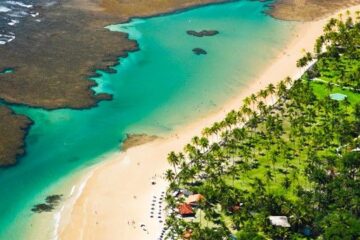
Maraú Peninsula: A natural paradise between the sea and the lagoons of Bahia
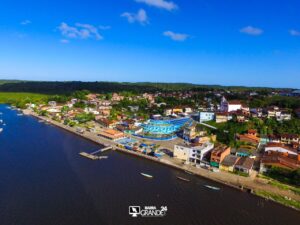
The city of Maraú is located on the side of the peninsula facing the bay, on the banks of the Maraú River.
Away from the beaches and holidaymakers, the small town of Maraú maintains the same pace of life as before.
Access and features
Difficult to reach by car, the town centre is a fishermen’s village with friendly people, streets and old houses well worth a visit.

Natural beauties
The Maraú Peninsula, an extension of the wonders of the Dendê Coast, is dotted with paradisiacal corners. It has mangroves, dunes, waterfalls, 40 kilometres of beaches, river lagoons and natural pools formed by coral reefs.
Local economy
Mainly inhabited by fishermen, the region’s other sources of income are the production of palm oil, cloves, pupunha, cacao, guaraná and black pepper. The establishment of resorts has boosted tourism in the area.
History
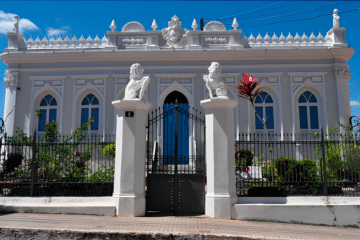
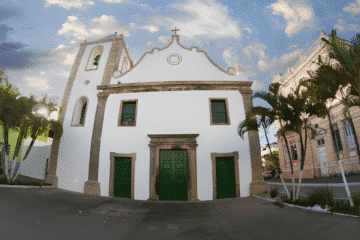
Founded in 1705 by Capuchin priests on the site of the Indian village of Mayrahú, little Maraú has preserved some of its ancient buildings.
Viewpoints and views
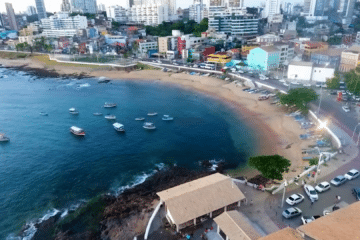
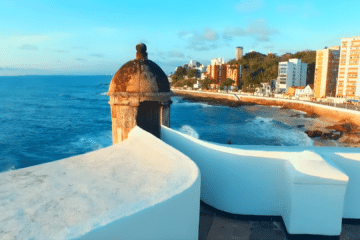
From the viewpoint in the Upper Town, the view of the mouth of the Maraú River is beautiful. From there you can see the Anchorage and the whole of the Lower Town.
Tourist infrastructure
As most visitors arrive by boat, the tourist infrastructure is concentrated in the town of Barra Grande, where the port is located.


See the map of the Dendê Coast
Videos of Maraú and the Maraú Peninsula
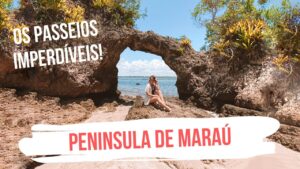
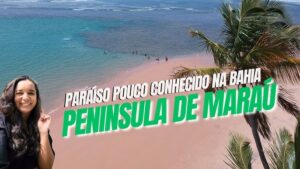
Maraú Peninsula and Camamu Bay
Maraú Peninsula and Camamu Bay are not the same thing, but they are closely related.
- Camamu Bay is the third largest bay in Brazil (after Todos os Santos Bay and Guanabara Bay). It is home to several islands and inlets, including the Maraú River, and serves as an important nautical access to the region.
- The Maraú Peninsula is a strip of land that stretches between the Atlantic Ocean and Camamu Bay, home to paradisiacal beaches, villages and lagoons.
In short, Camamu Bay bathes the western part of the Maraú Peninsula and is the starting point for trips to the region’s islands and waterfalls.
Attractions on the Maraú Peninsula in Bahia
The Maraú Peninsula, in the south of Bahia, offers paradisiacal beaches, natural pools and mangroves.
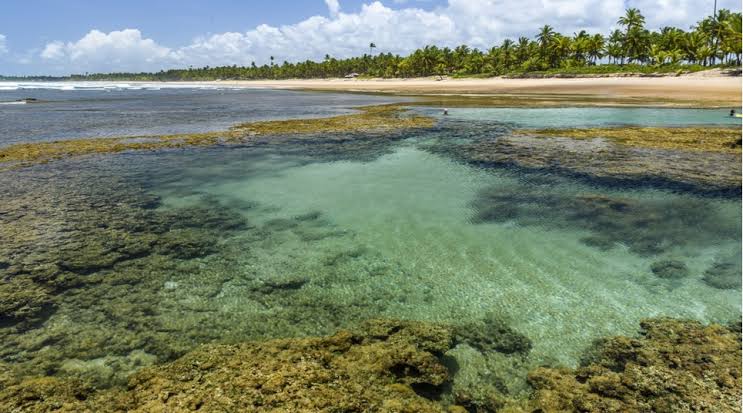
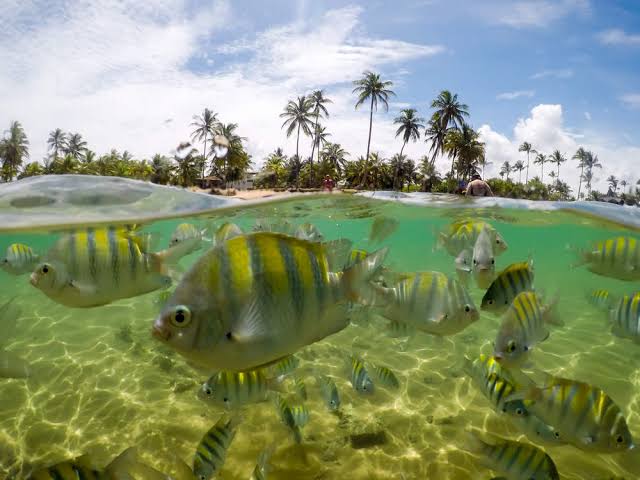
Highlights include Taipu de Fora Beach, with reefs ideal for snorkelling, the village of Barra Grande and the Tremembé Waterfall, which flows into the sea.

Walks around Camamu Bay reveal lush islands, and Morro do Celular offers incredible views.
- Village of Barra Grande
- Maraú River
- Tremembé Waterfall
- Goió Beach
- Beach at Campinho Island
- Barra Grande beach
- Três Coqueiros Beach
- Taipus de Fora Beach
- Cassange Beach
- Saquaíra beach
- Algodões beach
1. Village of Barra Grande
The town of Barra Grande is the second most important town in the municipality of Maraú, after Maraú itself.
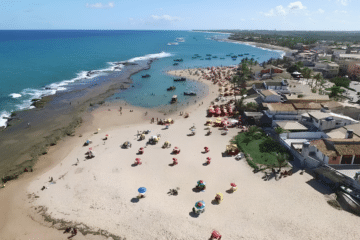
Facing Camamu Bay, Barra Grande beach has a long stretch of clear sand and warm, calm waters, making it one of the most popular destinations on the Dendê coast.

A former fishing village on the Maraú Peninsula, south of Salvador, Barra Grande enchants visitors with its paradisiacal beaches, boat trips, nature trails and excellent seafood and cuisine.
See Bahia’s Barra Grande Village: Complete Guide for Tourists.
2. Maraú River
The city of Maraú is a good starting point for exploring the Maraú River, an arm of the Camamu Bay, which stretches dozens of kilometres to the south, separating the peninsula from the mainland.
Little visited by most tourists who prefer the beaches, the Maraú River hides beautiful landscapes, mangroves, forests and waterfalls.
3. Tremembé Waterfall
Travel up the Maraú River to Tremembé, a small fishing village that until recently could only be reached by boat. With the construction of the BA-001 motorway, it is now possible to get there by car.

The main attraction here is an imposing waterfall that plunges directly into the waters of the Bay. It’s worth spending some time in the village of Tremembé and getting to know its friendly inhabitants.
4. Goió Beach

Located on the island of Goió, it’s a straight beach with light waves, light-coloured and loose sand, surrounded by coconut trees and the Atlantic Forest. It has cottages and is a 1 hour boat ride from Camamu.
5. Beach at Campinho Island

With similar characteristics to the others, this beach has a fishing village and is also located 1 hour by boat from Camamu.
6. Barra Grande beach

Facing Camamu Bay, this beach is straight, with clear sand and surrounded by Atlantic Forest. It has a village and a few holiday homes. It can be reached by boat(1h30 from Camamu on a regular line).
7. Três Coqueiros beach
This beach faces the open sea, with coarse yellow sand, relatively strong waves, native coconut palms and a few holiday homes.

From this beach, there is a series of 40 km of connected beaches, which can be travelled by buggy or motorbike (from Ponta do Mutá to Praia do Pontal). To the north there is a inn with restaurant and camping site.
8. Taipus de Fora beach

One of the most famous beaches on the peninsula, known for its large natural pool, 1 kilometre long and 500 metres wide, surrounded by coral reefs and full of fish.
9. Cassange Beach

It has yellowish, softer sand than the other beaches in the area, surrounded by coconut trees and with slight waves.
10. Saquaíra beach
A straight beach with slight waves, coconut trees in the background and a village. It has several restaurants.

Next to the beach is the Cassange Lagoon, ideal for swimming and sailing. It can be reached by boat(1 hour 40 minutes from Camamu) or by land(Ubaitaba – Maraú – Saquaíra).
11. Algodões beach
It has yellow sand and slight waves. At Arandi there are natural pools at low tide. It is possible to hire boats.

With slightly stronger waves than the other beaches and yellowish sand, this is the last beach in Maraú, on the border with Itacaré.
History of the municipality of Maraú
The Maraú Peninsula belongs to the municipality of Maraú, located on the southern coast of Bahia. The seat of the municipality is inland, while the peninsula, which is the most famous part of the region, is home to several paradisiacal beaches, villages and tourist attractions.
The Maraú Peninsula stretches along Camamu Bay and is one of the most popular destinations on the Dendê Coast.
1705 – The origin of the parish
The origin of the municipality was a Indian village called “Mayrahú”, which means “Sunlight at Dawn” in the indigenous language. The village was discovered in 1705 by Italian Capuchin friars.
The existing indigenous tribe was called “Mayra”. It is not known when they disappeared or to which branch they belonged.
By order of the Portuguese Crown, the bandeirante João Gonçalves da Costa built a road called “Estrada da Nação”.
The movement along this road favoured the smuggling of the “Quinto de Ouro”, which led to the creation of the Povoado dos Funis, where the road forked in the direction of Camamu and the town of Barra do Rio de Contas (now Itacaré).
To prevent smuggling along the road through the hinterland of Fazenda Ressaca, the town of Vitória da Conquista was built there. Thus, Mayrahú had its Tax Office created to collect the “Quinto da Coroa”.
1718 – The district of Mayrahú
The District of Mayrahú was created in 1718, and the Chapel, built by the Capuchin Friars and financed by the Captain Major José Ribeiro Torres, was raised to the category of Parish, with the name of “São Sebastião de Mayrahú”, by Archbishop Dom Sebastião Monteiro da Vide in the same year.
1756 – Villages and sites in the parish of São Sebastião de Mayrahú
In 1756, the List of Villages and Places in the Parish of São Sebastião de Mayrahú was drawn up by the vicar Pedro do Espírito Santo.
The parish was elevated to the category of City by order of the Provisional Government, which succeeded that of D. Antônio de Almeida Soares e Portugal, 3rd Count of Avintes, on 17 June 1761.
1860 – First factory
Between 1860 and 1864, the United Kingdom of England set up a plant in Maraú to distill paraffin from peat and extract oil shale.
The plant, popularly known as “João Branco”, employed about 500 workers and had an internal railway with two locomotives.
The Companhia Internacional de Maraú was closed due to labour disputes, culminating in the departure of the English industrialist Mr Grant from the region.
Today, the ruins of the factory and the railroads can be found in the town still called João Branco.
1938 – From village to city of Maraú
By Decree-Law No. 10.724 of 30 March 1938, the village of Mayrahú was elevated to the category of City of Maraú.
The municipality is located on the Maraú Peninsula, where an APA (Environmental Protection Area) has been created, with a perimeter of 212 km², totalling 21,200 hectares.
The municipality is rich in minerals, especially oil shale, gypsum and petroleum. Although the oil has not yet been extracted, its existence has been confirmed by renowned geologists.
Bahia.ws is the largest tourist guide to Bahia and Salvador.
Tourist guide of Maraú in Bahia

Publicações Relacionadas
Correntina: Discovering the Heart of Bahia
Ventura Village: A Rich History of Diamonds
Waterfalls and trails in the Capão Valley: Complete Guide
Paranaguá Palace — History, architecture and visiting information | Ilhéus (BA)
The best beaches near Salvador (distance, facilities and tips)
Guide to Trancoso (BA) — what to do, beaches and inns
Tourist attractions in the Gamboa neighbourhood in Salvador BA
Discover the 23 beaches of Salvador — A complete guide and tips
Parks and Squares in Salvador for Leisure Activities
Church and Convent of Nossa Senhora da Palma in Salvador, Bahia
Diving Spots in Bahia: Discover Underwater Treasures
Municipality of Entre Rios has first official naturist beach
Ponta de Corumbau — an unspoilt paradise on the southern coast of Bahia
Mucugê: Discover the local history and culture
Ecotourism in Bahia: discover village of Santo André
Chapada Diamantina: A Complete Guide to Attractions and Itineraries
Places to visit on the south coast of Bahia
Main islands of Todos os Santos Bay | Visitor’s Guide
Costa do Sauípe: Discover Paradise in Bahia
Alcobaça, Bahia: A Comprehensive Guide to Beaches and History
Bahia Art Museum (MAB): Learn about its history and collection
Discover the Abrolhos Archipelago: a haven for humpback whales and a biodiversity hotspot
Barreiras: Where Carnival Meets Adventure Tourism
São Sebastião Cathedral (Ilhéus) — History, architecture and tourism
Discovering Brazil - Porto Seguro is the beginning of Brazil
History of the Founding of Salvador, Bahia - History of Brazil
Marimbus Pantanal: Adventure in Chapada Diamantina
History of the settlement of Chapada Diamantina
Tourist Regions of Bahia: Discover the diversity of the state
Tourist Areas in Bahia - Tourist Guide
The Municipality of Conde, Bahia: Beaches and a Comprehensive History
Torrinha Cave: A Speleological Marvel in Brazil
Barra do Cahy: Brazil's first beach - history and nature
Descobrimento National Park in Bahia: A Natural Heritage Site
Churches of Salvador: Architectural and Historical Treasures
Skydiving, Paragliding and Ballooning in Bahia
This post is also on:
 Português
  English
  Deutsch
  Español
  Français