Discover the village of Barra Grande: A paradise on the Maraú Peninsula
The village of Barra Grande in Bahia is the second most important place in the municipality of Maraú, after the city of Maraú itself.
Natural Beauty
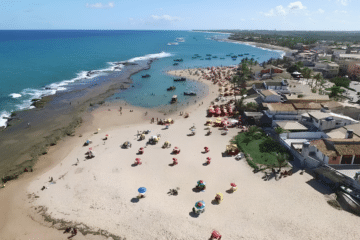
Facing Camamu Bay, Barra Grande Beach has a long stretch of clear sand and warm, calm waters, making it one of the most popular destinations on the Dendê Coast.

History and Culture
A former fishing village on the Maraú Peninsula, south of Salvador, Barra Grande enchants visitors with its paradisiacal beaches, boat trips, nature trails and excellent seafood and cuisine. The town’s historical importance is linked to several factors:
- Fishermen’s Village: Barra Grande was founded as a fishermen’s village, giving it a rich maritime tradition that has influenced the local culture.
- Cultural Connection: The village has been a meeting point between different cultures, especially between the natives, the colonists and the Africans brought here as slaves, resulting in a rich cultural heritage.
- Tourism Development: Since the 1990s, Barra Grande has been transformed into a popular tourist destination, bringing new economic and social dynamism, as well as helping to preserve the local culture.
- Strategic importance: Located on the Maraú Peninsula, Barra Grande has a strategic location that makes it a starting point for exploring natural beauties such as islands and lagoons, as well as a place of passage and trade over the years.
- Preservation of identity: Despite the growth of tourism, Barra Grande has managed to maintain its identity and authenticity, preserving traditions and ways of life that date back to past eras.
Gateway to the peninsula
The village is the main gateway to the Maraú Peninsula, especially for those arriving by boat from the town of Camamu.

Accommodation and Gastronomy
Barra Grande has holiday homes, charming inns and the region’s main bars and restaurants, offering everything from traditional Bahian cuisine to more sophisticated dishes.
Quiet atmosphere
As a restricted access destination, Barra Grande retains its authenticity and quiet atmosphere.

Unique experiences
Those who arrive are enchanted as they walk along the sandy streets, feel the quiet rhythm of the village and are welcomed by the warm hospitality of the locals, who still preserve the habit of having a siesta after lunch.
As well as relaxation, the region offers unmissable activities such as diving in the natural pools, ecological hikes, speedboat trips to the neighbouring islands and the chance to watch one of Bahia’s most spectacular sunsets.

Videos about the village of Barra Grande, the Maraú Peninsula and Camamu Bay

Península de Maraú: 5 passeios imperdíveis

Barra Grande - Reportagem05:50
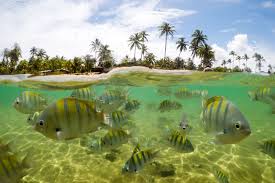
Praias imperdíveis em Barra Grande - Maraú15:02

Barra Grande - Dicas03:11
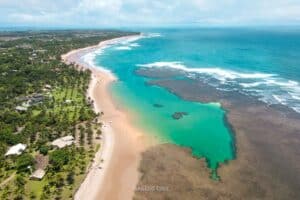
Barra Grande e Ponta do Mutá - Drone e Guia02:34
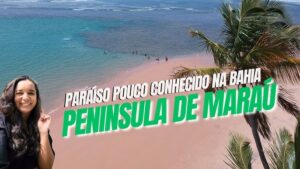
Barra Grande e Taipus de Fora - Guia Turístico
Attractions Municipality of Maraú
The city of Maraú, the seat of the municipality, is full of historical and cultural charm and is one of the least explored tourist attractions, but one with great potential.
Its old houses and quiet streets date back to the time of Portuguese colonisation. The town was once an important shipping depot due to its strategic location on Camamu Bay.

- Taipu de Fora: Considered one of the most beautiful beaches in Brazil, famous for its natural pools, coconut groves and tourist infrastructure. At low tide, the crystal clear pools are ideal for snorkelling and reveal a wealth of marine life.
- Pedra Furada Island: A small island with impressive rock formations surrounded by clear waters. Ideal for boating and diving.
- Tremembé Waterfall: One of the only waterfalls in the region where fresh water flows directly into the sea. It can be reached by boat through Camamu Bay and is a true immersion in nature.
- Ponta do Mutá: The perfect place to watch the sunset, with rustic bars and kiosks creating a romantic and relaxed atmosphere.
- Lagoa do Cassange: Separated from the sea by a narrow strip of sand, it offers fresh waters ideal for relaxation and sports such as stand-up paddle boarding and kayaking.
- City of Maraú: In addition to the historic centre, the town has nature trails, waterfalls and viewpoints that offer privileged views of the region.


With its natural beauty, unspoilt beaches and peaceful lifestyle, Maraú and its villages are an unmissable destination for those seeking contact with nature, adventure and relaxation on the Bahia coast.
History of Barra Grande Village
The village of Barra Grande, located in the municipality of Maraú, in Bahia, has a rich history linked to colonisation, local development and the gold trade.
Its origins date back to the Portuguese occupation of Brazil, particularly on the southern coast of Bahia, a key region for the colonisation process and the exploitation of natural resources.
Strategic importance
During the colonial period, the Barra Grande region was a strategic area for shipping and trading, serving as an outlet for products and natural resources such as gold and spices, which were transported to Europe.
The area was inhabited by indigenous communities, mainly the Tupinambá tribe, who played an important role in the Portuguese colonisation process.
Development of the village
The town of Barra Grande was gradually established as the Nação Road (which linked Salvador to the interior of Bahia) became an important transport route.
This road connected the interior of Bahia with the coast, facilitating the transport of goods and the gold trade, especially to the port of Ilhéus and other coastal towns.
Initially, the village was a small settlement based on the supply of ships and the exploitation of natural resources, such as timber and sugar cane.
The seasonality of their activities was marked by periods of greater commercial activity linked to the gold cycle and agricultural production.
Expansion in the 19th century
In the 19th century, Barra Grande experienced an expansion in fishing and agriculture, consolidating its local economy.
Over time, the town organised itself around the Parish of Nossa Senhora do Livramento de Barra Grande, founded in the 18th century, which focused on Catholic religiosity and the construction of a chapel dedicated to Nossa Senhora do Livramento.
The city’s growth was mainly due to its strategic location, which allowed for urban development and commercial dynamism in the regional context.
Recognition and tourism
Barra Grande began to be recognised as a point of maritime transport and tourism, especially due to its pier and natural harbour.
Over time, the town has grown in commercial importance and infrastructure, reflecting the vitality of the region as a link between the coast and the interior of Bahia.
Today, fishing, agriculture and tourism are the main economic activities in Barra Grande, which retains a rustic charm and is a popular destination for tourists seeking unspoilt nature and quiet.
Barra Grande is now one of Maraú’s main tourist destinations, famous for its paradisiacal beaches, such as Barra Grande Beach and Ponta do Mutá Beach, as well as its growing infrastructure of hotels, restaurants and local shops.

Maraú Peninsula
The Maraú Peninsula is part of the Municipality of Maraú, located in the Southern Bahia Lowlands, at one end of the Camamu Bay.
In recent years, the region has made a name for itself on the tourist scene, especially in the ecotourism segment.
The peninsula is a natural paradise, with more than 40 kilometres of unspoilt beaches, natural pools formed by coral reefs, extensive coconut groves, waterfalls, islands and lush mangroves.
The natural potential of the municipality of Maraú has Barra Grande as its main tourist centre.
This destination, in addition to its scenic beauty, is characterised by its growing infrastructure, attracting tourists seeking direct contact with nature and a peaceful environment.
History of the municipality of Maraú
The origin of the municipality of Maraú dates back to an Indian village called“Mayrahú“, founded in 1705 by Italian Capuchin friars.
The indigenous tribe that inhabited the region was called“Mayra“. It is not known exactly when this tribe disappeared, nor to which branch they belonged.
By order of the Crown, the bandeirante João Gonçalves da Costa built a road called“Estrada da Nação“.
The movement along this road facilitated the smuggling of the “Quinto de Ouro”, which led to the creation of the village of Funis, where the road branched off in the direction of Camamu and the village of Barra do Rio de Contas, which is now the town of Itacaré.
The town of Vitória da Conquista was built on this site to prevent smuggling along the road that led to the hinterland of the Ressaca farm.
Thus, Mayrahú had its “Tax Office”, forced by the need to collect the “Quinto da Coroa”.
The District of Mayrahú was created in 1717 and the chapel built by the friars was elevated to the category of Parish by Archbishop “São Sebastião de Mayrahú“.Sebastião Monteiro da Vide in the same year. Sebastião Monteiro da Vide in the same year.
The parish was elevated to the category of city by order of the provisional government that followed that of D. Antônio de Almeida Soares e Portugal, 3rd Count of Avintes, on 17 June 1761, and was installed by the Ombudsman General of Bahia, Dr Luiz Greire Deveras, on 23 July of the same year. On this date the city of Maraú was founded.
By Decree-Law no. 10724 of 30 March 1938, the town was elevated to the category of city.
Between 1860 and 1864, the United Kingdom of England won a tender to build a plant to distil paraffin, extracted from peat, from naphtha, and also to extract oil shale in Maraú.
The company was built on the banks of the Maraú River. The popular version is that it was called John Grant, but the farmers, finding it difficult to pronounce, shortened it to João Branco.
When the João Branco mill was installed, with all the requirements of a large refinery, the cost to the British Crown was 600,000 pounds sterling.
The works employed about 500 workers and had an internal railway on which two locomotives ran.
One of them is said to be locomotive no. 12, which now stands in front of DETRAN in Ilhéus. According to tradition, the Ilhéus Hotel was built with refractory bricks from the five chimneys of the João Branco factory.
Tourist guide to Barra Grande on the Maraú Peninsula

Publicações Relacionadas
Blue Fountain in Chapada Diamantina: a complete guide
Discover the Magnificence Fort of Nossa Senhora de Monte Serrat
Trekking in the Pati Valley in Chapada Diamantina
Iraquara is also known as the "city of caves"
Pelourinho: what to do in Salvador’s Historic Centre
History, the Festival of Nossa Senhora das Candeias and Tourist Attractions
Santo Antônio da Barra Fort — history, Barra Lighthouse and the Nautical Museu
Palaces in Salvador to visit and learn about Brazil's history
Cachoeira (BA) — National Monument and Historical Trail
Tinharé Archipelago: Discover Hidden Island Gems
Coast of Discovery: Bahia's Historical Treasures
History of the Cathedral Basilica of Salvador
Ecotourism in Bahia: discover village of Santo André
Subaúma Beach: The Perfect Escape in Bahia
Discovery Route in Bahia: History, Culture and Tourism
Barreiras: An Ecological Paradise in Bahia
Porto Seguro's nightlife: Where to have fun
Garcez Beach: Discover Paradise in Jaguaripe
Bahia Maritime Museum: History of Navigation at the Barra Lighthouse
Chocolate Road and trails of the Cocoa Coast - video
Complete Guide to Visiting Arraial d'Ajuda in Bahia
History of Cocoa: From Aztecs to Modern Use
Caravelas (BA) — Complete Guide: Beaches, History and Abrolhos
Birds Found in Chapada Diamantina: A Guide
The Secret History of Salvador, Bahia: Caramuru and the City’s Early Day
Learn more about the sloth and its unique characteristics
Ventura Village: A Rich History of Diamonds
Discover the reasons for a holiday in Salvador, Bahia
The 15 Most Visited and Well-Known Beaches in Bahia
Origin and History of Capoeira in Brazil Explained
Places to visit on the south coast of Bahia
Picos das Almas, Itobira and Barbado Trekking Guide
Madre de Deus Island (BA) — Beaches, Islands and Tourism in the Recôncavo
South Coast of Bahia: Discover Stunning Beaches
History and sights of Avenida Contorno in Salvador BA
Massarandupió Naturist Beach in Bahia
This post is also on:
 Português
  English
  Deutsch
  Español
  Français