Discover the São Francisco River Valley: A Unique and Enchanting Tourist Destination
The São Francisco River Valley, an icon of the Northeastern Hinterland, was discovered in 1501 by Americo Vespuccio and André Gonçalves on October 4th, the feast day of St Francis of Assisi.
The São Francisco River rises in Minas Gerais and crosses Bahia from south to north, going as far as Pernambuco and flowing into the border between Alagoas and Sergipe.
The cities of the São Francisco River Valley in Bahia have excellent tourist potential, especially for those who like to explore places that haven’t been much explored yet.
The São Francisco River Valley is the region drained by the São Francisco River and its tributaries.
It is located in the states of Minas Gerais, Bahia, Pernambuco, Sergipe and Alagoas.
The rivers, rapids, caves, waterfalls, archaeological sites and stone walls hidden among the vegetation of the caatinga and cerrado enchant visitors to the São Francisco River Valley.
This is a special part of Brazil for those who want to get off the beaten track and learn more about their country.
The folklore, handicrafts and cuisine are authentic because they have not been adapted to please visitors, as happens in some places where tourism is the main source of income.
Paulo Afonso, which attracts extreme sports enthusiasts, is a good base for those wishing to navigate the canyons of the São Francisco River.
Why is the São Francisco River Valley a unique tourist destination?
- Natural Beauty: The region is known for its stunning landscapes, which include rivers, waterfalls, caves and cliffs, providing a perfect setting for nature lovers.
- Authentic culture: The valley is home to folkloric manifestations, handicrafts and typical cuisine that have not been adapted for tourism, offering a genuine experience of northeastern culture.
- Adventure Activities: The region is ideal for extreme sports such as rafting, climbing and hiking, especially in places like Paulo Afonso, which attract adrenaline lovers.
- History and Heritage: The valley has archaeological sites and a rich history dating back to Portuguese colonisation, allowing visitors to learn more about Brazil’s past.
- Ecological Diversity: The caatinga and cerrado vegetation is home to a rich biodiversity, making it an interesting place for ecotourists.
These factors combine to make the São Francisco River Valley a destination that offers visitors a varied and unforgettable experience.

See the map of Lagos de São Francisco
São Francisco River Valley
Things to do
- Wine Tourism: Explore the region’s many wineries, take guided tours and enjoy wine and sparkling wine tastings.
- Ecotourism: Enjoy the natural landscapes of the São Francisco River with boat trips, ecological trails and river baths.
- Gastronomy: Try typical dishes from the hinterland, such as roast goat, carne de sol and delicious fish dishes from the river.
- Culture and History: Visit museums, cultural centres and take part in events celebrating the rich history and culture of the Sertão.

Main destinations and attractions

Rio São Francisco - Reportagem06:00

Rio São Francisco - Reportagem Completa
Rio São Francisco é repleto de belezas16:50
- Bom Jesus da Lapa
- Barreiras
- Juazeiro
- Paulo Afonso
- Petrolina
- São Desidério
- Wine Route in the São Francisco River Valley
1. Bom Jesus da Lapa
Located in the middle of São Francisco, in the Polygon of Droughts, a poor region, Bom Jesus da Lapa is known as the “Bahian capital of faith”.

The sanctuary of Bom Jesus da Lapa, a place of religious pilgrimage, is located in a complex of caves at the top of a hill that rises about 100 metres above the plain.
The religious “high season” lasts from July to September, when the city is visited by hundreds of thousands of people, reaching its peak on 6 August, dedicated to Bom Jesus da Lapa, whose image is carried in procession.
2. Barreiras
To the west of the São Francisco River, on the banks of its tributary, the Rio Grande, lies the city of Barreiras.
More geared towards business tourism than leisure, as it is the region’s main political and economic centre, the city has surprises in store for those seeking unusual landscapes and new adventures.

Nearby are archaeological sites, mountains for trekking, waterfalls and cliffs for abseiling, rapids for rafting and caves. Its rivers are ideal for fishing, canoeing and rafting.
The biggest event in the city of Barreiras is the Micareta Barreiras Folia, an off-season carnival that attracts mainly young people. The same goes for the carnival and the June festival, when Bahia forgets the axé and boils to the rhythm of the forró.
3. Juazeiro
If you think Juazeiro, in the north of Bahia on the banks of the São Francisco River, is a rough and backward place, think again. The city is modern, with new buildings and paved streets lined with carnauba trees.

There is a public promenade on the banks of the river where locals go to watch the sunset and enjoy the scenery.
The São Francisco has several river islands in the Juazeiro region. Massanganos is popular with young people, who organise luaus by the light of bonfires that don’t end until dawn.
For trekking enthusiasts, there are trails leading into the mountains and to the cave paintings on the walls of a large canyon.
Main attractions
- Juazeiro Waterfront: Offers panoramic views of the São Francisco River and Petrolina, as well as bars and restaurants.
- Producers Market: One of the largest fruit markets in Brazil, where you can buy fresh fruit directly from the producers.
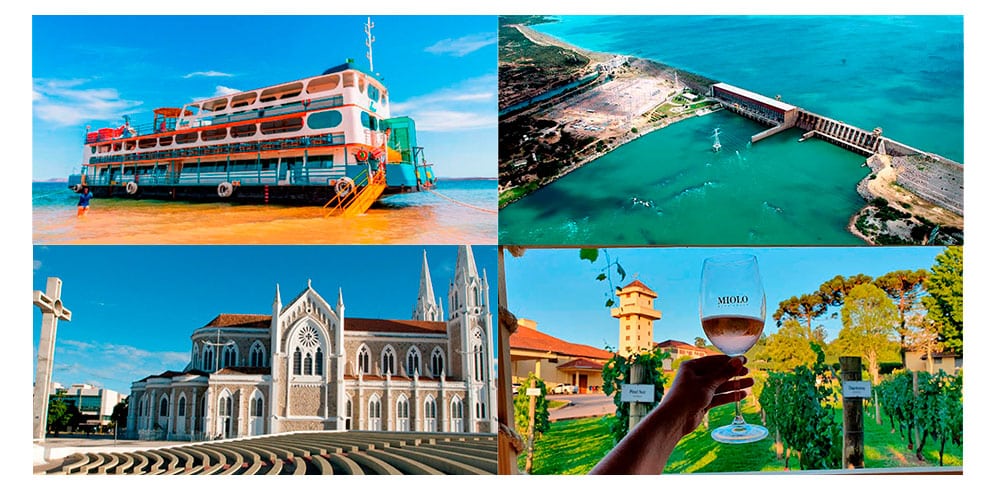
- Vapor do Vinho: A boat trip down the São Francisco River with wine tasting and lunch on board.
4. Paulo Afonso
Located on an island in the São Francisco River, the city was founded in 1725 as a settlement on the sesmaria of Paulo Viveiros Afonso.

In 1913, businessman and engineer Delmiro Gouveia built the Angiquinho hydroelectric power station on this stretch of the river, which operated until 1960.
The São Francisco River, which is navigable near Paulo Afonso, offers catamaran trips and water sports.
Local handicrafts include leather goods, straw, vines, hammocks and lace. Tourist infrastructure is satisfactory.
Main attractions
- Paulo Afonso Hydroelectric Complex: Visit the impressive hydroelectric power stations and the canyon of the São Francisco River.
- Paulo Afonso Waterfall: One of the most impressive waterfalls in Brazil, especially during the rainy season.
5. Petrolina
The Pernambuco side of the Velho Chico’s sister cities is one of the best ecotourism destinations in Brazil.
This means that in Petrolina you’ll find a wide range of excursions, from tours of the region’s prestigious wineries to islands in the middle of the São Francisco River, as well as plenty of culture, handicrafts and gastronomy.
Main attractions
- Wineries: The region is famous for its wine production. Visit wineries such as Vinícola Miolo and Vitivinícola Ouro Verde to learn about the production process and take part in tastings.
- Ilha do Rodeadouro: A river island with freshwater beaches, ideal for swimming and relaxing.
- Museu do Sertão: A museum dedicated to the culture and history of the northeastern hinterland.
- Petrolina Cathedral: A beautiful example of neo-Gothic architecture, located in the city centre.

6. São Desidério
São Desidério is a small town in the western region of Bahia, 900 kilometres from Salvador, and has become famous among tourists who are passionate about nature and extreme sports.
The town has more than 100 caves, ideal for those who love climbing and hiking.
7 Wine route in the São Francisco Valley
Wine production in the São Francisco Valley is concentrated between Bahia and Pernambuco, on the Petrolina-Juazeiro axis.
Discover our itinerary on the São Francisco River Valley Wine Route, full of surprises and unforgettable experiences.
The starting point is Petrolina, from where you can visit the most important wineries in the municipalities of Lagoa Grande and Santa Maria in Pernambuco and Casa Nova in Bahia.
An itinerary to discover the production of tropical wines, with grapes grown in an environment that is not very favourable for wine production – dry, clayey, stony soil and lots of sun. Discover the history of winemaking in the region, the techniques of vineyard management and enjoy fine still and sparkling wines. All on the banks of the São Francisco River.
Curiosities of the region
- Emblematic grapes of the region: Syrah. Tempranillo and Moscato
- The region produces what are known as tropical wines, with their own originality and identity, distinctive in the world of wine.
- On the same day, you can see the vineyards at different stages: resting, pruning, budding and harvesting.
- In the São Francisco Valley, the vine cycle is 4 months, which results in 2 harvests per year, whereas in the wine world, there is usually only 1 harvest per year.
- Harvest periods: April to August and October to February. Travelling during these periods is an interesting way to experience the grape harvest!
- The region is responsible for 90 per cent of Brazil’s table grape production and is the country’s largest producer of mangoes.
Travel tips
- Transportation: Senador Nilo Coelho Airport in Petrolina is the main access point to the region. From there you can hire a car or use transfer services to explore the São Francisco Valley.
- Best time to visit: May to September, when the climate is milder and drier. During the rainy season, from October to April, the river and waterfalls are fuller and the landscape greener.
- Accommodation: There is something for every taste and budget, from comfortable hotels in Petrolina and Juazeiro to rustic inns in rural areas.
The São Francisco Valley is a fascinating destination, combining lush nature, rich Sertanejo culture and a thriving wine industry. Take advantage of all that this unique region has to offer and enjoy an unforgettable experience in the heart of Brazil.
Bahia.ws is the largest tourist guide for Bahia and Salvador.

Publicações Relacionadas
Alcobaça, Bahia: A Comprehensive Guide to Beaches and History
Marimbus Pantanal: Adventure in Chapada Diamantina
Mangue Seco: The Last Beach on the North Coast of Bahia
History and sights of Avenida Contorno in Salvador BA
History of the Church of Nosso Senhor do Bonfim in Salvador
Discover the Magnificence Fort of Nossa Senhora de Monte Serrat
The best beaches near Salvador (distance, facilities and tips)
Coast of Discovery: Bahia's Historical Treasures
Camamu Bay — A Hidden Paradise in Bahia
Ilha dos Frades — History, beaches and tourist attractions
Correntina: Discovering the Heart of Bahia
Bom Jesus dos Passos Island: A Complete Guide (Beaches, Church and How to Get There)
Chapada Diamantina: A Complete Guide to Attractions and Itineraries
Palmeiras: A Gateway to Chapada Diamantina
Best Beaches in Bahia: Your Guide to Paradise
Madre de Deus Island (BA) — Beaches, Islands and Tourism in the Recôncavo
Humpback whales in Brazil — characteristics, migration and sanctuaries (Abrolhos)
Bom Jesus da Lapa Sanctuary: A Complete Visitor’s Guide
Guide to Trancoso (BA) — what to do, beaches and inns
Prado (BA) — Beaches, Cliffs and Whale Watching | Whale Coast
Municipality of Una: A Beach Paradise Awaits
Maraú Peninsula: Explore Its Stunning Beaches
Imbassaí Beach: Discover the Best of Bahia
Historic Towns in Bahia: A Journey Through Time
Origin and History of Capoeira in Brazil Explained
Cathedral Basilica of Salvador — History, Sacred Art and Collection
Where to Stay in Salvador for Your Best Experience
Barreiras: Where Carnival Meets Adventure Tourism
Church of São Pedro dos Clérigos — History, architecture and religious art
Tourist Attractions on the Discovery Coast in Bahia
Main caves in the municipality of Iraquara in Chapada Diamantina
The 3 most paradisiacal beaches in Bahia
Barreiras: An Ecological Paradise in Bahia
Relief, Fauna and Flora of Chapada Diamantina
Catabrigas Waterfall — A natural haven in Ibirajá, Itanhém (BA)
A History of the Forts and Lighthouses of Salvador (Bahia)
This post is also on:
 Português
  English
  Deutsch
  Español
  Français