Baroque architecture is an important part of Western history, with unique characteristics that shaped the urbanisation of Europe and can still be seen in Brazil today.
Although the first signs of Baroque architecture can be found in works from the early 16^(th) century, it was only towards the end of this period that the Baroque style gained momentum and spread throughout Europe.

Trevi Fountain – The fountain was built in 1732 by the Italian architect Nicola Salvi and is considered one of the most beautiful examples of Baroque architecture in the world.
This development occurred in parallel with the Catholic Church’s need to assert its sovereignty in the period following the Protestant Reformation.
The emergence of Protestantism, which questioned Catholic dogma, prompted the leaders of this Christian denomination to initiate the Counter-Reformation movement.
The Church then held the Council of Trent, which aimed to reaffirm the absolute truth of Catholic faith and tradition. It was during this period that the foundations of the Baroque style were consolidated.
At this council, the Catholic Church decided that art should be used to spread Catholicism as the one true Christian religion.
Artistic expressions should depict biblical scenes, saints and sacraments, among other things.
Furthermore, art should be simple and easy to understand so that Catholicism could reach everyone.
It was also decided that the paintings could not depict nudity or pagan symbols, and that the scenes should be realistic.
Thus, Baroque art became associated with Catholic Christianity, which is why the finest examples of Baroque architecture can be found in churches, basilicas and Christian monuments.
The Baroque was an artistic, social, historical and cultural movement. It encompassed literature, painting, sculpture, architecture and even music.
It was mainly characterised by dualism; the dilemma between body and soul, heaven and hell, the profane and the sacred. It was also characterised by rich detail, with exuberant and luxurious paintings, architecture and sculptures.
It arrived in Brazil at the start of the 17th century, remaining there until the middle of the 18th century.
The Brazilian states of Minas Gerais, Bahia and Pernambuco have the greatest architectural legacy from this period.
However, the movement did not only occur in cities in Minas Gerais; it also began in Salvador and Recife.
Videos about Baroque architecture in Minas Gerais.

A história do Aleijadinho16:51
Pintor Manuel da Costa Ataíde14:24
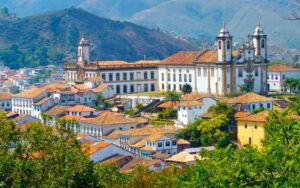
Conheça as belas igrejas de Ouro Preto MG17:39
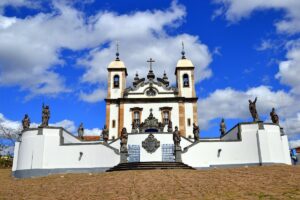
Santuário do Bom Jesus de Matozinhos - Congonhas MG20:35
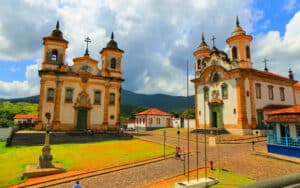
Conheça a cidade histórica de Mariana13:01
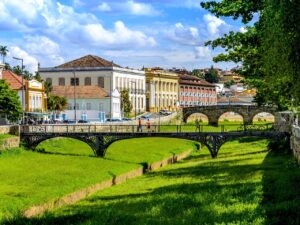
São João del Rei MG - Pontos Turísticos01:00
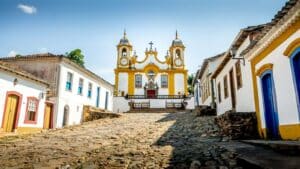
Conheça os principais pontos turísticos de Tiradentes09:27
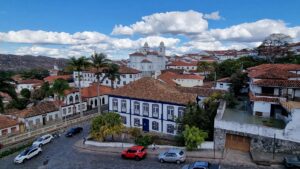
Centro histórico de Diamantina MG19:40
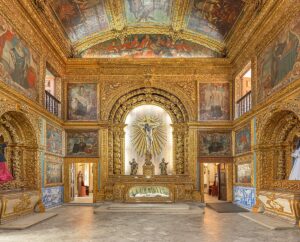
Curiosidades da Capela Dourada de Recife01:28:49
The main characteristics of Baroque architecture:
As the Baroque movement sought to affirm Catholic sovereignty, the arts of this period were marked by the exaltation of God and the Church.
The Baroque movement broke with the rationality and symmetry of Greco-Roman classicism, beginning to use forms and textures that convey movement and produce emotions and sensations.
The exaltation of the Church is also achieved through the use of many ornaments and extravagant decorations that convey the ideas of grandeur, power and wealth.
Baroque is a bold style, with irregularities in proportion being common. Its most striking characteristics are:
- There is a strong presence of oval shapes and spaces, which convey the idea of centralisation.
- The use of the Greek cross identifies Christianity.
- Convex or concave façades reinforce the idea of movement.
- Use of twisted columns and arches.
- Exuberant decorative elements and a strong gold presence.
- plaster or stucco effects;
- a sense of infinity and grandeur.
- Murals and ceiling paintings.
- Use lighting to create a sense of mystery.
- The exaltation of God and Christ as central figures.
- Despite being the most striking, these characteristics were not present in all Baroque architecture, as the style varied according to each country’s historical context.
In France, for example, Baroque architecture also sought to glorify the monarchy, as seen in the Palace of Versailles.
The Baroque style gained momentum in England when London needed to be ‘rebuilt’ after the Great Fire of London, which destroyed more than 13,000 houses and 87 churches.
On that occasion, London was redesigned in an architectural style influenced by trends in Italy and France.
The leading names and works of Baroque architecture.
1. Carlo Maderno
Carlo Maderno, known as one of the pioneers of the Baroque style, was an architect and Italian sculptor. His first major work was the façade of the Church of Santa Susanna, which features columns typical of the Baroque style.
In 1603, Maderno was appointed chief architect of St Peter’s Basilica in the Vatican, a role that would become his most notable achievement.
2. Borromini
Borromini was an architect who became renowned for his revolutionary approach to architecture, which broke completely with the classical style.
He is renowned for designing the Church of San Carlo alle Quattro Fontane in Rome. This was the first Baroque building whose dome was covered with geometric shapes rather than frescoes.
3. Gian Lorenzo Bernini
Many consider Bernini to be the leading figure of the Baroque period. His works can be found throughout Rome, but his greatest contributions to Baroque architecture are the trapezoidal square of St Peter’s Basilica and the oval Church of Sant’Andrea al Quirinale.
4. Carlo Fontana
Fontana, who collaborated with Bernini, also became renowned as one of the leading figures of the Roman Baroque movement. He was responsible for the reconstruction of the Basilica of Santa Maria in Trastevere’s façade and the restoration of the fountain that stood in front of it.
5. Aleijadinho
Antonio Francisco Lisboa, also known as Aleijadinho, was a leading figure in the development of Baroque architecture in Brazil.
Aleijadinho was a sculptor, woodcarver and architect whose works are scattered throughout the state of Minas Gerais, particularly in the historic cities of Ouro Preto, Sabará, São João del-Rei and Congonhas.
His most notable works were the Church of St. Francis of Assisi in Ouro Preto and the Shrine of Bom Jesus de Matosinhos in Congonhas.
Influenced by Rococo, Aleijadinho is considered the greatest figure in Brazilian colonial architecture and one of the most important names in Baroque art in the Americas.
Baroque architecture in Brazil
- The lining of the sacristy and the door cloth of the Church of the Third Order of St Francis of Assisi in Mariana.
- The ceiling of the nave of the Church of the Third Order of Saint Francis of Assisi in Ouro Preto.
- The ceiling of the Church of Our Lady of the Rosary of the Black People in Mariana.
- Panels in the Mother Church of Conceição do Mato Dentro.

The main works of this period:
- Igreja de São Miguel, localizada em São Miguel, Rio Grande do Sul;
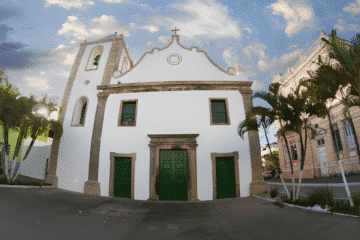
- The Church of Saint Anthony is located in Cairu, Bahia.
- The Basilica and Convent of Our Lady of Carmel is located in Recife, Pernambuco.
- The Church of St Francis of Assisi is located in Ouro Preto in the state of Minas Gerais.
- The Twelve Prophets are sculptures located in the Church of Bom Jesus de Matozinhos in Congonhas, Minas Gerais.
- The Church of St Francis of Assisi is located in Ouro Preto in the state of Minas Gerais.
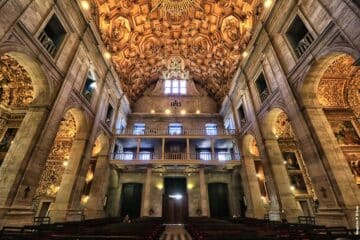
- The Church and Convent of São Francisco is located in Pelourinho, Salvador, Bahia.
Baroque architecture in north-east Brazil and Minas Gerais.
Baroque architecture spread throughout Brazil and reached its peak during the period known as the ‘Gold Cycle’. This period coincided with the exploitation of minerals in Minas Gerais.
The Baroque style became famous in Brazil thanks to Aleijadinho, an artist responsible for historic works such as the Sanctuary of Bom Jesus de Matosinhos in Congonhas and the Church of São Francisco de Assis in Ouro Preto, for which he designed both the architecture and the interior decoration.
Features such as sumptuous and ornate forms are characteristic of Baroque architecture. This style also became a reference point in art, music and literature.
As a result, the state boasts the greatest Baroque architectural heritage. The cities of Ouro Preto, Tiradentes, Congonhas, Mariana and Diamantina are particularly notable in this context.
1. Ouro Preto, Minas Gerais
Ouro Preto was one of the first cities to be listed by IPHAN (the National Institute of Historic and Artistic Heritage) in 1938, and was the first Brazilian city to be designated a World Heritage Site by UNESCO in 1980.

1.1. Church of St Francis of Assisi

It is one of the most admirable examples of the late 18th-century Minas Gerais style, with a façade that follows the Portuguese design of the great mother churches.
The building is a religious, social and artistic landmark of the city and the state. Its architectural design, façade and ornamental elements, such as the pulpits, altarpiece, lavabo and ceiling of the chancel, are the work of Aleijadinho, as are the paintings. Ataíde.
The entire ceiling of the nave is covered by a painting by Ataíde depicting the Assumption of Our Lady of the Conception, the patron saint of the Franciscans.
1.2. Pilar Mother Church
Construction began between 1728 and 1730, replacing the village’s oldest temple, which was dedicated to the Virgin of Pilar.

It is one of the most important examples of Minas Gerais Baroque from the Golden Cycle. As well as its fine artwork, the church houses the Silver Museum.
The Parish Archives, the most complete in Ouro Preto, are preserved in the corridor adjoining the consistory.
1.3. Church of Our Lady of the Rosary of the Black People
Dating back to 1785, it is dedicated to the patron saint of black people and mixed-race individuals, and boasts the most original design of all the Baroque churches in Minas Gerais.

The ceiling of the nave is shaped like an ellipse and resembles a ship’s keel. The interior is impressive for its acoustics and clarity.
The side altars are dedicated to Saint Helena, Saint Efigênia, Saint Anthony of Nubia, Our Lady Mother of Men, Saint Elesbão and Saint Benedict.
Some researchers claim that the images of Saint Anthony and Saint Benedict were made by Father Félix, the elder brother of Aleijadinho.
1.4. Church of Our Lady of Carmel
It was built during the third phase of the Baroque period, with the main part completed in 1772 and the embellishments and finishing touches completed in 1848.

The artists Manoel Francisco Lisboa (father of Aleijadinho) and Manoel da Costa Ataíde, among others, participated in its decoration.
It is located at the top of a slope, which can be accessed via an extensive staircase. The site was frequented by the local aristocracy.
The Portuguese tiles adorning the ten panels must have cost the religious brotherhood that financed them a great deal of gold. The tiles came from Portugal and were transported to Minas Gerais by donkey from Rio de Janeiro.
1.5. Church of Santa Efigênia (also known as the Church of Chico Rei)
It was built in 1736. The project involved several artists, including Manoel Francisco Lisboa, Francisco Xavier de Brito and Manuel Gomes da Rocha.


Manuel Francisco Lisboa, the contractor, worked on the construction of the Mother Church of Nossa Senhora da Conceição de Antônio Dias, in which he and his son Aleijadinho are buried.
The Mother Church is one of the oldest parishes in Minas Gerais and also stands out for being one of the largest and most sumptuous.
The former sacristy now houses the Aleijadinho Museum, where visitors can admire several works by the master, including images of Saint Francis of Paola and the crucified Christ.
1.7. Chapel of Our Lady of the Rosary of the Priests
The name comes from Father João de Faria, who commissioned its construction in the early 18th century. Originally dedicated to Our Lady of Carmel, around 1740 the chapel also began to house the White Brothers of the Brotherhood of the Rosary.

The chapel is the only example within the urban perimeter of Ouro Preto that represents the original Serra de Ouro Preto constructions. It is considered by many to be the most exquisite of all.
2. Santuário de Bom Jesus de Matozinhos, em Congonhas, Minas Gerais
Considered one of the masterpieces of world Baroque, the Shrine of Bom Jesus de Matozinhos was inscribed in the Book of Fine Arts by Iphan in 1939 and recognised as a World Cultural Heritage Site by UNESCO in December 1985.

The Sanctuary of Bom Jesus de Matozinhos is located in Minas Gerais, in the municipality of Congonhas. Construction of the sanctuary began in the second half of the 18th century. The Congonhas Museum has been operating next to the sanctuary since 2015 and is open to visitors, offering insights into the various dimensions of this heritage site.
The built complex consists of a church with a Rococo interior, a walled churchyard and a monumental external staircase decorated with statues of the 12 prophets in soapstone, as well as six chapels arranged side by side on the slope in front of the temple. These chapels, called Passos, illustrate the Via Crucis of Jesus Christ.
It draws strong inspiration from Portuguese examples such as the Church of Bom Jesus do Monte (Braga) and the Shrine of Nossa Senhora dos Remédios (Lamego), both of which are located in Portugal.
The 66 polychrome wooden sculptures in life-size, housed in the six chapels that depict the seven scenes of the Passion of Christ, comprise one of the world’s most complete collections of sacred sculptures. They are undoubtedly one of the masterpieces of Francisco Antônio Lisboa, known as Aleijadinho, who left humanity with a work of great expression and originality.
The Sanctuary is in good condition, enabling its materiality to convey its significance and the values associated with it. It represents a unique artistic achievement and an exceptional example of 18^(th)-century Brazilian architecture.
The built and sculptural ensemble retains its intrinsic values: the Church of Bom Jesus; the churchyard with its soapstone statues of prophets; and the steps and chapels with their seven stations, which were completed in 1805. There is also an expressive sculptural ensemble representing the Passion of Christ.
Despite the urban growth of Congonhas resulting from intense iron mining, the sanctuary remains intact and is still an icon of sacred art and religious devotion in Brazil today.
3. Mariana MG
Mariana was the first capital of Minas Gerais, followed by Ouro Preto. It is the only colonial city in Minas Gerais with a planned layout.

Mariana’s historic centre, which was listed by IPHAN in 1945, boasts an architectural heritage that bears witness to its past as a gold-mining town.
The polycentric urban layout, dotted with churches, Passos da Paixão (Steps of the Passion) and fountains, reveals the scenic effect typical of the baroque aesthetic influenced by Portuguese culture.
Designed by the Portuguese architect José Fernandes Pinto Alpoim, Mariana features straight streets and rectangular squares in keeping with modern principles. Despite its expansion and constant loss of character, these features can still be seen today.
In the second half of the 18^(th) century, institutional buildings started to appear, and the entire architectural collection had been established by the end of the century.
Unlike other towns that emerged with the gold rush, it is the only town in the province that had its urban layout planned during the colonial period.
The following stand out among the listed religious monuments:
- Cathedral of Our Lady of the Assumption (also known as the Sé Church and one of the oldest churches in Minas Gerais).
- Marianna Major Seminary (in neoclassical style).
- The group of townhouses on Rua Direita (with commercial premises on the ground floor and balconies on the upper floors; one of these houses was the residence of the poet Alphonsus de Guimarães).
- There are also sacred paintings by Manoel da Costa Ataíde.
Just a few metres apart in Praça João Pinheiro stand the churches built by the powerful brotherhoods of São Francisco de Assis and Carmo.
The churches of Nossa Senhora das Mercês and Rosário, which belong to the black brotherhoods, are located further away from the others: the former is five blocks from the square, while the latter is situated on a distant elevation.
Mariana has fewer civil buildings and temples than Ouro Preto because it did not undergo the same level of development.
4. São João del Rei, Minas Gerais
The city, with its hills, churches, museums and houses, reveals to its visitors the lifestyle of the miners and presents magnificent Brazilian Baroque buildings, in addition to holding the wealth obtained from gold.

The city of São João Del Rei is an example of Baroque architecture, made possible by gold, while commerce gave it an eclectic character with modern touches.
Visitors can observe the Minas Baroque style in the city’s churches and houses, as well as Neo-Gothic, Neoclassical and Modern influences in the façades of some buildings. The city offers a rich architectural experience, spanning from Baroque to contemporary styles.
Like other colonial towns in Minas Gerais, São João del Rei originated from small settlements that formed around mining sites. Initially, the area was sparsely populated, with small, low houses grouped around a chapel.
The city’s religious architecture largely follows traditional Minas Gerais patterns, featuring naves, chancels, sacristies and side aisles. The façades are typically composed of a central section flanked by two sacristies and side aisles. The aisles and façade are usually square in profile, with a main section flanked by two sacristies and side aisles. The ornamentation is predominantly Rococo, a style typical of the second half of the 18^(th) century and the beginning of the 19^(th) century.
Even before gold was discovered in the area, it was already a mandatory stopping point for people heading to the mines.
5. Tiradentes, Minas Gerais
The architectural and urban ensemble of Tiradentes, which was listed by IPHAN in 1938, represents one of the most significant stages in the interiorisation and consolidation of the colonisation of Brazilian territory.

In addition to the typical colonial buildings, the listed heritage comprises traces of the city’s occupation, the way in which the plots are subdivided, the formation of blocks, and the relationships between densely populated areas and sparsely populated areas. It also includes the green areas adjacent to the traditional urban site.
The city boasts one of the most significant architectural collections in Minas Gerais, comprising 18th-century religious, civic and official buildings.
In terms of civil architecture, the harmony of the single-storey houses is striking, characterised as they are by their simple lines stretching continuously along the city’s main streets.
The urban landscape is also characterised by some peculiarities, such as single-storey houses with an odd number of windows, lowered lintels and intricately designed guillotine and latticework fences.
The townhouses, of which there are fewer, are characterised by the exquisite stonework in the openings (including polychrome paintings in some cases) and their extremely rich interior finishes, particularly the painted and panelled ceilings with polychrome Baroque compositions and decorative elements.
The Town Hall, in addition to other official buildings such as the Courthouse, stands out among the larger two-storey buildings.
The Santo Antônio Mother Church stands out as one of the most important examples of colonial religious architecture in Minas Gerais. It was designed by Antônio Francisco Lisboa, also known as Aleijadinho.
Built according to the standards of the great cathedrals of Minas Gerais, the church has rich ornamentation in the nave and chancel, as well as in the various sacristies. The exceptional composition of the choir and the beautiful decoration of the organ are also notable features, with the latter being considered a unique piece in Minas Gerais.
In Tiradentes, traces of the interaction between natural and social processes stand out. These were produced from the 18th century onwards in a territory that had been cleared by settlers seeking wealth. These settlers overcame resistance and took advantage of the area’s natural conditions.
The city was built on high ground with gentle slopes between the streams and the River of Death. This avoided the fragile, gully-prone soil and steeper slopes.
Gold mining was carried out and some urban services were provided in low-lying areas that were swampy and unsuitable for urban occupation.
6. Diamantina, Minas Gerais
Diamantina is the most beautiful historic city in the diamond-rich state of Minas Gerais, home to Chica da Silva.

Diamantina is a precious stone in the Brazilian Baroque art scene. It is a city whose historical heritage is among the most important in Brazil, appearing alongside icons such as Ouro Preto, Tiradentes, Olinda and Paraty.
The city of Diamantina, located in the state of Minas Gerais, is an architectural gem recognised by UNESCO as a World Heritage Site.
Few people know that this treasure belongs to the São Francisco River basin, where it is one of the most important cultural attractions.
The city is majestic in its preserved houses, welcoming in its mountain climate and enticing with its traditional delicacies. It also enchants with its colourful Baroque style and lively atmosphere.
The Baroque elements originate from the churches, townhouses and restored public buildings.
The youthful atmosphere stems from the students, who fill the city with residences and transform the hills and narrow streets into vibrant meeting places.
Furthermore, Diamantina is notable for having produced two illustrious sons.
The first of these is Francisca da Silva de Oliveira, also known as Chica da Silva, a former slave who rose to prominence in the elite society of 18^(th)-century Minas Gerais.
The second is Juscelino Kubitschek, a statesman and the revolutionary founder of Brasília in the early 1960s, who is considered one of the most memorable presidents in Brazil’s recent history. Both Chica and Juscelino had their homes transformed into must-see tourist attractions for visitors to Diamantina.
7. Olinda, PE
The Baroque architectural style captivates with its richness and ornamentation.
This style is magnificently manifested in the churches of Olinda, telling the story of the city and conveying its cultural and historical importance.

Taking a tour of these churches is like taking a journey through Olinda’s history, revealing the unique characteristics of Baroque architecture.
The Sé Church, the Church of São Bento, the Church of Carmo and the Church of Misericórdia are stunning examples of this style, with imposing façades, elaborate altars and impressive works of art. These churches are cultural and historical treasures that preserve the identity of Olinda.
These churches promise to continue delighting future generations, keeping the Baroque heritage and unique importance of Olinda’s churches alive.
8. Recife, PE
The Baroque style in the Northeast emerged from lay associations, such as Confraternities, Brotherhoods and Third Orders, which took the initiative to sponsor artistic production in the 18th century as religious orders weakened.

Baroque churches in the centre of Recife:
- Basilica and Convent of Nossa Senhora do Carmo The exterior façade is in the Baroque style. Inside, the Baroque decorations are of great value. It was built between the 17th and 18th centuries.
- Church of Santa Teresa D’Ávila of the Third Order of Carmelites (a284, a285) – Initially built for white people and the wealthy. The Baroque ceiling and altar are particularly noteworthy.
- The Mother Church of the Blessed Sacrament of Saint Anthony was built in the colonial Baroque style.
- The Golden Chapel of the Third Order of Saint Francis is the ultimate expression of Baroque architecture in Recife.
- The Church of the Venerable Third Order of Saint Francis features 17th- and 18th-century Portuguese tile panels.
- Church and Franciscan Convent of Saint Anthony The church’s single tower is set back from the façade, creating a diagonal deviation in the composition — a characteristic feature of Baroque architecture.
Take a look at the main baroque churches in Recife, Pernambuco.
9. Salvador, Bahia
The churches in Salvador are a fine example of Baroque architecture in Brazil.
See the Baroque Churches of Salvador, Bahia.

The History of Baroque Architecture in Northeast Brazil and Minas Gerais

Publicações Relacionadas
The influence of Arab architecture on the buildings of Pernambuco
Jean-Baptiste Debret: biography and works in Brazil
Franciscans in Brazil: Urban, architectural and artistic heritage
Brazil’s Northeast: Must-See Tourist Destinations
Cultural Aspects of Northeast Brazil Explained
José Américo de Almeida: A Brazilian Literary Icon
Popular Art from the Northeast of Brazil
Woodcuts and Cordel Literature in Northeastern Brazil
Northeast Tourism Guide: Destinations and Tips
Historic Towns in the Northeast: Explore the Past
Musical styles, rhythms, singers and composers of northeastern Brazil
Brazil's northeastern subsoil has emeralds and archaeology
History of Northeast Brazil - Chronology and Summary
Maranhão's handicrafts have more than 400 years of tradition
Colours of houses and buildings in the colonial architecture of the northeast
The Rhythm of Candomblé and the Invocation of the Orixás
Candomblé: A Blend of African and Catholic Traditions
Bobbin lace and embroidery: predominant handicrafts in Ceará
Iemanjá: Discover the Orixá and the Traditional Festival in Salvador
Plastic Arts of the Northeast: A Cultural Journey
History of the introduction of Portuguese tiles in Brazil
King Momo, Pierro, Harlequin and Colombina - Carnival characters
Extreme sports in the Northeast of Brazil: Destinations not to be missed
Geography and Climate Regions of Northeast Brazil
São Jorge dos Erasmos Sugar Mill: A Landmark in Brazil
Jorge Amado's Life and Literary Contributions
History and Chronology of the Portuguese Tile Industry
The origins of Afro hairstyles in Salvador, Bahia
Origin and history of Acarajé: Discover the Afro-Brazilian tradition
Brazil's historic moments illustrated in great works
História e Evolução do Trio Elétrico no Carnaval
History of the 8-bass accordion and its influence on forró
History and Chronology of the Carnival of Salvador de Bahia
History of Afro-Brazilian Religions: Candomblé and Umbanda
Northeastern architecture with typical colonial features
The culture of Northeastern Brazil: how it originated, influenced and flourished
This post is also on:
 Português
  English
  Deutsch
  Español
  Français