Capoeira in Salvador: An authentic martial art
Salvador, in Bahia, is one of the birthplaces of capoeira and offers numerous opportunities to see this martial art in its most authentic setting. The city is home to many renowned capoeira groups and historical sites where capoeira is practised regularly.

The history of capoeira
The history of Capoeira began in the 16th century, when Brazil was a colony of Portugal. African slave labour was widely used in Brazil, especially on the engenhos (sugar plantations) of the northeast. Many of these slaves came from the region of Angola, also a Portuguese colony.
The cultural influence of the Angolans
Angolans in Africa performed many dances to the sound of music. The famous capoeira, which can be seen in the streets and hillsides of Salvador, has a history linked to oppression and culture. This is how this dance or martial art, whatever you want to call it, was born.
The context of slavery in Brazil
Slavery in Brazil began around 1538, and with the arrival of Africans, the customs they brought with them were a way of minimising suffering in the New World.
The religious rituals and memorial dances performed in their homeland were the first steps that would eventually lead to Capoeira.

The origin of Capoeira
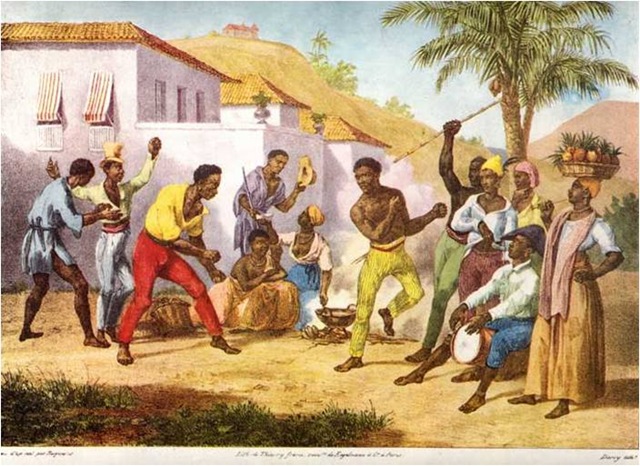
Capoeira was born shortly after the first slave escapes.
The runaways needed something to defend themselves and to attack the “capitães-do-mato” (slave hunters).
And with movements such as ginga, jumps and kicks, what was once a celebratory dance takes on the character of a fight.
História e Origem da Capoeira05:45
Instrumentos da Capoeira

Capoeira na Bahia04:53
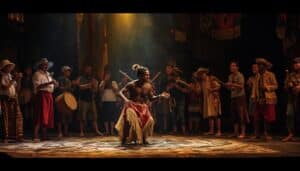
Raízes e Ritmo - A História da Capoeira01:42
See also Capoeira: Learn its origins and discover its history
History of Capoeira: development, tradition and culture
1. Origins of Capoeira
1. African roots
Capoeira has its roots in African traditions brought to Brazil by slaves, mainly from West Africa. Elements of ritual dance, martial arts and music were incorporated into the practice of capoeira, creating a unique art form that served as a means of cultural and physical resistance against the oppression of the slave owners.
2. Slavery and resistance
Between the 16th and 19th centuries, millions of Africans were brought to Brazil as slaves. Salvador, in Bahia, became one of the main entry points and centres of slavery. In this environment, capoeira was born as a form of expression, a means of preparation for self-defence and a way of keeping alive the African cultural heritage.
3. Capoeira in the time of slavery

During slavery and in the years following abolition, capoeira had such an impact that it was banned under penalty of imprisonment or even deportation. Its practitioners were considered idle and disorderly.
The diversity found in Bahia is also reflected in capoeira, which has three variations of fighting styles, music and songs.
The first style of capoeira emerged alongside its development during slavery.
Capoeira Angola, as it is called, corresponds to one of the characteristics of the African Bantu culture, which are some of its religious rituals.
4. Quilombos and Capoeira
Quilombos, communities formed by escaped slaves, were important for the development of Capoeira. Quilombo dos Palmares, for example, is known to have been one of the largest centres of slave resistance, where capoeira was practised as a form of military training and cultural preservation.
Although quilombos were scattered in different regions of Brazil, Bahia was one of the main centres of these resistance communities.
2. Capoeira in Salvador, Bahia
1. Centre of development
Salvador, with its significant Afro-descendant population, was one of the main places where Capoeira developed. The city, with its rich African culture, served as a fertile ground for the growth of this practice. Over time, capoeira became an integral part of Bahia’s culture, reflecting the struggle and resilience of its people.
2. Music and Capoeira Circle
Capoeira in Salvador is characterised by the capoeira circle, where practitioners play and demonstrate their skills.
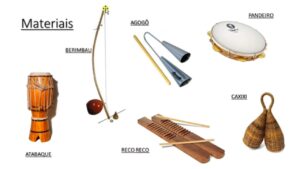
The music, played on traditional instruments such as the berimbau, atabaque and pandeiro, is essential in the circle, guiding the movements and giving rhythm to the game.
The songs generally tell stories of resistance, express a longing for freedom and keep alive the memory of African heritage.
3. Capoeira Angola and Capoeira Regional
In Salvador there are two main forms of Capoeira: Capoeira Angola, which is more traditional and maintains slower movements and rituals, and Capoeira Regional, developed by Mestre Bimba (Manoel dos Reis Machado) in the 1930s, which introduced faster techniques and a formal teaching structure.
3. Recognition and dissemination
1. Persecution and legalisation
During the 19th century, Capoeira was persecuted by the authorities, who considered it a subversive and criminal practice.
However, with the passage of time and the recognition of its cultural importance, capoeira was legalised in 1937.
Salvador played a central role in changing the public perception of capoeira, helping to transform it from a marginalised practice to a symbol of Brazilian cultural identity.
2. Cultural Heritage
In 2008, the Capoeira Circle was recognised as an Intangible Cultural Heritage of Brazil by the National Institute of Historical and Artistic Heritage (IPHAN).
In 2014, capoeira was declared Intangible Cultural Heritage of Humanity by UNESCO. Salvador remains one of the main centres for learning and practising capoeira in the world.
3. International diffusion
From Salvador, capoeira spread to other parts of Brazil and the world, becoming a global form of expression that transcends cultural and linguistic barriers.
Many capoeira masters from Bahia helped to spread the art, teaching in different countries and attracting students from all over the world to learn in their hometown.
4. Effectiveness of Capoeira
The effectiveness of capoeira came in the form of victory in various battles, whether against the social oppression of the time or in wars such as the Paraguayan War.
Its world-famous name comes from “capoeiras”, or areas where the vegetation has been burned and is now growing again.
It was in these areas that the slaves found favourable conditions in their fight for freedom and life.
5. Capoeira Angola
The game of Capoeira Angola is full of wit, magic and elegant movements that follow the rhythm played by the orchestra. One of the most famous masters of Capoeira Angola is Vicente Ferreira Pastinha – Mestre Pastinha.
A disciple of the African master Benedito, Pastinha dedicated his life to teaching Capoeira at his academy in Pelourinho (Centro Esportivo de Capoeira Angola), focusing on breaking down the prejudices against Capoeira that were deeply rooted in society.
In the 1930s, here in Bahia, Manoel dos Reis Machado – known as Mestre Bimba – after 14 years of immersion in the teachings of Capoeira Angola, and seeing the flaws in that style, decided to create Luta Regional Baiana (Bahian Regional Fighting).
Today, the well-known Capoeira Regional is a refined form of Capoeira Angola with about 52 moves.
It was Master Bimba who, through his new approach to teaching Capoeira, managed to include women and later white people and people from other social classes.
He also required his capoeira practitioners to work or study, and even required everyone to wear white uniforms as a form of hygiene.
The history of capoeira shows that it was another way for slaves and their descendants to assert their identity and culture in a prejudiced society.
The latest Brazilian cultural heritage is practised in the streets of the Historic Centre of Salvador, where there are several academies, and in the traditional capoeira circle at the Mercado Modelo. Throughout the rest of the city, there is a gym or capoeira group waiting with open arms for new and old enthusiasts alike.
6. Three styles of Capoeira
There are three styles of Capoeira, which differ in their movements and accompanying musical rhythm.
1. Older style
The oldest style, created during the time of slavery, is Capoeira Angola. The main characteristics of this style are: slow musical rhythm, low strikes (close to the ground) and a lot of malícia (tricks).
2. Regional style
The regional style, created by Mestre Bimba, is characterised by a mixture of the viciousness of capoeira angola with fast movements to the sound of the berimbau.
The punches are fast and sharp and no acrobatics are used.
3. Contemporary style
The third type of capoeira is contemporary, which combines elements of the first two styles.
This last style of capoeira is the most widely practised today. However, it is important to stress that there is only one Capoeira, the Capoeira de Angola, which is considered the mother of all other styles and the closest to the Capoeira played by African slaves.
7. The best places to see Capoeira in Salvador
1. Pillory
- Location: Historic centre of Salvador.
- Description: Pelourinho is one of the most traditional places to see capoeira in Salvador. Every week, especially on Tuesday nights (known as “Terça da Benção”), capoeira circles are organised in the streets and squares of Pelourinho. These events attract both experienced capoeiristas and beginners, as well as tourists who want to experience authentic Bahian culture.
- Tips: Look for the bikes in Praça Terreiro de Jesus and Largo do Pelourinho.
2. Fort of Santo Antônio Além do Carmo (Capoeira Fort)
- Location: Rua Direita de Santo Antônio, Santo Antônio Além do Carmo.
- Description: This historic fort is home to the Mestre Bimba Foundation and is an important centre for capoeira. The site serves as a meeting place for capoeira masters and students, offering regular capoeira circles, classes and performances. It is a great place to see quality capoeira and learn about its history.
- Tips: Check the events calendar before you go, as the fort also offers exhibitions and other cultural activities.
3. Capoeira Angola Association – GCAP (Pelourinho Capoeira Angola Group)
- Location: Rua Gregório de Matos, Pelourinho.
- Description: Founded by Mestre Moraes, one of the leading masters of Capoeira Angola, GCAP is a renowned place where you can watch authentic Capoeira Angola circles. They regularly host capoeira circles and cultural events open to the public.
- Tips: The wheels usually take place on Friday evenings, but it is a good idea to confirm the time before visiting.
4. Model Market
- Location: Commercial area, near the Lacerda lift.
- Description: The Mercado Modelo is not only an important tourist destination for buying handicrafts and souvenirs, but also a place where capoeira shows are often held. Capoeira groups usually perform in the outdoor areas of the market, attracting the attention of tourists.
- Tips: Stop by the Mercado Modelo during the day and you are likely to see capoeira performers.
5. Mestre Bimba Foundation
- Location: Rua Gregório de Matos, Pelourinho.
- Description: Created in honour of Mestre Bimba, the creator of Capoeira Regional, the Foundation promotes classes, circles and cultural events. It is a good place to watch Capoeira Regional and learn about the history and evolution of this style of Capoeira.
- Tips: You can schedule visits and attend scheduled round tables and events.
6. João Pequeno de Pastinha Academy – CIPCD
- Location: Fort of Santo Antônio Além do Carmo.
- Description: Founded by Master João Pequeno, one of the greatest exponents of Capoeira Angola, this academy is dedicated to the teaching and practice of traditional Capoeira Angola. There are regular rodas (circles) and events open to the public.
- Tips: Check the calendar of events on site or contact them in advance.
7. Capoeira classes and retreats on the beach
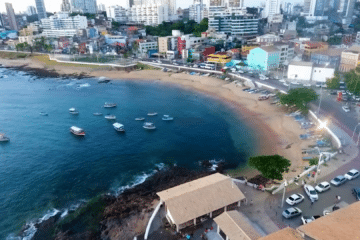
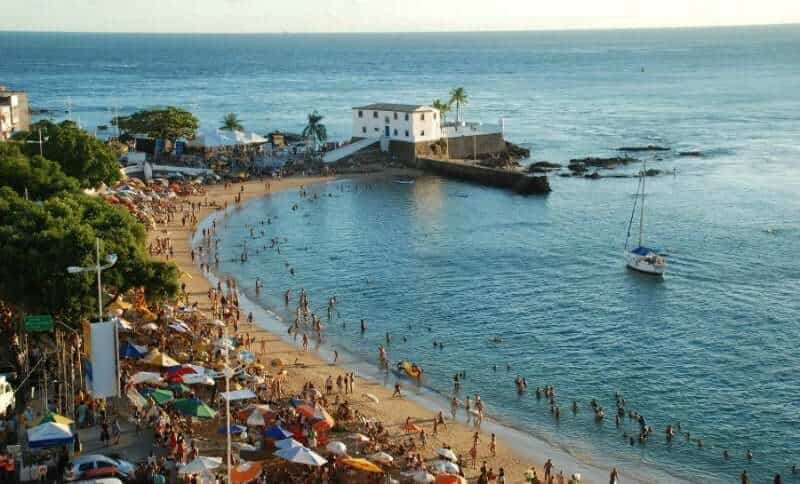
- Location: Beaches such as Porto da Barra, Itapuã and Ribeira.
- Description: Some capoeira schools organise outdoor classes and circles, especially on beaches, where visitors can try capoeira in a more relaxed setting. These sessions are often open to the public and offer an authentic experience.
- Tips: Check with local capoeira schools or ask locals for times and locations of beach circles.
8. Capoeira events and festivals
- Salvador regularly hosts capoeira festivals and events that attract capoeiristas from all over the world. These events offer the opportunity to see capoeira at a high level and to learn from renowned masters. Examples include the Encontro Internacional de Capoeira (International Capoeira Gathering) and the Festival de Capoeira da Bahia (Bahia Capoeira Festival).
- Tips: Check local cultural event calendars or consult capoeira group websites and social media pages for information on dates and locations.
Conclusion.
The history and origins of capoeira in Salvador, Bahia, are a testament to the resilience and creativity of enslaved Africans and their descendants. Capoeira has transcended its roots in resistance to become a cultural emblem of Afro-Brazilian identity, pride and heritage, and continues to influence and inspire generations around the world.
Bahia.ws – Tourist Guide to Salvador, Bahia and the Northeast

Publicações Relacionadas
Monte Santo in Bahia: History and Religious Tourism
European architecture - chronology, styles and characteristics
The culture of Northeastern Brazil: how it originated, influenced and flourished

Musical styles, rhythms, singers and composers of northeastern Brazil

Extreme sports in the Northeast of Brazil: Destinations not to be missed

Influences and main dishes of northeastern cuisine
Brazil's historic moments illustrated in great works
Biography of Victor Meirelles and analysis of the work "The First Mass in Brazil"
Jean-Baptiste Debret: biography and works in Brazil
History of Baroque Architecture in the Northeast and Minas Gerais
Popular Art from the Northeast of Brazil

History, biography and paintings of Frans Post in Dutch Brazil
History and Chronology of the Portuguese Tile Industry
Franciscans in Brazil: Urban, architectural and artistic heritage
Colours of houses and buildings in the colonial architecture of the northeast
King Momo, Pierro, Harlequin and Colombina - Carnival characters

History and Chronology of the Carnival of Salvador de Bahia
History of the introduction of Portuguese tiles in Brazil

Maranhão's handicrafts have more than 400 years of tradition
The influence of Arab architecture on the buildings of Pernambuco
Historic Towns in the Northeast: Explore the Past

Northeastern Brazilian Rhythms: 7 Main Musical Styles
Rural Maracatu: A carnival tradition in the interior of Pernambuco
Woodcuts and Cordel Literature in Northeastern Brazil

Brazil's northeastern subsoil has emeralds and archaeology
History of the 8-bass accordion and its influence on forró
June festivals: Tradition and Culture in the Northeast of Brazil
Bobbin lace and embroidery: predominant handicrafts in Ceará

Diógenes Rebouças and His Architectural Legacy
Turban is Religion, Fashion and Culture in Brazil and the World
Casa Grande & Senzala: The Work of Gilberto Freyre
São Jorge dos Erasmos Sugar Mill: A Landmark in Brazil
Graciliano Ramos: The life and work of the Brazilian writer
Lampião and Cangaço: Between history and mythology
Lampião and the Cangaço: Between History and Mythology

José Américo de Almeida: A Brazilian Literary Icon
This post is also on:
 Português
  English
  Deutsch
  Español
  Français