Capoeira: an Afro-Brazilian cultural expression
Capoeira is an Afro-Brazilian cultural expression that combines elements of martial arts, dance, music and acrobatics.

Origin of Capoeira
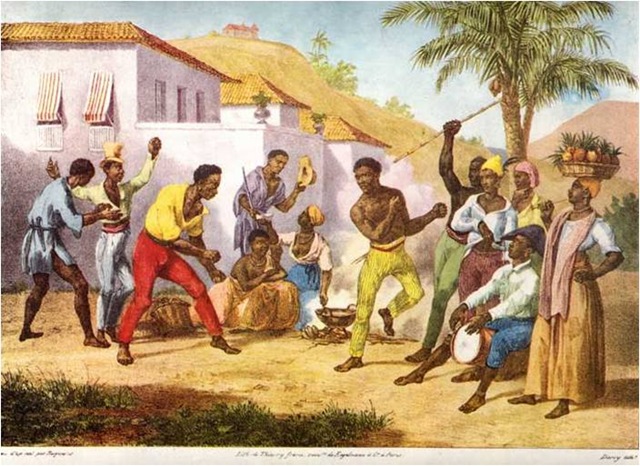
The origins of Capoeira are closely linked to the history of the African slaves brought to Brazil. From the 16th century, thousands of Africans were forced to work on sugar plantations and in other sectors of the Brazilian colonial economy.
Cultural and physical resistance
In this context of oppression, violence and exploitation, African slaves began to develop forms of cultural and physical resistance, of which capoeira is an important expression.
Official history and the oppressed
In official history, priority has always been given to events seen from the perspective of the dominant, resulting in a lack of information about the culture of the oppressed, mainly Indians and Blacks. Because of this situation, this review article aims to describe the origins of capoeira and to rescue its history.
Documentation and oblivion
What little documentation there was from the slavery period was burned in 1890 by order of Ruy Barbosa, Minister of Finance in the government of Deodoro da Fonseca (OLIVEIRA, 1989).
In the absence of such documents, events in the history of capoeira may have been forgotten or distorted over time, since much of what is known today about capoeira as practised by slaves was transmitted orally from generation to generation.
Elements of Capoeira
However, it contains elements of body expression, such as ginga, acrobatics and float, and communication, such as singing and music, Capoeira has remained alive in Brazilian popular culture since the beginning of our history, because it has captivated many who have devoted themselves to it with heart and soul.
Capoeira today
Today, Capoeira is quite widespread throughout the country, but it is very difficult to find documents about its roots.
Video – History and origins of Capoeira in Brazil
História e Origem da Capoeira05:45
Instrumentos da Capoeira

Capoeira na Bahia04:53
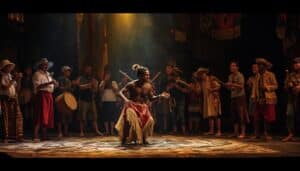
Raízes e Ritmo - A História da Capoeira01:42
HISTORY AND ORIGIN OF CAPOEIRA IN BRAZIL
- BLACKS IN BRAZIL
- SLAVES AND CAPOEIRA
- THE PERSECUTION OF CAPOEIRA
- CAPOEIRA STYLES
- THE MASTERS OF CAPOEIRA
- RHYTHMIC ELEMENTS AND INSTRUMENTS OF CAPOEIRA
- CONCLUSION
1. BLACK PEOPLE IN BRAZIL

The history of Capoeira is closely linked to the history of black people in Brazil. When the Europeans arrived, they needed cheap labour to work the land.
The indigenous people, who were immediately captured, reacted to slavery and could not stand the mistreatment they were subjected to. The colonists then had to look for new slaves and they brought black people from Africa.
Areias (1983), in his work “What is Capoeira”, states that blacks were taken from their homes, placed in the holds of ships and taken to new horizons recently discovered by the great powers of the time.
According to researchers Arnt and Banalume Neto (1995, p. 36):
“Slaves were sold by enemy tribal chiefs or, as in Angola, the Portuguese themselves invaded the interior and kidnapped what they called ‘pieces of India'”.
Petta (1996, p. 51), in his article “The Brazilian Way of Fighting”, comments:
“Scholars say that around 1550 the first African slaves from different tribes arrived in Brazil, bringing with them their customs and cultures”.
Oliveira (1989, p. 21), also known as Mestre Bola Sete, in his book “Capoeira Angola na Bahia”, states that
“The first African slaves to arrive in Brazil, and those who came in greater numbers, were Bantu blacks, originally from Angola”.
When they arrived, they were separated so that no one was with blacks who spoke the same dialect, to prevent them from communicating and rebelling.
The relationship between slave owners and black slaves was one of ownership, resulting from the payment for their acquisition. The slave owners believed that they had the right to demand the hardest work from the slaves.
In this regard, Areias (1996, p. 11) states
Working from dawn to dusk, driven by the whips of their overseers, they cleared the forests, prepared the land, planted the sugar cane and, with the bitterness of their suffering, produced sugar, the sweet wealth of their masters.
In addition to the suffering inflicted on the blacks, the distance from their homeland, combined with all the other adverse conditions they encountered in the new lands, caused them to rebel.

In order to prevent the slave regime from collapsing, more punishments and tortures were inflicted on the slaves.
How could they defend themselves in such an inferior position?
According to Mestre Pastinha (1988, p. 28) in his work Capoeira Angola:
“Black Africans in colonial Brazil were slaves, and in this inhuman condition they were not allowed to use any weapons or means of self-defence that could endanger the safety of their masters”.
2. SLAVES AND CAPOEIRA

Rego (1968, p. 21), author of Capoeira Angola: ensaio sócio-etnográfico, defines the word capoeira as follows:
“Currently, Tupinologists are almost unanimous in accepting the etymology caá, meaning bush, virgin forest, plus puêra, a nominal past tense that means what was and no longer is”.
There are many different opinions among researchers about the true origins of capoeira.
One of the reasons that has contributed to the lack of knowledge about the origins of capoeira is highlighted by Mello (1996, p. 29), who states:
“Ruy Barbosa, when he was Minister of Finance, arguing that he wanted to erase the dark history of slavery, ordered the incineration of a huge amount of documentation relating to that period”.
For some authors and scholars of the subject, capoeira was invented by blacks in Africa, where it existed as a form of ritual dance.
Later, with the process of Brazilian colonialism and the arrival of black slaves from Africa, capoeira appeared here as a form of self-defence for slaves against their oppressors on the plantations (SANTOS, 1990, p. 19).
According to Pastinha (1988, p. 26):
“There is no doubt that capoeira came to Brazil with African slaves”.
For Marinho (1956), there is no doubt that capoeira was brought to Brazil by African Bantu slaves, mainly from Angola.
“For other researchers, scholars of Afro-Brazilian and African culture and historians, capoeira emerged in Brazil through a process of acculturation in favour of human freedom for the black race enslaved by the rulers of colonial Brazil (SANTOS, 1990, p. 19)”.
According to Areias (1983), since African slaves had no weapons to defend themselves against their enemies – the overseers, the plantation owners – driven by their natural instinct for self-preservation, they discovered their own weapon, the art of fighting with their bodies, similar to animal fights, with their punches, kicks, jumps and lunges. They also made use of the cultural expressions they had brought with them from Africa, their dances, songs and movements. Thus was born what we now call Capoeira.
Areias (1996, pp. 15-16) added in a later publication:
“With Mother Nature as their teacher […], using structures brought from Africa […], blacks create and practise a form of self-defence against their enemies”.
Reis (1997a, p. 19), in a similar vein, states:
Capoeira is a Brazilian cultural expression that emerged from the struggle for freedom during the era of slavery.
Some authors have questioned the fact that capoeira only emerged in Brazil, although Africans of Bantu origin were taken to several other countries at the same time.
Capoeira (1998, p. 34), in his work Capoeira – pequeno manual do jogador (Capoeira – a short manual for the player), states:
“We now have an idea of how capoeira came about: a mixture of different martial arts, dances, rituals and musical instruments from different parts of Africa. This mixture took place on Brazilian soil during the time of slavery, probably in Salvador and the Baiano region of the Recôncavo in the 17th century”.
It is also worth mentioning the researcher Rego (1968), who, based on a series of data collected from written documents and, above all, from constant interaction and dialogue with people of that time or earlier who practised capoeira in Bahia, maintains that capoeira originated in Brazil, created by Africans and developed by their Afro-Brazilian descendants.
3. THE PERSECUTION OF CAPOEIRA

Once capoeira emerged and became part of their lives, black people practised it both on farms and in their yards.
However, according to Mello (1996, p. 32),
“This practice was carried out in secret because, since it was used as a weapon of struggle, the plantation owners began to suppress it vehemently, subjecting all those who practised it to terrible tortures”.
Santos (1990, p. 19) notes that in order to ensure the survival of capoeira at that time, capoeiristas, when in the presence of plantation owners, practised it in the form of a game, when in fact they were training.
The berimbau, which was used to set the rhythm, also served to announce the arrival of a feitor, or master, signalling that it was time to transform the fight into a dance.
“In time, our colonisers realised the deadly power of capoeira and banned it, calling it a ‘black art’ (SANTOS, 1990, p. 34).
In the article “A cara de Zumbi” (The Face of Zumbi) by Arnt and Banalume Neto (1995, p. 37) it is stated that blacks were punished for
“Any sign of rebellion was punished. After being whipped, those who escaped were given a cocktail of salt, lemon and urine to drink”.
In his book Zumbi, Santos (1985) recounts that in 1597, forty slaves escaped from a sugar mill in southern Pernambuco and, armed with sickles and clubs, massacred the free population of the farm.
Knowing that they would be hunted down one by one, they ran towards the setting sun. He also said that on the twentieth morning they felt safe because from where they were they could clearly see anyone coming from any direction.
Prata (1987, p. 7), in his article “The Martial Art of Brazil”, says that
“During the Dutch invasions in 1624, slaves and indigenous people (the first two victims of colonisation) took advantage of the confusion and fled to the forests”.
In the forests, blacks formed quilombos, or slave settlements, of which the Quilombo de Palmares was one of the most important, serving as the headquarters for all the other strongholds of fugitive slaves, located in Serra da Barriga, in the state of Alagoas. According to Arnt and Banalume Neto (1995, p. 32), “Palmares began to appear in 1597 and lasted until 1694”.
Santos (1990, p. 19) stresses:
“After the extinction of the existing quilombos, especially that of Palmares, capoeira was already known as a means of attack and self-defence, more precisely in the states of Bahia, Alagoas, Pernambuco, Rio de Janeiro, among other places where slaves were fighting for their freedom”.
Researchers Santos and Barros (2001, p. 1), in an article entitled “The history of capoeira: a brief overview from its origins to modern times”, point out that
“In 1888, slavery was abolished and many slaves were left on the streets without work. Capoeira was one of the means they used to survive”.
Oliveira (1989, p. 22) states:
“Even after the abolition of slavery, capoeira practitioners continued to be persecuted by the police and looked down upon by society. As a result, Areias (1983, p. 31) reports that blacks “mostly joined the already famous capoeira gangs and created others […] The rival Guaiamuns and Nagoas in Rio de Janeiro were the most feared groups of the time […]”.
In 1890, capoeira was considered “forbidden” by the former penal code of the Republic. In the chapter on vagrants and capoeira, article 402 imposed a penalty of two to six months’ imprisonment on anyone who dared to
“to perform, in the streets and public squares, the exercises of agility and physical skill known as capoeira: walking in a line, with weapons or instruments capable of causing bodily harm, promoting disturbance or disorder, threatening specific or unspecified persons, or instilling fear of harm (REGO, 1968, p. 292)”.
Referring to this period, Areias (1983, p. 52) points out:
“[…] transformed into a true acrobatic fight, perfected and mixed with as many tricks as necessary to escape persecution by the powerful, capoeira and capoeiristas managed to survive this turbulent period through cunning and skill”.
In the 1930s, Getúlio Vargas seized power, overthrew President Washington Luis and, according to Capoeira (1999, p. 25), “allowed the (supervised) practice of capoeira: only in closed places and with police permission”.
Areias (1983, p. 65) comments:
“No longer persecuted, the capoeiristas, thirsty for expression, infested the streets and squares of the cities with their capoeira circles. Capoeira was an integral and obligatory part of all popular festivals”.
Dossar (1991, p. 42) states:
“The first academy that formally taught capoeira was founded by Manoel dos Reis Machado in 1932”.
Mello (1996, p. 34) provides valuable information:
“An important figure in the history of capoeira appears: Manoel dos Reis Machado, known as Mestre ‘Bimba'”.
4. THE STYLES OF CAPOEIRA

Capoeira (1985) mentions that there are several styles of capoeira, but the only fundamental ones are the traditional Angolan style and the regional Bimba style.
4.1. Capoeira Angola
Capoeira (1998) states that the traditional style, called Capoeira Angola, was practised at the Academia de Pastinha.
In his book Capoeira Angola, Pastinha (1988, p. 27) states:
“The name Capoeira Angola is a consequence of the fact that the Angolan slaves in Bahia were the ones who excelled most in its practice”.
Pastinha (1988, p. 28) adds that
Capoeira Angola resembles a graceful dance in which the mischievous ‘ginga’ shows the extraordinary flexibility of the capoeiristas. But Capoeira Angola is above all a fight, and a violent one at that.
Oliveira (1989, p. 179), in his book A Capoeira Angola na Bahia, states:
“The Master Angloiro tries to transmit to his pupil the veneration of the rituals and rules that exist in Capoeira Angola, and at the same time prepare him to defend himself, without interfering with his creative potential, giving him a large dose of malice, based on calmness and speed”.
4.2. Regional Capoeira
Almeida (1994) noted that Bimba used an ancient form of fighting in Bahia called ‘Batuque’ – in which his father was a champion – as well as Capoeira and his creative genius to create a new style he called Capoeira Regional.
Bimba said in the book A Saga de Mestre Bimba (The Saga of Master Bimba), by Almeida (1994, p. 17):
“In 1928 I created Regional, which is Batuque mixed with Angola, with more moves, a real fight, good for the body and the mind.”
Regarding the creation of Regional Capoeira, Vieira (1998, p. 1) states:
“When the Regional was born, there was already a well-established tradition of Capoeira, especially in the street circles of Rio de Janeiro and Bahia”.
Capoeira (1998, p. 52) emphasises:
“With Bimba’s academy, a new era began: capoeira would attract the middle class and bourgeoisie of Salvador. Before that, capoeira (in Bahia) was practised exclusively by Africans and their descendants, that is, the economically poor classes”.
According to Capoeira (1998, p. 52):
“The teaching method, the new moves and the new way of thinking, combined with the fact that most of Bimba’s students belonged to the middle class, with different values, made Bimba’s style very different from traditional capoeira”.
5. THE MASTERS OF CAPOEIRA
5.1. Master Pastinha
Vicente Ferreira Pastinha, known as Mestre Pastinha, was born in the city of Salvador on 5 April 1889. Oliveira (1989, p. 32) reports that Pastinha was the son of José Señor Pastinha, a Spaniard, and Raimunda dos Santos, a black woman from Bahia.
Regarding Mestre Pastinha’s teachings, the book Capoeira (1998, p. 54) states that
“He was initiated as a boy by a black man from Angola named Benedito, who constantly saw the boy being beaten up by an older boy”.
Capoeira (1998, p. 55) states:
“Pastinha opened his academy a few years after Bimba’s, and there he practised the traditional style, which, to distinguish it from the regional style, he began to call Capoeira Angola. Some authors refer to it as “old” or “outdated”, since it predates “regional capoeira”.
Despite practising this sport, which he considered violent, Mestre Pastinha was a very popular person.
Capoeira (1998, p. 55) states:
“With his charisma, his energy and his kind and friendly personality, Pastinha transformed his academy into a place frequented by great angoleiros and artists such as Carybé and Jorge Amado”.
Although he dedicated his whole life to Capoeira, Mestre Pastinha was not properly recognised.
The author of “Capoeira” (1998, p. 57) reports:
“Already old and almost blind, the authorities took away his gym under the pretext of renovating Largo do Pelourinho. Although they promised a new gym, they never delivered. Mestre Pastinha lived the last years of his life in a small room”.
Oliveira (1989, p. 32) said that Mestre Pastinha “was considered by the most famous masters of his time to be the most perfect capoeira angola fighter in Bahia”.
He also gave a brief overview of Pastinha’s professional life:
He spent eight years in the navy, where he was a musician and capoeira instructor, played football and even trained with Ypiranga, his favourite team. […] he was a shoeshine boy, sold newspapers, practised fencing, helped build the port of Salvador, was a tailor, worked as a miner and also ran a gambling den where he was the bouncer, […]. But all this was fleeting in the master’s life, his desire was to live from his art, because besides being a capoeirista, he was also a painter and popular poet”.
Regarding the result, Capoeira (1998, p. 57) says
He died in 1981 at the age of ninety-two, leaving behind many students, the most famous of whom are Master João Grande and Master João Pequeno.
5.2. Mestre Bimba
Manoel dos Reis Machado, known as Mestre Bimba, was born on 23 November 1900 in the neighbourhood of Engenho Velho, Freguesia de Brotas, in Salvador, Bahia.
Almeida (1994, p. 15) says that:
“At the age of 12, Bimba, the youngest son of D. Martinha, began to practise capoeira on Estrada das Boiadas, today the large black neighbourhood of Liberdade. His master was the African Bentinho, captain of the Bahia Shipping Company”.
Almeida (1994, p. 16) reports that after some time of practicing capoeira, Bimba:
“He began to feel that capoeira, which he had been practising and teaching for a long time, had become folkloric, […] that it was being used for exhibitions in public places and, because its powerful, deadly moves had been eliminated, it left much to be desired in terms of fighting”.
Capoeira (1985, p. 48) states that:
“Manoel dos Reis Machado […] was one of the greatest capoeira fighters of his time. An excellent player, a dangerous fighter, an exceptional and creative berimbau player, a talented singer, he was a man with a strong and striking personality”.
Capoeira (1985, p. 48) reports that Bimba
“He left the capoeira angola circles of his time and opened his own academy around 1930, where he began to teach his style of capoeira, which came to be known as ‘regional'”.
Vieira (1998, p. 2) said that:
“With the emergence of Mestre Bimba, the world of capoeira began to divide into two parts, with some focusing on the preservation of traditions and others seeking to develop a faster form of capoeira geared towards combat”.
In Almeida (1994, p. 17), Bimba recalls:
“Until 1918 there were no capoeira schools. There were capoeira circles on street corners, at warehouse doors, in the middle of the forest. The police forbade it, and once I paid them 100 contos de réis to let us play for two hours”.
According to Vieira (1998, p. 139):
“Towards the end of his life, Bimba moved to Goiânia in 1973 […]. He died in Goiânia on 5 February 1974, the victim of a stroke”.
6. RHYTHMIC ELEMENTS AND INSTRUMENTS OF CAPOEIRA

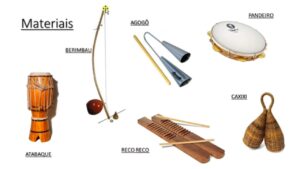
Capoeira is the only Brazilian martial art that uses musical instruments.
Capoeira circles are rhythmed by the sound of the instruments and the clapping of the capoeiristas.
According to Rego (1968, p. 70), the musical accompaniment of capoeira, from its beginnings to the present day, “has been provided by the berimbau, pandeiro, adufe, atabaque, ganzá or reco-reco, caxixi and agogô”.
Mestre Pastinha (1988, p. 36) states: “The instruments that make up the ensemble are: berimbau, pandeiro, reco-reco, agogô, atabaque and chocalho”.
6.1. Berimbau
The berimbau is an instrument made from a wooden stick, traditionally biriba wood, with a steel wire, and the resonating body is a dried gourd. Freitas (1997, p. 67) states that
“The berimbau is one of the oldest instruments in the world, originating on the African continent about fifteen thousand years before Christ”.
Rego (1968, p. 71) admits that “the berimbau did not exist only for capoeira; it was used by Afro-Brazilians in their celebrations and especially in the samba de roda […]”.
Even before it was incorporated into capoeira, the berimbau was used in other ways. Reis (1997b, p. 201) comments:
“The so-called belly berimbau appears in the iconography of chroniclers who visited Brazil in the 19th century, generally associated with street trading and begging”.
Freitas (1997, p. 66) states that “the berimbau was the last instrument to become part of capoeira, at the end of the 19th century”.
Almeida (1994, p. 77) tells how Mestre Bimba made the berimbau:
“The wood […] had to be ‘biriba’. He removed the steel wire from old tyres, […] the pumpkin was opened with a sharp knife, then he removed the seeds and sanded it with fine sandpaper”.
Only when everything was ready would Master Bimba begin to assemble his berimbau.
According to “Capoeira” (1998, p. 83),
“The berimbau is held firmly in the left hand together with a coin which, when struck against the steel string, produces two musical notes”.
Pastinha (1988, p. 36) adds:
“The right hand holds the stick with the thumb, index and middle fingers, leaving the little and ring fingers free to hold the caxixi”.
Regarding the technique of playing the instrument, Capoeira (1998, p. 83) teaches:
“By moving the instrument closer or further away from the body, and by pressing the coin with different force, we can achieve some variations in the two basic tones”.
It is well known that in capoeira, the sound of the berimbau is fundamental in guiding the game played by the capoeiristas. Areias (1983, p. 93) states: “there are different types of games, always dominated by the sound of His Excellency, the berimbau”.
According to Mestre Pastinha (1988, p. 41),
“The berimbau is tuned by raising or lowering the string that connects the sound box (gourd) to the wire or string”.
There are also different berimbau rhythms, and Oliveira (1989, p. 61) explains that “some have undergone modifications and others were invented by certain masters, and there is also considerable confusion about their original names”. Capoeira (1998) comments on berimbau rhythms that some are known and played by everyone, such as Angola, São-Bento-Pequeno and São-Bento-Grande.
Reis (1997b, p. 203) comments:
“The berimbau is not only responsible for the style and type of game played, it also determines the rhythm of the capoeira songs, which include ladainhas, quadras and cantos corridos”.
6.2. Tambourine
The pandeiro is a percussion instrument that is also traditional in capoeira circles. Rego (1968, p. 80) states that,
“In Brazil, the tambourine was introduced by the Portuguese in the first procession held in Brazil, that of Corpus Christi, in Bahia on 13 June 1549”.
After that, it was used by the blacks in their festivities.
Freitas (1997, p. 75) comments:
“In capoeira, thin leather tambourines are more often used, not only because of the tradition of the old capoeira masters, but also because of the sound they produce. Leather tambourines produce a more primitive, muffled sound that is pleasant to listen to”.
6.3. Reco-reco
The reco-reco is a primitive musical instrument made of bamboo. Rego (1968, p. 85) describes it as follows:
“The ganzá, or reco-reco as it is called in Bahia, is made from a piece of bamboo with transverse grooves over which a metal rod is passed”.
6.4. Agogô
Rego (1968, p. 87) states that “the agogô is a percussion instrument made of iron that was brought to Brazil from Africa”. The author also reports that the term agogô belongs to the Nago language and means bell.
6.5. Atabaque
The atabaque, a percussion instrument used in Afro-Brazilian ceremonies, is often found in capoeira circles. Rego (1968, p. 83) states: “The term atabaque is of Arabic origin and is unanimously accepted by Arabic etymologists”.
Rego (1968, p. 85) says:
“Although Africans were already familiar with the atabaque, and some types even came from Africa, I believe that when they arrived in Brazil, they found that it had already been brought by the Portuguese to be used in festivals and religious processions, in circumstances similar to those of the pandeiro and the adufe”.
According to Vieira (1998, p. 106):
“The use of the atabaque is resisted by older masters because this instrument produces a loud sound that prevents capoeiristas from distinguishing the beat played by the berimbau”.
For those who use this instrument in capoeira circles, Capoeira (1985, p. 58) teaches:
“Those who play the atabaque must be aware that if they hit the skin too hard, they will drown out the sound of the berimbaus. [
They must find the right volume to provide support and mark the spot where the berimbaus can be heard”.
6.6. Caxixi
The caxixi is a small closed basket containing seeds, used in the game of capoeira in Bahia and also in Candomblé (Cascudo, 1972).
According to Rego (1968, p. 87),
“The caxixi is a small rattle made of straw, woven with a gourd base, cut into a circular shape with a straight top, and ending with a handle made of the same straw”.
The dried seeds inside the gourd give it its characteristic sound when shaken. The gourd is usually played with the hand that holds the stick, along with the berimbau.
7. CONCLUSION
Based on the analysis of the theoretical framework used, and taking into account the limitations of the study, it can be concluded that the history of capoeira is closely linked to the black population in Brazil.
One of the reasons that contributed to the lack of knowledge about the origins of capoeira was the fact that Ruy Barbosa, when he was Minister of Finance, ordered the incineration of a huge amount of documentation relating to this period, arguing that it would erase the dark history of slavery.
Most authors claim that capoeira was brought to Brazil by Bantu slaves.
For a long time, capoeira was disguised and hidden from plantation owners and overseers.
Today, it is considered a cultural expression born out of the black struggle for freedom. Even after the abolition of slavery, capoeira was persecuted and classified under the old penal code.
Mestres Pastinha and Bimba are considered the representatives of the Angolan and regional styles of capoeira, respectively. The rhythmic part of capoeira is mainly driven by the berimbaus and pandeiros, with the addition of instruments such as the reco-reco, agogô and atabaque.
REFERENCES
- ALMEIDA, Raimundo César Alves de. The legend of Master Bimba. Salvador: Ginga Capoeira Association, 1994.
- AREIAS, Almir das. What is Capoeira. 2nd edition, São Paulo: Brasiliense, 1996.
- AREIAS, Anande das. What is Capoeira. 4th edition. São Paulo: Ed. da Tribo, 1983.
- ARNT, Ricardo; BANALUME NETO, Ricardo. The face of Zumbi. Magazine Superinteressante, São Paulo, year 9, nº 11, pp. 30-42, Nov. 1995.
- CAPOEIRA, Nestor. The “rhetoric of the body” of Getúlio Vargas and its reflections in Capoeira today. Revista Camará Capoeira, São Paulo, year 1, no. 5, pp. 25-27, Nov. 1999.
- CAPOEIRA, Nestor. Capoeira: pequeno manual do jogador (Capoeira: a short manual for the player). 4th edition. Rio de Janeiro: Record, 1998.
- CAPOEIRA, Nestor. Galo já cantou (The Rooster Crowed). Rio de Janeiro: Arte Hoje, 1985.
- CASCUDO, Câmara. Dictionary of Brazilian Folklore. 3rd edition. Rio de Janeiro: Ediouro, 1972.
- DOSSAR, Kenneth. Capoeira: an African-based tradition in the United States. Joperd, Reston, v. 62, no. 2, pp. 42-44, Feb. 1991.
- FREITAS, Jorge Luiz de. Capoeira infantil: the art of playing with the body. Curitiba: Editora Abadá, 1997.
- MARINHO, Inezil Penna. Contributions to the History of Capoeira in Brazil. Rio de Janeiro: Tupy, 1956.
Origin and history of Capoeira in Brazil

Publicações Relacionadas

Arembepe: beaches (Piruí, Praia do Canto), Hippie Village and the Tamar Project

Paranaguá Palace — History, architecture and visiting information | Ilhéus (BA)

São Jorge Parish Church in Ilhéus — history, architecture and religious art

History of the Convent and Church of Nossa Senhora da Piedade in Ilhéus

São Sebastião Cathedral (Ilhéus) — History, architecture and tourism

The 15 Most Visited and Well-Known Beaches in Bahia

The 3 most paradisiacal beaches in Bahia

Skydiving, Paragliding and Ballooning in Bahia

Historic Towns in Bahia: A Journey Through Time
Places to visit on the south coast of Bahia

História da Arte - Caracteristicas, Aspectos e Periodos
Tourist Attractions in Bahia: main attractions, beaches and cities

Subaúma, Bahia: where it is, things to do and where to stay

Massarandupió Naturist Beach, Bahia: Rules and Access

Beaches on the South Coast of Bahia: 10 Best and Tips

Towns and the Abrolhos Archipelago — The southernmost tip of Bahia

Baixio: Between lagoons, dunes and the charm of a village surrounded by nature

Best Beaches in Bahia: Your Guide to Paradise
Salinas da Margarida (BA) — Beaches, Attractions and a Complete Guide

Guarajuba Beach, Bahia: Natural Pools and Tips

Barra do Cahy: Brazil's first beach - history and nature

Garcez Beach: Discover Paradise in Jaguaripe

Barreiras: An Ecological Paradise in Bahia
Catabrigas Waterfall — A natural haven in Ibirajá, Itanhém (BA)

Serra Grande: Your Guide to Bahia's Paradise

Corumbau, Bahia: Ponta de Corumbau, beaches, map, how to go

Taipu de Fora: Discovering Natural Pools

Iguaí: A Guide to Waterfalls and Relaxation

Morro de São Paulo: Map, Beaches & How to Get There (2026)
Tourism in São Francisco do Conde (BA) — Tips and Attractions
Todos-os-Santos Bay (Bahia) — History, geography and conservation
Todos os Santos Bay — Nature, History and Water-based Tourism
Bay of Todos os Santos: nature, history and cultur

Rafting in Taboquinhas: The Ultimate Adventure Guide

Abseiling Sites in Bahia: Top Locations to Explore

Diving Spots in Bahia: Discover Underwater Treasures
This post is also on:
 Português
  English
  Deutsch
  Español
  Français