The history of Afro-Brazilian religions begins with the forced encounter between the African peoples brought over by slavery and the Indigenous and European cultures of Brazil. Out of this coexistence, distinct traditions were born, such as candomblé and umbanda, which are linked by common roots and by a long path of resistance.
- Main religions: candomblé, umbanda, tambor de mina (MA), xangô (PE) and batuque (RS).
- Candomblé: worship of the orixás, voduns and inquices, with Yoruba, Jeje and Bantu roots; moreover, it became consolidated in Bahia in the 19th century.
- Umbanda: a Brazilian religion that emerged in Rio de Janeiro in the early 20th century, with African, Indigenous, Catholic and Spiritist influences.
- Followers: about 1.8 million people (1% of the population) declared themselves followers of umbanda or candomblé in the 2022 Census, which is three times the 2010 figure.
- Dates: November 15 (National Umbanda Day) and January 21 (National Day to Combat Religious Intolerance).

Video about the history of Afro-Brazilian religions

Religiões afro-brasileiras47:35

Religiões afro-brasileiras - Documentário09:39

História, mitos e verdades sobre a religião Umbanda12:03

7 DIFERENÇAS ENTRE UMBANDA E CANDOMBLÉ06:27
What are Afro-Brazilian religions?
First of all, Afro-Brazilian religions are traditions of African origin that took shape in Brazil from the colonial period onward. Although they share common roots, each one has its own doctrine, rituals and organization.
Regional variety
In addition, these practices vary according to the region and local history:
- Northeast: Bahian candomblé, tambor de mina (Maranhão) and xangô (Pernambuco);
- Southeast: above all candomblé and umbanda, which are very present in Rio de Janeiro and São Paulo;
- South: the batuque of Rio Grande do Sul. In fact, Rio Grande do Sul has the highest proportion of followers in the country, with 3.2% of the population in the 2022 Census.
In this way, this diversity shows both the endurance of African cultures and their adaptation to the Brazilian context.
Furthermore, Afro-Brazilian religions belong to a larger family linked to the African diaspora in the Americas. Among them are Haitian vodou, Cuban santería, obeah and kumina from Jamaica, and winti from Suriname.

Candomblé: origin and beliefs
Candomblé results from the preservation and reworking of traditional cults from West and Central Africa, which were brought to Brazil between the 16th and 19th centuries through the trade in enslaved people. It is, therefore, a complex religious system that brings together beliefs, rituals, music, dance, language and community life. To learn more, see our post about candomblé, its origin and history in Bahia.
The Supreme Being and the deities
In candomblé, practitioners believe in a Supreme Being whose name varies according to the nation: Olorum (or Olodumare) in the Yoruba traditions; Mawu or Avievodun among the Jeje; and Nzambi in the Bantu branches. However, this Supreme Being is not worshipped directly. Instead, the connection between the divine and the human world takes place through the deities:
- Orixás, in the nations of Yoruba origin, such as ketu and nagô;
- Voduns, in the Jeje traditions, which are of Fon origin;
- Inquices, in the Bantu branches, such as angola and congo.
In turn, the orixás have their own personalities and are linked to elements of nature, such as rivers, seas, winds and forests, as well as to aspects of life, such as justice, motherhood and work. Although West Africa recognizes hundreds of orixás, Brazilian candomblé worships around 16 main deities, depending on the tradition of each terreiro.
Repression and syncretism
Indeed, during slavery, the colonial authorities and the Catholic Church classified African practices as witchcraft. As a result, there were persecutions, arrests and the destruction of terreiros.
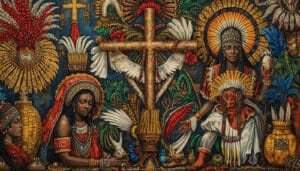
To protect their deities, many believers therefore turned to religious syncretism, associating the orixás with Catholic saints. For example:
- Iemanjá with Our Lady of the Conception;
- Iansã with Saint Barbara;
- Oxóssi with Saint George in Bahia and, in contrast, with Saint Sebastian in Rio de Janeiro;
- Xangô with Saint Jerome or Saint John, depending on the region.
Thus, syncretism worked as a strategy of resistance. Today, however, many terreiros advocate ending this association in order to affirm the African identity of their worship.
Rituals, language and music
In general, ceremonies take place in the terreiros (places of worship and community) or houses of saint, where initiations, public festivals for the orixás and services to the community are held. However, part of the rituals is reserved for initiates and may include the ritual offering of animals, which is understood as an exchange of axé (vital energy) with the deities.
In addition, the ceremonies use liturgical African languages, such as ritual Yoruba. The atabaques also play a central role, since each rhythm is linked to an orixá. Learn more about the rhythm of candomblé and the invocation of the orixás.

Candomblé and Brazilian culture
For centuries, the terreiros preserved languages, memories, cuisine, music and forms of community organization. For this reason, elements of candomblé, such as its rhythms, ritual cuisine and the festivals of Iemanjá, still influence music, literature and the arts in Brazil today.
While the terreiros were once attended almost exclusively by Black people, candomblé now also brings together believers of different backgrounds. Even so, the religion remains central to the affirmation of Black identity.
Umbanda: origin and principles
Umbanda, on the other hand, is a Brazilian religion that became consolidated in the early 20th century in Rio de Janeiro. Thus, it combines elements of African traditions, Catholicism, Kardecist Spiritism and Indigenous traditions.
The origin of umbanda
According to umbanda tradition, the religion was born on November 15, 1908, in Niterói (RJ). On that date, the medium Zélio Fernandino de Moraes is said to have received the entity Caboclo das Sete Encruzilhadas, who announced the new form of worship. For this reason, November 15 is National Umbanda Day, established by federal law in 2012.
In the following decades, Zélio and other mediums founded centers and organized rituals and principles that set umbanda apart from candomblé. In 1941, for example, the First Congress of Umbanda Spiritism took place in Rio de Janeiro.
Influences
- African traditions: above all cabula, of Bantu origin, and candomblé, which inspire the use of atabaques and incorporation (spirit embodiment).
- Catholicism: responsible for the association between orixás and saints.
- Kardecist Spiritism: brings the ideas of reincarnation, spiritual evolution and communication with spirits.
- Indigenous traditions: present in the caboclos, as well as in the use of herbs and smoke cleansing.
Principles of umbanda
According to the umbanda federations, the religion believes in one single creator God, called Olorum or Zambi. In addition, umbanda holds the following principles:
- reincarnation, as a path of learning and evolution;
- the law of cause and effect (karma), whereby actions influence one’s spiritual path;
- mediumship, understood as an instrument of charity;
- and, above all, charity, the central ethical axis of the religion.

Guides and entities
During the rituals, umbanda mediums incorporate guides, entities that guide and advise those who come for consultation. Among the main lines are:
- Caboclos: spirits linked to Indigenous peoples, to nature and to strength;
- Pretos-velhos: spirits of formerly enslaved elders, who are symbols of humility and wisdom;
- Erês or children: linked to joy and purity;
- Exus and pombagiras: guardians associated with protection, with paths and also with matters of the heart.
Contrary to what prejudice claims, these entities are not “demons”. For umbanda practitioners, they are instead evolving spirits dedicated to the work of helping others.
The giras
In general, the rituals take place in terreiros, centers or tents, in the so-called giras (ritual gatherings). In them, for example, the pontos (sacred chants) are sung in Portuguese to the sound of atabaques. In addition, there is smoke cleansing with herbs, as well as candles, images and pontos riscados (sacred drawn symbols). As a rule, the giras are open to the public and focused on spiritual assistance.

Differences between umbanda and candomblé
| Candomblé | Umbanda | |
|---|---|---|
| Origin | African cults reworked in Brazil; consolidated in Bahia in the 19th century | Brazilian religion from the early 20th century, in Rio de Janeiro |
| Worship | Orixás, voduns and inquices | Spirit guides (caboclos, pretos-velhos, erês, exus) and also orixás |
| Language | Liturgical African languages | Portuguese |
| Rituals | Long initiation, obligations and public festivals | Giras open to the public, with incorporation and spiritual assistance |
| Organization | Strict hierarchy, led by an ialorixá or babalorixá | More flexible, instead led by leaders, pais or mães de santo |
In short, both share African roots. While umbanda is more syncretic and focused on communication with spirits, candomblé preserves African traditions and liturgies more strictly.

Persecution, resistance and recognition
Police repression
From the colonial period until well into the 20th century, Afro-Brazilian religions were persecuted. In the republican period, for example, the Penal Code of 1890 punished “quackery” and the “practice of magic”. As a result, terreiros were closed, sacred objects were seized, and pais and mães de santo were arrested.
In Bahia, terreiros even needed a police license to operate, a requirement that was only lifted in 1976. Consequently, many groups declared themselves “Spiritist” or “white table” (mesa branca) groups, thus moving closer to Kardecist Spiritism, which was more socially accepted.
The internal diversity of umbanda
As a consequence of this repression, many groups of African origin began to call themselves umbanda groups in order to escape persecution. Thus, umbanda gained great internal diversity, with several lines and branches, some closer to Spiritism and others closer to candomblé.

Recognition and heritage
In recent decades, however, there has been important progress:
- in 1984, the Terreiro da Casa Branca in Salvador became the first terreiro listed as heritage by IPHAN (Brazil’s National Historic and Artistic Heritage Institute);
- later, the 1988 Constitution guaranteed freedom of worship;
- Law 10.639/2003 then made the teaching of Afro-Brazilian history and culture mandatory in schools;
- finally, Law 11.635/2007 created the National Day to Combat Religious Intolerance (January 21), in memory of Mãe Gilda, an ialorixá from Salvador.

Afro-Brazilian religions today
In the 2022 Census, about 1.8 million people, or 1% of the population, declared themselves followers of umbanda or candomblé. In 2010, by contrast, there were about 589,000. In other words, the number tripled in 12 years. Moreover, many people attend terreiros without declaring themselves followers.
Even so, these religions continue to face challenges:
- intolerance and religious racism, with attacks on terreiros and on believers;
- misinformation about their principles and rituals;
- continuity of oral traditions, which are passed down from generation to generation;
- and, finally, the use of sacred symbols without respect for their religious meaning.
On the other hand, appreciation of these traditions is growing, especially among young Black people, as is their presence on the internet, in universities and in interfaith dialogue.

In summary, Afro-Brazilian religions were born from the violence of slavery, but they asserted themselves as expressions of resistance, creativity and faith. Therefore, knowing their history is essential to combat religious racism and to value Brazil’s diversity.

Frequently asked questions about the history of Afro-Brazilian religions
What are the Afro-Brazilian religions?
Without a doubt, the best known are candomblé and umbanda. Besides these, there are also tambor de mina, the xangô of Pernambuco, the batuque of Rio Grande do Sul and omolokô.
What is the difference between candomblé and umbanda?
First of all, candomblé worships the orixás, voduns and inquices, with rituals in African languages. Umbanda, on the other hand, is a 20th-century Brazilian religion, with spirit guides and rituals in Portuguese.
When did umbanda emerge?
According to tradition, it emerged on November 15, 1908, in Niterói (RJ), through the medium Zélio Fernandino de Moraes.
For this reason, this is the date of National Umbanda Day.
How many people follow Afro-Brazilian religions?
According to the 2022 Census, about 1.8 million people declared themselves followers of umbanda or candomblé, that is, 1% of the population.
What is religious syncretism?
In other words, it is the association between orixás and Catholic saints, such as Iemanjá and Our Lady of the Conception.
Thus, during slavery, syncretism helped to protect African forms of worship.
When is the National Day to Combat Religious Intolerance?
It is on January 21, a date created in 2007 by Law 11.635 in memory of Mãe Gilda, an ialorixá from Salvador.

Publicações Relacionadas

Monte Santo in Bahia: History and Religious Tourism
European architecture - chronology, styles and characteristics
The culture of Northeastern Brazil: how it originated, influenced and flourished

Musical styles, rhythms, singers and composers of northeastern Brazil

Extreme sports in the Northeast of Brazil: Destinations not to be missed

Influences and main dishes of northeastern cuisine
Brazil's historic moments illustrated in great works
Biography of Victor Meirelles and analysis of the work "The First Mass in Brazil"
Jean-Baptiste Debret: biography and works in Brazil

History of Baroque Architecture in the Northeast and Minas Gerais

Popular Art from the Northeast of Brazil

History, biography and paintings of Frans Post in Dutch Brazil

History and Chronology of the Portuguese Tile Industry
Franciscans in Brazil: Urban, architectural and artistic heritage
Colours of houses and buildings in the colonial architecture of the northeast
King Momo, Pierro, Harlequin and Colombina - Carnival characters

History and Chronology of the Carnival of Salvador de Bahia

History of the introduction of Portuguese tiles in Brazil

Maranhão's handicrafts have more than 400 years of tradition

The influence of Arab architecture on the buildings of Pernambuco
Historic Towns in the Northeast: Explore the Past

Northeastern Brazilian Rhythms: 7 Main Musical Styles
Rural Maracatu: A carnival tradition in the interior of Pernambuco

Woodcuts and Cordel Literature in Northeastern Brazil

Brazil's northeastern subsoil has emeralds and archaeology
History of the 8-bass accordion and its influence on forró
June festivals: Tradition and Culture in the Northeast of Brazil

Bobbin lace and embroidery: predominant handicrafts in Ceará

Diógenes Rebouças and His Architectural Legacy
Turban is Religion, Fashion and Culture in Brazil and the World
Casa Grande & Senzala: The Work of Gilberto Freyre

São Jorge dos Erasmos Sugar Mill: A Landmark in Brazil

Graciliano Ramos: The life and work of the Brazilian writer
Lampião and Cangaço: Between history and mythology
Lampião and the Cangaço: Between History and Mythology

José Américo de Almeida: A Brazilian Literary Icon
This post is also on:
 Português
  English
  Deutsch
  Español
  Français