Rei Momo, Pierrô, Arlequim and Colombina are the best known and most traditional Carnival characters and can be seen at parties and in marchinhas.
The colourful costumes of these characters gave rise to the costumes worn at Carnival balls and are part of the joys of this popular festival.

Video – Brazilian Carnival and Commedia dell’Arte characters
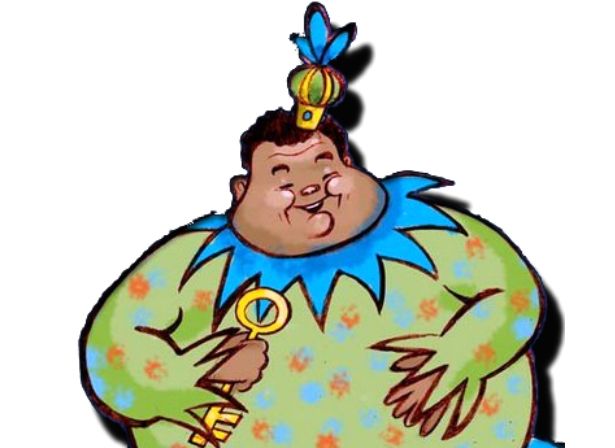
História do Rei Momo - Carnaval00:57

Pierrô, Arlequim e Colombina - Carnaval - Commedia dell’Arte03:13
CARNIVAL CHARACTERS
1. KING MOMO
Rei Momo is the figure of a big, smiling and charismatic man, the symbol of the Brazilian Carnival. There are various myths about how he arrived in Brazil and became an important figure in national folklore during this festive season.

Son of Sleep and Night, he was concerned only with scrutinising the actions of gods and men, even going so far as to reprimand them. Considered the God of Mercy, he had a very jocular character.
He was depicted with a mask in one hand and a ridiculous figure in the other, to suggest that he removed the mask from people’s vices and laughed at their folly.
He was elected Judge of the Works of Neptune, Vulcan and Minerva: none of them he considered perfect.
- He criticised Ne ptune because when he composed a bull, he didn’t put horns on it.
- He criticised the man forged by Vulcan because he did not make a window in his heart to see his secret thoughts.
- He criticised the house built by Minerva because it couldn’t be moved (according to Greco-Roman mythology).
King Momo also has a connection with ancient popular theatre, being an actor who performed in popular farces. He was one of the court jesters who entertained the Portuguese masters and lords with pantomimes and satires.
2. HARLEQUIN
A character from the ancient Italian comedy, Commedia dell’Arte, the Harlequin wore a multi-coloured costume made of lozenges. At first, his job was to entertain the audience during the interval with jokes and buffoonery.
Later he became part of the plots of comedies and one of their most important characters.
Harlequin is Colombina’s lover and is described as farcical, trickster, braggart, quarrelsome, cynical and passionate.
3. COLOMBINA
The main female character in Commedia dell’Arte, Colombina is Harlequin’s lover and Pierro’s companion. She is described as:
- flirtatious, cheerful, futile, beautiful, smart, seductive and voluble.
She wore silk or white satin dresses, a short skirt and an elegant cap. 3.
4. PIERRO
Also from the Commedia dell’Arte, the Pierro is naive and sentimental.
His costume includes
- wide trousers and jacket, decorated with pom-poms and a ruffled collar.
Who are Pierro, Harlequin and Colombina?
Learn about the origins of three of the main characters of Carnival, who first appeared in a Manners Satire that was very popular in Italy.
They are characters from the Commedia dell’Arte, a style of theatre that originated in 16th century Italy and is known for its social satires and improvisations.
In the plot, they form a love triangle:
- Pierrô loves Colombina,
- Colombina loves Harlequin,
- and Harlequin also wants Colombina.
This style emerged as an alternative to the Commedia Erudita, written in Latin, which was inaccessible to the majority of the population. Thus the story of the Trio enamorado became a real popular entertainment with roots in carnival jokes.
Performed in the streets and squares, it satirised the lives of the powerful. Other Commedia characters included:
- Pantaleon, a greedy merchant;
- The Doctor, a pompous intellectual;
- The Captain, a cowardly and tyrannical officer;
- Isabella and Oracio, children of the bosses;
- Various other servants.
The plays followed a fixed plot, but with a lot of improvisation, requiring comic talent and agility from the actors.
“To this day, Commedia dell’Arte is a very rich method of learning and training actors.”
A typical moment in the play was the lazzo, a pause with acrobatics, extra jokes or political satire, outside the main action. The plot would then pick up where it had left off.
Outstanding characters of the Commedia dell’Arte
1. Pierrot
His original name was Pedrolino, but in 19th century France he was renamed Pierrot. He was the poorest of the servants, wearing clothes made of flour sacks, his face painted white and no mask.
Suffering from love for Colombina, he was the constant butt of jokes. His image influenced the circus clowns.
2. Pantaleon
The most famous of the Patrons, he represented the Italian elite. Known as The Old Man or The Merchant of Venice, he was a tyrannical miser and a clumsy gallant, ridiculed by his servants.
3. The Harlequin
The servant of Pantaleon, he was cunning, lazy, insolent and pretended to be naive. He would leap onto the stage and move around with dancing steps and acrobatic movements.
She loved to do tricks and then escape with agility. His trademark was his colourful diamond outfit.
4. Colombina
The maid of Pantaleon’s daughter, she was beautiful and refined, the object of Harlequin’s desire and Pierro’s love. To win Harlequin’s heart, she sang and danced gracefully in the shows.
See History and Chronology of the Carnival of Salvador de Bahia.
Traditional carnival figures
Bahia.ws – Tourism and travel guide for Salvador, Bahia and the Northeast

Publicações Relacionadas
Northeastern Literature: A Rich Cultural Tapestry
Plastic Arts of the Northeast: A Cultural Journey
Casa Grande & Senzala: The Work of Gilberto Freyre
Música, Ritmos e Danças do Nordeste do Brasil
Musical styles, rhythms, singers and composers of northeastern Brazil
June festivals: Tradition and Culture in the Northeast of Brazil
Popular Art from the Northeast of Brazil
History and Chronology of the Portuguese Tile Industry
Bobbin lace and embroidery: predominant handicrafts in Ceará
Rapadura: A Sweet Treat from Northeastern Brazil
História e Evolução do Trio Elétrico no Carnaval
Itineraries focused on religious tourism in Salvador, Bahia
Iemanjá Festival: Meaning and Celebrations
Franciscans in Brazil: Urban, architectural and artistic heritage
Biography of Victor Meirelles and analysis of the work "The First Mass in Brazil"
Candomblé: A Blend of African and Catholic Traditions
Brazil's northeastern subsoil has emeralds and archaeology
Northeastern architecture with typical colonial features
Brazil’s Northeast: Must-See Tourist Destinations
Discover the History of Capoeira in Salvador
Monte Santo in Bahia: History and Religious Tourism
Origin and history of Acarajé: Discover the Afro-Brazilian tradition
The influence of Arab architecture on the buildings of Pernambuco
Extreme sports in the Northeast of Brazil: Destinations not to be missed
José Américo de Almeida: A Brazilian Literary Icon
The origins of Afro hairstyles in Salvador, Bahia
The culture of Northeastern Brazil: how it originated, influenced and flourished
Iemanjá: Discover the Orixá and the Traditional Festival in Salvador
São Jorge dos Erasmos Sugar Mill: A Landmark in Brazil
Turban is Religion, Fashion and Culture in Brazil and the World
History of Northeast Brazil - Chronology and Summary
The Rhythm of Candomblé and the Invocation of the Orixás
History of Carnival in Brazil: Origins and Traditions
History of Baroque Architecture in the Northeast and Minas Gerais
Woodcuts and Cordel Literature in Northeastern Brazil
European architecture - chronology, styles and characteristics
This post is also on:
 Português
  English
  Deutsch
  Español
  Français