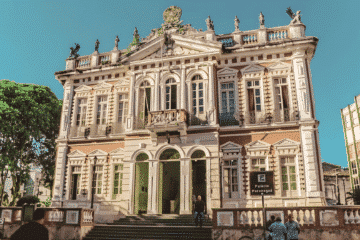
The São Jorge dos Erasmos sugar mill was built in the newly founded town of São Vicente.
The São Jorge dos Erasmos sugar mill was the third sugar mill to be built in Portuguese America, located in the centre of the town of São Vicente, now in the municipality of Santos in São Paulo.
This sugar mill is one of the most remarkable monuments of Brazil’s economic past and the only one in the State of São Paulo. The monument has been listed by the Historical Heritage in all instances.

Historical context
During the colonial period, sugar production was one of Brazil’s main economic activities, becoming the engine of economic development in the captaincies.
Engenho São Jorge dos Erasmos
Sugar was highly valued in Europe, especially in countries like Portugal and England, and its production required a complex system that included the use of slave labour.
Sugar cane not only boosted the local economy, but also had a profound effect on the social structure of the time, leading to the formation of a society based on inequality and exploitation.
The success of sugar as an export product led to the introduction of new technologies and agricultural techniques, as well as the strengthening of trade routes between Brazil and Europe.
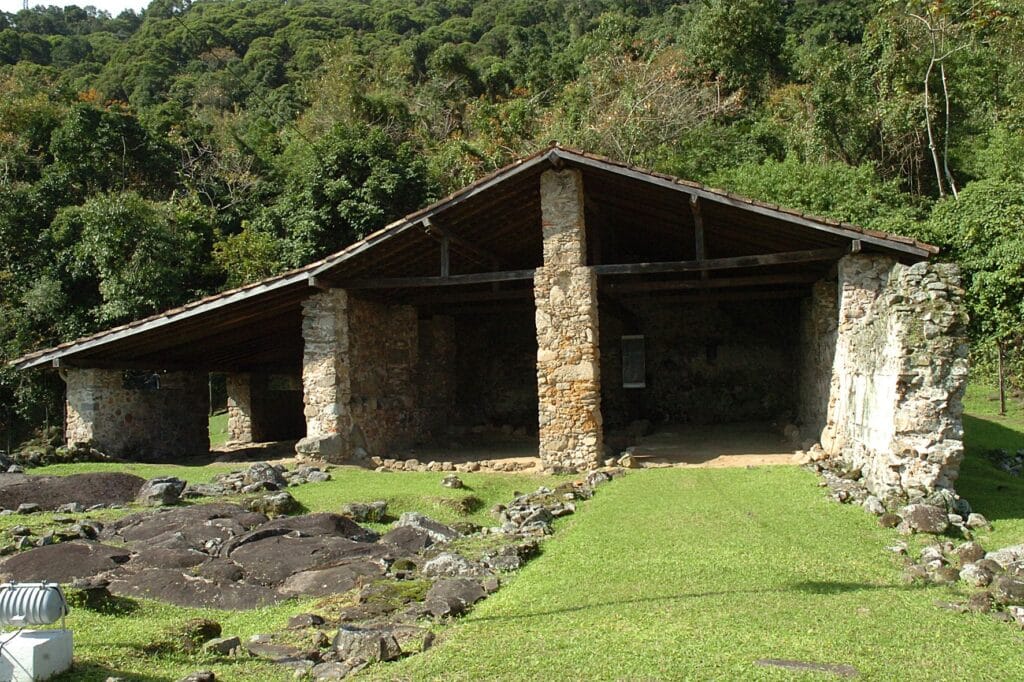
Foundation of the mill
According to historians, the founding of the Engenho coincides with the formation of the local settlement around 1534.
The grantee of the captaincy of São Vicente, Martim Afonso de Sousa, founded what was then known as Engenho do Senhor Governador or Armadores do Trato, together with his brother Pedro Lopes and others such as Johan Van Hielst, the Lisbon representative of the Antwerp trading house of the Schetz family.

Origin of the name
In the middle of 1540, after Martim Afonso de Sousa left for India, the mill was renamed Engenho São Jorge dos Erasmos. This name is a combination of two main elements:
- Saint George: refers to the patron saint worshipped at the time, symbolising protection and bravery.
- Erasmos: in honour of Erasmos Schetz, a merchant from Antwerp who was involved in the purchase of the mill.
Thus, the name reflects both the religious aspect and the commercial reality of the colonial period.
Structure of the mill
The São Jorge dos Erasmos mill was one of the first three mills built in Brazil, with a structure that was robust by the standards of the time. It had
- A water mill
- The Chapel
- Mill House
- Furnace House
- Boiler Room
- Washing house
In addition, the mill had a pasture at the side that extended to the sugar cane fields, where ox carts transported the sugar cane.
Economic contribution
The Engenho was responsible for boosting the Captaincy of São Vicente and the sugar cane product, which spread to other captaincies in Brazil and contributed significantly to the country’s development through the settlement of the inhabitants on the land.
Archaeological discoveries
Researchers from the USP have found sugar loaf moulds under layers of ash, probably the result of a fire in 1615 caused by the Dutch pirate Joris Van Spilbergen‘s refusal to provide him with the supplies he needed.
Preservation and legacy
In 1958, the land at Rua Alan Cíber Pinto, 96, in Santos, was donated by Octávio Ribeiro de Araújo, of the company that urbanised Vila São Jorge, to the USP for its preservation. The facilities were restored and reopened in 2005.
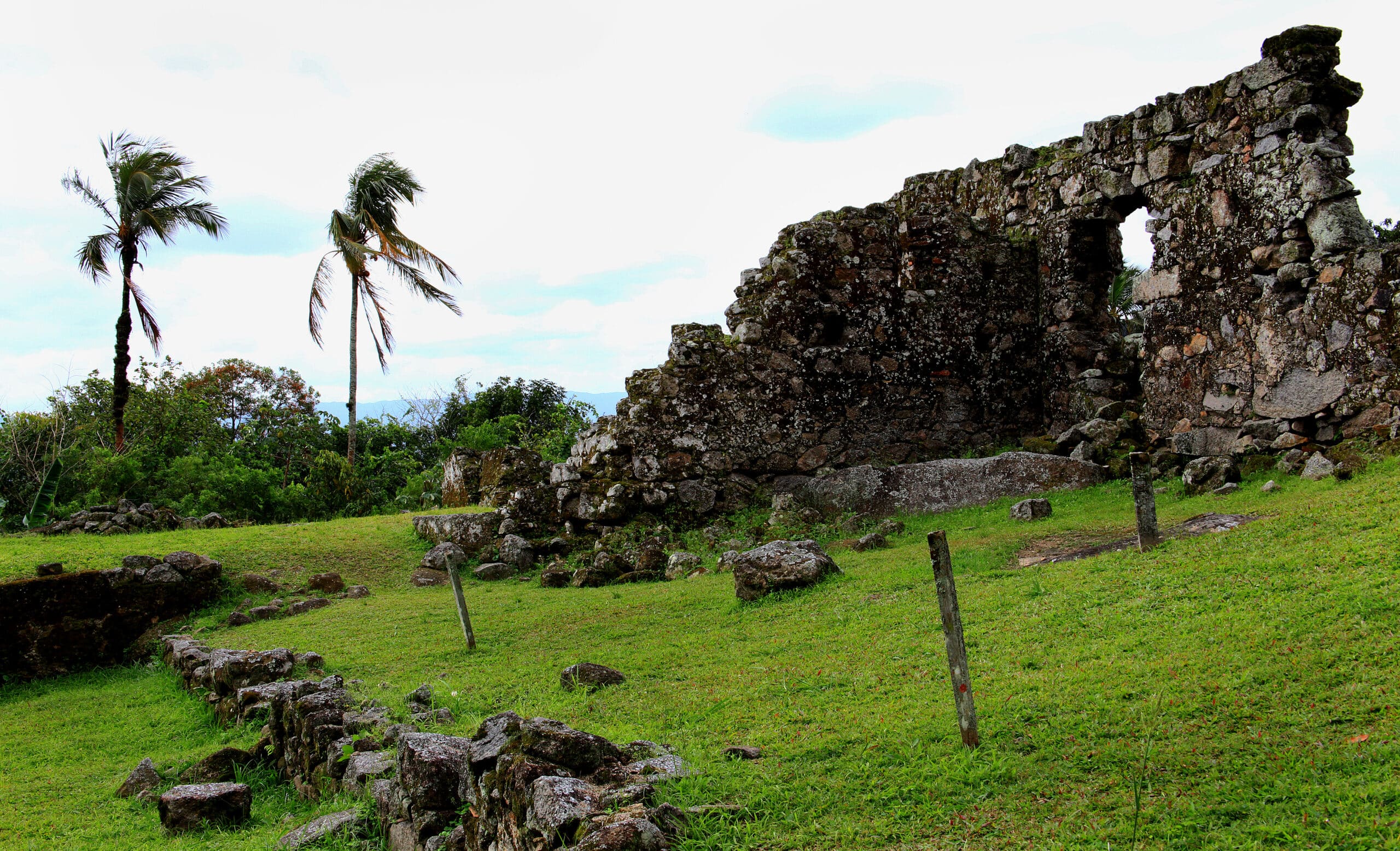
The Ruins of Engenho São Jorge dos Erasmos are located on the border between the municipalities of Santos and São Vicente, in the state of São Paulo, at the foot of the Morro da Caneleira, facing the sea, and form an important archaeological site. The Engenho was built in the newly founded town of São Vicente.
Publicações Relacionadas
Música, Ritmos e Danças do Nordeste do Brasil
Casa Grande & Senzala: The Work of Gilberto Freyre
Influences and main dishes of northeastern cuisine
Tropical flowers are grown on a large scale in northeastern Brazil
History of Northeast Brazil - Chronology and Summary
Northeastern architecture with typical colonial features
Geography and Climate Regions of Northeast Brazil
Jorge Amado's Life and Literary Contributions
Cultural Aspects of Northeast Brazil Explained
History of the introduction of Portuguese tiles in Brazil
Northeastern Literature: A Rich Cultural Tapestry
História e Evolução do Trio Elétrico no Carnaval
José Américo de Almeida: A Brazilian Literary Icon
Maranhão's handicrafts have more than 400 years of tradition
Tracunhaém and Its Rich Clay Handicraft Tradition
Historic Towns in the Northeast: Explore the Past
History of Carnival in Brazil: Origins and Traditions
Rapadura: A Sweet Treat from Northeastern Brazil
The influence of Arab architecture on the buildings of Pernambuco
Brazil’s Northeast: Must-See Tourist Destinations
Plastic Arts of the Northeast: A Cultural Journey
This post is also on:
 Português
  English
  Deutsch
  Español
  Français