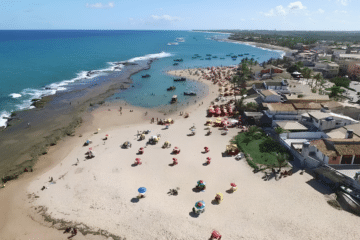
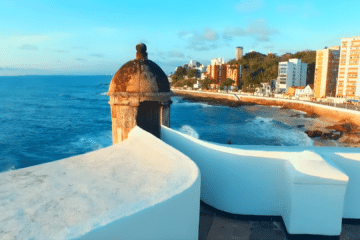
The architecture of the northeast has baroque buildings built by the sugar company mark the starting point of the long and varied path that northeastern architecture has travelled over five centuries.
On the balconies of the sobrados of old São Salvador there are memories of maidens from the time of the emperor,” sang Dorival Caymmi in the early 1940s.

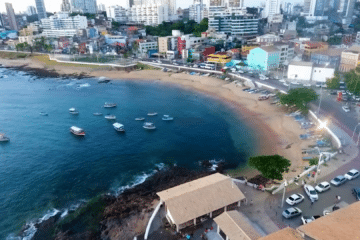
The sobrados, steeped in history, still stand in the centre of the city and form one of the most impressive architectural ensembles in the country.
Salvador’s houses are not isolated: they are part of a vast heritage built over the centuries in the Northeast of Brazil.
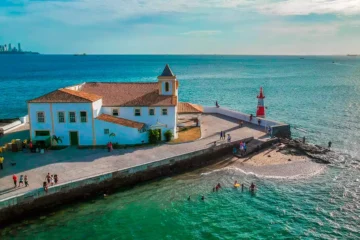
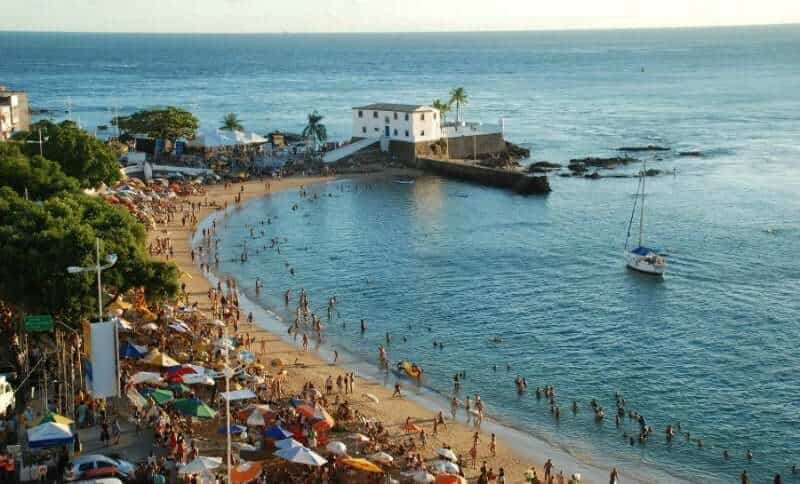
This heritage includes a large number of fortresses built to defend the colony’s extensive coastline from invaders and pirates (there were fifteen forts in Salvador’s Baía de Todos os Santos alone).

Arquitetura Barroca no Brasil
The great architectural heritage of the north-east, however, is the numerous churches scattered along the coast.
Most of them were built by the religious orders that accompanied the colonisers, especially the Jesuits: the Society of Jesus worked intensively in the region until 1759, when it was expelled from Brazil, and thus had the time and influence to impose on the colony what is known as the Jesuit style, characterised by “more Renaissance compositions, more moderate, regular and cold, still imbued with the austere spirit of the Counter-Reformation”, according to the architect Lucia Costa.
Churches from the 16th to the early 18th centuries have simple, generally rectangular plans and sober, unadorned façades.
Inside, however, you’ll find the elaborate ornamentation typical of the Baroque period – as if, in keeping with the ideals of the Society of Jesus, they valued the virtues of the spirit over outward appearances.
EUROPEANS COLONISED BRAZIL
The Europeans dominated the Tupiniquin lands with their architectural style, especially in sacred architecture, with the luxury and richness of detail in the decoration of churches. Housing, on the other hand, was simpler at first. Even the large farmhouses had few decorative elements, despite their enormous interior space and beautiful balconies.
This was because much of the wealth generated in Brazil went to Europe. However, with the arrival of the Portuguese royal family in the country, who landed in Salvador in 1808 and moved on to Rio de Janeiro soon after, the luxury of the home became more apparent.
As urbanisation increased in the 17th century, and the need to protect houses from pirate attacks on the coast, semi-detached houses were built, following a more compact model.
The facades formed a large ‘wall’. The open space was at the rear. Commercial activity took place on the ground floor – hence the predominance of large doors. Dwellings were on the upper floors.

Since the end of the 20th century, many buildings in the Northeast of Brazil have been revitalised with colourful paint on their facades, brightening up the streets and becoming a tourist attraction.
See also Colours of houses and buildings in the colonial architecture of the Northeast.
TILES
Azulejo tiles began to be used in churches in the north-east at the end of the 17th century. At that time, the material used in the churches of Bahia was ordered and brought directly from Lisbon, Portugal.
In fact, it was from the Portuguese that Brazilians acquired a taste for azulejos, which were used to make panels depicting colonial customs and Christian traditions.
In the 19th century, this decorative element began to conquer the façades of houses, as in São Luís and Belém. Maranhão should also be mentioned, as it began to cover its houses with tiles, thanks to the development of the cotton industry in the region.
CHURCHES AND FORTS
Although its external appearance has remained restrained, the religious architecture of the north-east has changed over time: the simple, un-towered gables of the 17th century evolved into the belfries of the 18th century.
The altarpieces have also become more elaborate over the centuries, with rich carvings covered in gold leaf.
Often, the same building had several styles, the result of the constant renovations, extensions and reconstructions that took place as the sugar industry prospered. A fundamental element in the decoration of colonial churches is the painting of the theta.
Illusionist perspective techniques, developed by Italian artists in the 17th century, began to be used in Brazil in the second quarter of the 18th century, especially in Recife and Salvador, with their forts and churches.

This feature can be seen in the ceiling of the nave of the Church of São Pedro dos Clérigos in the capital city of Pernambuco, and in that of the Church of Nossa Senhora da Conceição da Praia in Salvador – the latter painted by José Joaquim da Rocha, one of the great names of Brazilian Baroque.
Finally, it is worth highlighting the extensive use of tiles, brought from the metropolis in the 18th century, to decorate the exterior of buildings, domes of towers (such as the Franciscan Convent of João Pessoa), cloisters and sacristy – interestingly, these places for the private use of priests were lavishly decorated in the churches of the Northeast, possibly because they were also used by members of the local aristocracy.
The magnificent sacristy of Salvador’s Basilica Cathedral, where the large wooden chest inlaid with tortoiseshell and ivory stands out, is an example of this splendour.
BAROQUE ARCHITECTURE

Built by the Sugar Company, the Baroque buildings are a kind of first landmark of Northeastern architecture, translating a cultural trend that began in Europe in the 16th century, but with a Brazilian touch.
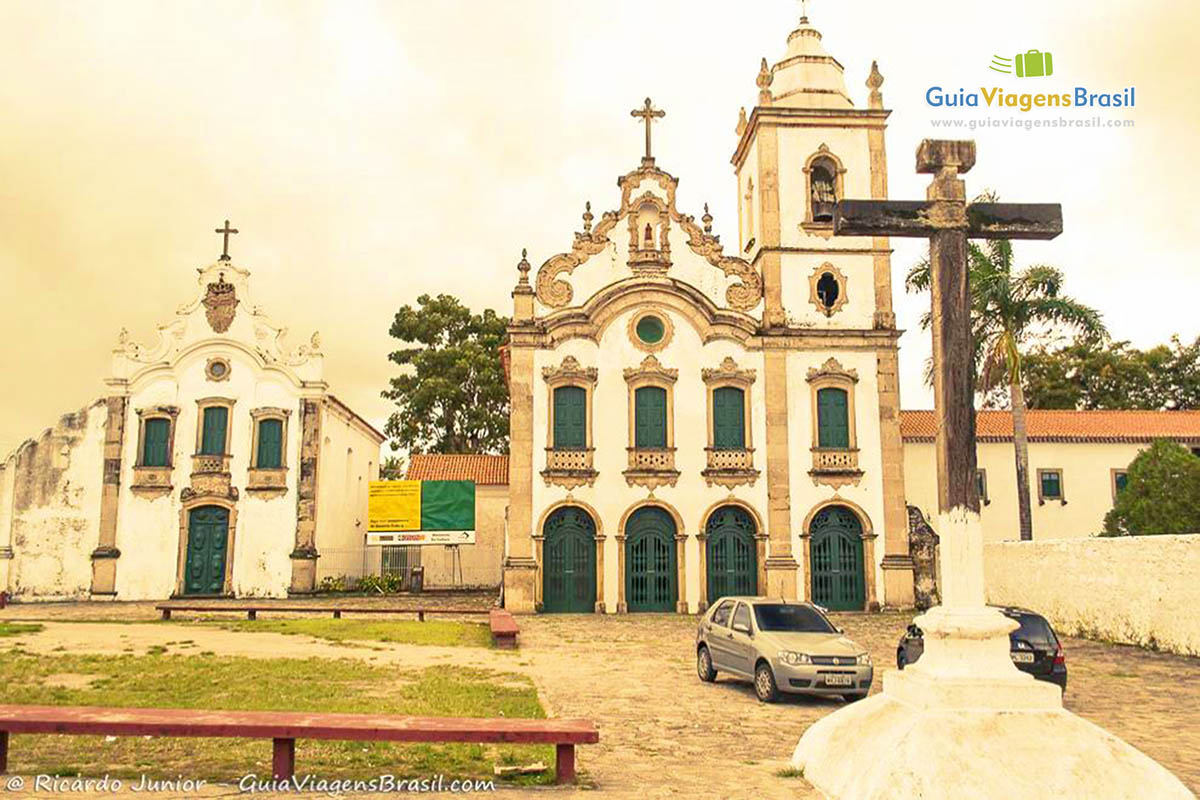
Fases da arquitetura religiosa e Arquitetura Barroca
Very present in the churches of the Northeast, the Baroque architecture is characterised by the curves and the richness of the details of the buildings and monuments, as well as the grandeur of its edifices, with the aim of exalting the principles and customs of Christianity, spreading its ideas through art.
The construction of many churches, especially in Bahia, was the work of the religious orders that accompanied the colonists, especially the Jesuits.
Initially, the parishes had sober, bare facades. At the beginning of the 17th century, elaborate Baroque solutions began to appear, giving these places a unique touch.
Convex or concave facades that emphasise the idea of movement, rounded columns, arches, an abundance of gilding, paintings rich in detail and exuberant decorative elements are some of the most striking features.
See also History of the Minas Baroque.
ARCHITECTURE FROM THE CASA GRANDE TO THE SOBRADO

Sugar cultivation led to the development of a particular type of architecture.
Rural estates were real complexes that included the great house where the masters lived, the slave quarters and the indispensable chapel, as well as the sugar mill itself with its machinery.
As sugar production increased, the buildings became more luxurious.
The original rammed earth was replaced by brick, and the low, bare house by the manor house.
The Solar do Unhão, built in the 17th century as the residence of the judge Pedro Unhão Castelo Branco, is an example of both the refinement and the accumulation of functions of rural properties: it housed a large house, a slave quarters, a chapel, warehouses and a pier.
The complex was restored in 1962 by the architect Lina Bo Bardi and today houses the Museum of Modern Art.
The owners lived their entire lives within the confines of the Engenho; in the early years of the colony, the towns were little more than trading posts and administrative centres, with modest houses.
As the process of urbanisation accelerated at the beginning of the 19th century, more luxurious buildings began to appear, the grand mansions that housed the fanatical homes of the elite.
In the capital of Maranhão, São Luís – whose wealth came from cotton, not sugar – the facades of the sobrados were covered with Portuguese tiles like those used in churches in Pernambuco and Bahia.
In the northeast, as throughout the colony, sobrados also served a dual function for small merchants who worked on the ground floor and lived upstairs.
In the semi-arid northeast, on the other hand, the estates associated with cattle ranching had simple, unadorned masonry houses, but – like the large houses on the coast – with verandas or balconies that often served as living quarters.
THERE ARE TWO TYPES OF HOUSES IN THE COLONIAL PERIOD
The architecture of the Northeastern region of Brazil is very much characterised by features typical of colonial structures, inheriting from Portuguese town planning traditions the regular streets and the buildings in the alignment of the plot, whose facades border the boundaries of the land.

The colonial houses have a façade of about ten metres and are very deep. The streets are defined by the fronts of the houses. Pavements were rare.
There are two predominant types of colonial dwellings that are quite common in the architecture of northeastern Brazil: the single-storey house and the sobrados. One-storey houses are more popular.
They also had dirt floors. The more economically privileged classes, on the other hand, adopted the sobrado, which had two storeys and a parquet floor.
Both have gabled roofs that allow rainwater to run off to the front and back of the house. To solve this problem, gutters and eaves were used to direct the water to a specific point.

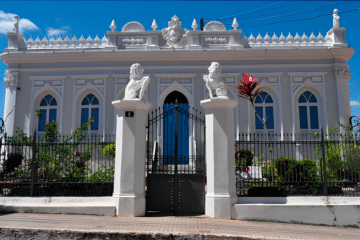
Characterised as the highest part of the façade, the platbands had the function of hiding the roof, preventing rainwater from entering the streets and, more importantly, decorating the houses in the city centre.
Enrichment from the monocultures of the Northeast – such as sugar cane in Pernambuco – led to a desire for social affirmation, which led to the emergence of a variety of ornaments for the platbands, mixing Gothic, neoclassical and even Art Nouveau styles, classified by Lemos (1989) as “neo-colonial”.
This style combines solutions inspired by the past and became popular in the 1920s and the beginning of the following decade.
It is common to find public buildings in the cities of Recife, Natal, Salvador and in the northeastern interior with platbands decorated with sculptures of women in porcelain, eagles symbolising independence and freedom, royal signs, baroque shells, arches and balusters. It’s also common to find the year of the building’s completion on the plaques.
A rich collection of platibandas can be seen in the historic centres of the capital cities and historic towns of the Northeast.

It’s important to mention that the revitalisation of houses in the historic centres of the Northeast has boosted tourism and consequently the economy of these cities, such as João Pessoa, Salvador and inland towns like Ilhéus and Canavieiras.
The lime-based paintings of each house, painted on irregular façades and platbands, are the result of centuries-old artisanal whitewashing practices, a technique that was gradually replaced by new materials and processes without the same characteristics.
Later, platbands were no longer included in municipal codes. However, their use remained commonplace in some regions of the Northeast, despite the industrial modernisation of the Southeast of Brazil, which was reflected in its architecture.
The memory of the golden age of monoculture in the Northeast is still alive in the houses of the reference cities. In the countryside, however, platibandas are common not only because of their history, but also because of their cultural ties to identity.
WHAT IS A PLATIBANDA?
The architectural term platibanda refers to a horizontal strip (wall or railing) that frames the upper part of a building and has the function of concealing the roof.

It can be used on various types of buildings, such as houses and churches, and became a characteristic ornament in the Gothic style.
In modern times, it is often used on buildings that were once residential and have now been converted into commercial premises.
In order to hide the former use of the property, the facade is modernised and a platband is added (which can be a wall higher than the roof to hide it and take away the appearance of the house).
In addition to this function, platbands were also designed to enhance the construction and decorate the building.
Among the most common elements in this type of structure are a record of the year of construction, baroque shells, eagles and sculptures of women, among others.
In the capital cities, such as Salvador, Recife and Natal, there are many houses and public buildings where platibandas stand out. They are not only a reference to the days of monoculture, but also to the cultural identity of the northeast.
The lime-based paintings on the panels and façades are a long-established craft that is very characteristic of the region.
Video Rural architecture in the Seridó hinterland
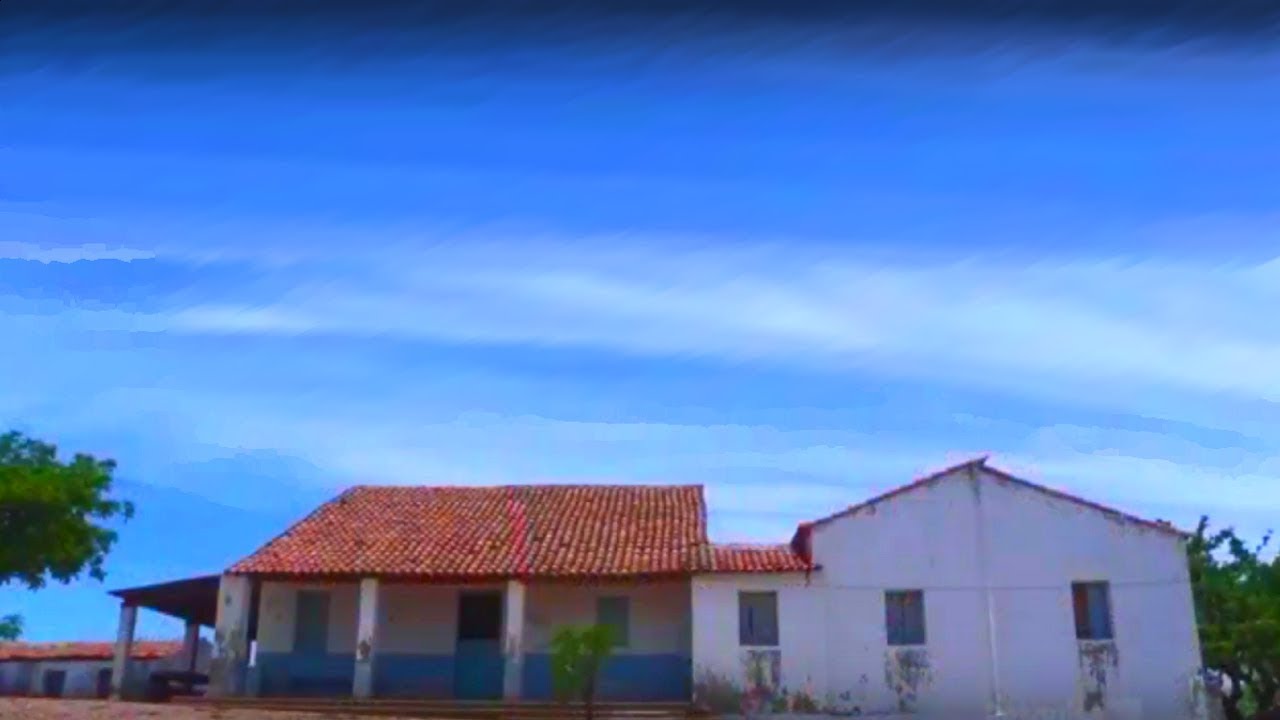
Arquitetura rural do sertão do Seridó
RURAL ARCHITECTURE OF THE SERIDÓ HINTERLAND
The Seridó is a micro-region in the semi-arid region of Rio Grande do Norte, characterised by caatinga vegetation and highly eroded soils due to the scarcity and uneven distribution of rainfall.
Settlement began in the 17th century and today the region is home to around 300,000 people, 42 per cent of whom live in rural areas.
Cattle ranching was the activity that led families to settle in the hinterland of Rio Grande do Norte, and the cultivation of cotton, which later proved to be a very profitable economic activity, was the driving force behind the settlement of the population in the Seridó.
The cattle ranches of the region are examples of great importance for the Brazilian architectural heritage.
Although they were built in modest forms, without the signature of architects, their constructions were based on popular knowledge (both in their construction and their appreciation), with an intrinsic logic linked to their function.
Unfortunately, this collection, which is fundamental to the identity of the region and of Rio Grande do Norte, has fallen into disrepair, which is why this research aims to contribute to the preservation and dissemination of the culture, tradition and rural built heritage of the Seridó-RN.
See Rural architecture in the Seridó hinterland
See Inventory of rural buildings in the Seridó
OTHER INFLUENCES ON NORTHEASTERN ARCHITECTURE
In the mid-19th century, newly independent Brazil was building its new face, turning its back on its colonial and baroque past.

Recife was reforested in 1840, and got a public transport system with stagecoaches and piped water; the Palácio do Campo das Princesas was built in 1840, the Santa Isabel Theatre in 1850, and the Liceu de Artes e Oficias in 1880.
Other cities were rebuilt and many capitals were transferred from the old colonial cities: the capital of Piauí moved from Oeiras to Teresina in 1852, and that of Sergipe from São Cristóvão to Aracaju in 1855.
The transformative impulse continued in the early years of the 20th century, when a major urban reform, modelled on that of Rio de Janeiro, introduced urban sanitation measures and redesigned the city, demolishing much of Recife’s old quarter.
The same happened in other capitals, such as João Pessoa and Salvador.

Modern architecture, which flourished in Brazil between the 1930s and 1960s, reached the capital of Pernambuco through the hands of professionals such as Acácio Gil Borsoi from Rio de Janeiro and Delfim Amorim from Portugal, two of the founders of the so-called Recife School, which would spread throughout the Northeast.
Among the architects who introduced new elements into the region’s landscape were Luís Nunes, Mário Russo, Mário Láscio, Carlos Alberto Carneiro da Cunha and Liberal de Castro.
Since the 1970s, revitalisation projects have restored the historic centres of several colonial cities, such as São Luís and Salvador.
At the same time, in the hinterland and on the outskirts, you’ll find popular houses with unique features, small and very colourful, with ornate cornices – a complement to Jesuit austerity, Baroque excess and modern rationality, a spontaneous, cheerful and sunny architecture, like the culture of the Northeast itself.
North-Eastern architecture

Publicações Relacionadas
Iemanjá Festival: Meaning and Celebrations
Jean-Baptiste Debret: biography and works in Brazil
Lampião and the Cangaço: Between History and Mythology
Cultural Aspects of Northeast Brazil Explained
History and Chronology of the Portuguese Tile Industry
Plastic Arts of the Northeast: A Cultural Journey
June festivals: Tradition and Culture in the Northeast of Brazil
Popular Art from the Northeast of Brazil
Iemanjá: Discover the Orixá and the Traditional Festival in Salvador
Casa Grande & Senzala: The Work of Gilberto Freyre
Candomblé: A Blend of African and Catholic Traditions
Colours of houses and buildings in the colonial architecture of the northeast
Woodcuts and Cordel Literature in Northeastern Brazil
Música, Ritmos e Danças do Nordeste do Brasil
Graciliano Ramos: The life and work of the Brazilian writer
Itineraries focused on religious tourism in Salvador, Bahia
História e Evolução do Trio Elétrico no Carnaval
Influences and main dishes of northeastern cuisine
Franciscans in Brazil: Urban, architectural and artistic heritage
Turban is Religion, Fashion and Culture in Brazil and the World
Lampião and Cangaço: Between history and mythology
History of Northeast Brazil - Chronology and Summary
The origins of Afro hairstyles in Salvador, Bahia
The dress of the Baianas is influenced by African culture
History and Chronology of the Carnival of Salvador de Bahia
Discover the History of Capoeira in Salvador
Origin and history of Acarajé: Discover the Afro-Brazilian tradition
History of the 8-bass accordion and its influence on forró
Maranhão's handicrafts have more than 400 years of tradition
The Origins of Umbanda: Brazilian History, Beliefs and Practices
Northeastern Literature: A Rich Cultural Tapestry
King Momo, Pierro, Harlequin and Colombina - Carnival characters
History of Carnival in Brazil: Origins and Traditions
The culture of Northeastern Brazil: how it originated, influenced and flourished
Monte Santo in Bahia: History and Religious Tourism
Brazil's northeastern subsoil has emeralds and archaeology
This post is also on:
 Português
  English
  Deutsch
  Español
  Français