Acarajé: An Expression of Afro-Brazilian Tradition
Acarajé is much more than just a dish from Bahian cuisine; it is a true expression of the rich Afro-Brazilian tradition. With roots stretching back to Africa, this delicacy symbolises the fusion of cultures and the resilience of Afro-descendant communities over the centuries.

Street Trading in Salvador
Sold on the streets of Salvador by women known as baianas, the acarajé is not just a food, but also a central element in religious and cultural practices. In this text, we will explore the history and meanings surrounding this delicacy, revealing the importance of acarajé to the cultural identity of Bahia and Brazil.
A Culinary Speciality
Acarajé is a culinary speciality of Afro-Brazilian cuisine. As well as being the dish that symbolises Bahia, sold on every street corner in Salvador, it is the food of an orixá. “It is an offering made to Iansã, in the candomblé terreiro.” The communion wafer is to the Catholic Church what the acarajé and abará are to the religions of African origin.
Ingredients and Side Dishes
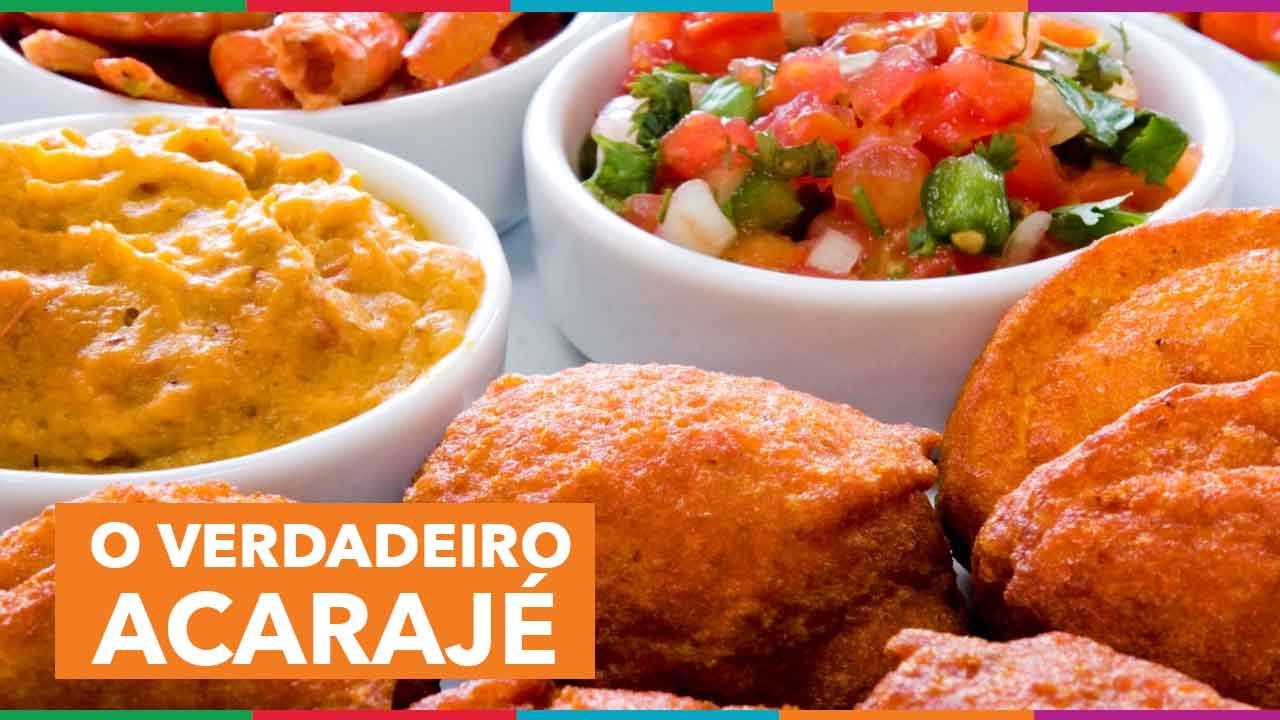
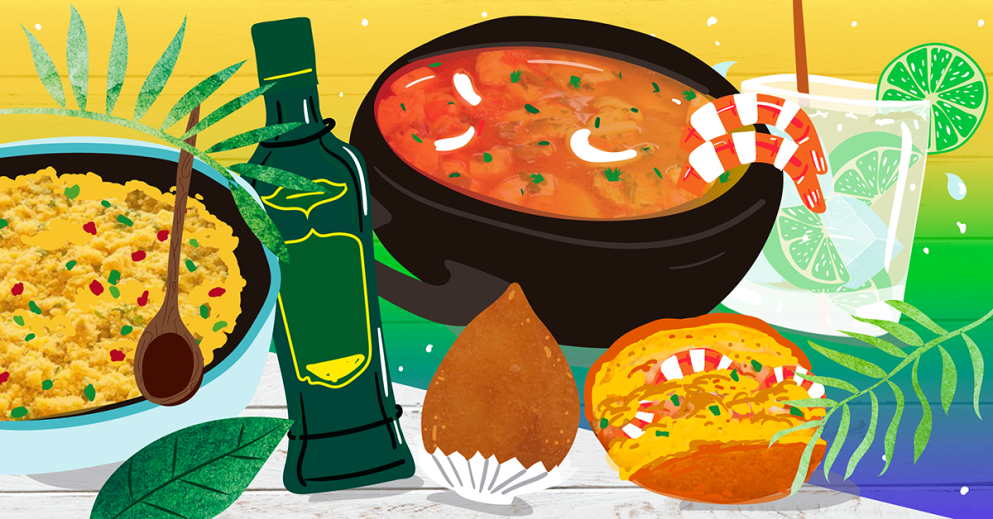
Acarajé is made from black-eyed pea batter, onion and salt, and is fried in palm oil. It can be served with chilli, dried prawns, vatapá, caruru or salad — almost all of which are typical ingredients and dishes of Northeastern Brazilian cuisine.
The Sacred and the Legend of Iansã
Not everyone realises that acarajé is a sacred food, offered to Oyá, also known as Iansã — the African goddess who controls winds, storms, lightning and fire.
Oral tradition preserves more than one version of how Iansã came to possess the power to breathe fire, which is why it is recounted in different ways throughout this text.
According to one version, an African legend tells that Iansã, after separating from Ogum and joining forces with Xangô, was sent by her second husband to the land of the Baribas in search of a potion which, when ingested, would give her the power to breathe fire. With her boldness, the goddess tasted the liquid and gained this power.

Ceremonies and Traditions
Historical accounts also reveal that, to honour the gods, Africans perform ceremonies involving fire, such as the acarajé, in which the initiate swallows strands of cotton soaked in burning palm oil — a ritual reminiscent of the preparation of the traditional acarajé.
Videos on the history of the Baiana, acarajé and the acarajé recipe

The Origins and History of Acarajé
1. The History of Acarajé
For at least three centuries, the baianas of the acarajé have been perfecting their recipes, which were brought from Africa during the colonial period. It was the so-called escravas de ganho—whose role was to go out onto the streets and work for their mistresses, selling goods from trays—who started this tradition.
They sold everything from porridge to fried fish, from acarajés to cakes and sweets, such as cocada. Although they had to hand over a large part of their profits to their owners, the slaves who earned their own income were allowed to keep a small portion of what they received.
And that is how many of them supported their families — and there were even cases of women who managed to buy their own freedom. No wonder Rita Santos says that the woman from Bahia who sold acarajé was the first female entrepreneur in Brazil.
It was from the profits made by the Baianas’ stalls that the money also came to establish the religious brotherhoods and to fund the Candomblé terreiros, yet another argument for the religious importance of the acarajé. In the African-based religions, Iansã, goddess of the winds and storms, sought out Ifá, an oracle, to prepare a meal for her husband, Xangô, the orixá of justice, lightning, thunder and fire — this is another version of the legend about the origin of the power of fire, as told by other traditions within Candomblé.
The oracle’s instruction was that, after eating, Xangô should speak to his people. When he did so, flames began to shoot out of his mouth, and the same happened to Iansã.
Everything about the acarajé and the baianas is steeped in symbolism, from the preparation of the recipe to the cooks’ clothing. When prepared for Iansã—as an offering—the acarajé is always deep-fried and served plain.
The craft of the Baianas continued after the end of slavery and became firmly established in the popular imagination throughout the 20th century. In 1939, Dorival Caymmi and Carmen Miranda asked what a Baiana has, in the song that Caymmi composed and Miranda made famous, whilst Ary Barroso, in ‘Na Baixa do Sapateiro’, recalled that “on the tray of the Baiana there is vatapá, caruru, mungunzá and umbu”.
In the 21st century, the craft of the baianas do acarajé was registered by IPHAN in 2005 as intangible cultural heritage of Brazil — a recognition which, in 2022, was extended from Salvador to the whole of the country. You can find the official details of the registration on the IPHAN website.
The importance of this dish is such that FIFA, during the Confederations Cup and the World Cup in 2013 and 2014, gave in to intense pressure and allowed the women from Bahia to be inside the Fonte Nova Arena, selling their acarajés, just as they had been doing for decades.
The tradition is set to continue: the baianas have also been given permission to sell acarajé inside the Arena Fonte Nova during the 2027 FIFA Women’s World Cup, for which Salvador will be one of the host cities.
And there may well be even greater things on the horizon: some are calling for the acarajé to be declared World Heritage, in a joint petition to be submitted by Brazil and Nigeria, where a version of the dish is a staple breakfast for many. In the meantime, one thing has not changed — the dish remains linked to faith, even if it is no longer the exclusive preserve of the baianas of the acarajé.
2. Buying Freedom in Colonial Brazil
In colonial Brazil, the acarajé was sold on the streets on trays that slaves balanced on their heads, whilst singing to attract customers. Through the sale of this delicacy, many of them were able to buy their freedom. The name ‘acarajé’ may be a shortened version of the chant sung by these women in the early 19th century.
The musician Dorival Caymmi freely adapted, in his song A preta, one of them: “O acará jé ecó olailai ô”, which was the call to encourage customers to buy the acarajé. Initially, the feijão fradinho was grated on a stone, 50cm long by 23cm wide, and about 10cm high. The flat surface, rather than being smooth, was slightly pitted by the grater, so as to make it porous or rough.
A cylindrical roller, rolled back and forth over the stone in the manner of a millstone, easily ground the maize, the beans, the rice, as explained by the author of the first ethnographic description of the acarajé, Manuel Querino, in his text ‘The Culinary Arts in Bahia’, written around 1922 and published posthumously in 1928.
It was only with the passage of time that electric mills appeared to make the work easier. “When my grandmother taught me how to make acarajé, we used to grate the beans whole on a stone to break them up; nowadays we buy beans that have already been broken up,” compares Regina, a “Bahian woman” for 37 years and one of the most traditional in Salvador. She also says that the acarajé used to be served on a banana leaf with just chilli, but customers became more demanding and the women from Bahia began to add new fillings such as salad, vatapá, prawns and caruru.
3. Religiousness and the Acarajé
Previously, the only people authorised to sell acarajé were the daughters of Iansã and Xangô, but as the snack became more popular, baianas from all religions. Today, as well as women, you can also find men making acarajé.
What is interesting, however, is that they all maintain an unwavering respect for the rituals surrounding the act of making the buns. The famous Regina, for example, does not touch the ingredients without first taking an “axé bath” (a bath made from leaves). When she arrives at her spot in Itapuã, she makes seven acarajés to cleanse the area and keep the street clear and peaceful.
4. Standardisation of Acarajé
A recent survey showed that the quality of the acarajés sold in Salvador was not particularly good. To address this finding, the work of the baianas came to be regulated by Municipal Decree 12.175/1998 and subsequent by-laws, which even stipulate standardised clothing and trays, with a particular focus on hygiene in the preparation and handling of food. A minimum distance of 50 metres between the trays was also established.
Currently, in order to sell their delicacies, the Baianas must undergo training through courses and have also received financial support to maintain their trays, which are now subject to inspection.
The initiative demonstrates a commitment to preserving the tradition of acarajé, ensuring it remains one of the main attractions on the menu for both locals and the thousands of visitors who come to Bahia every year. This is part of the culture and heritage of the people of Bahia!
5. Acarajé from Baiana
A woman from Bahia selling acarajé on the streets of Salvador. The acarajé is also a typical dish of Bahian cuisine and one of the main items sold on the tray of the Bahian (the name given to the container used by the Bahian acarajé seller to display the food), which are more heavily seasoned and tastier, unlike those made for the orixá.
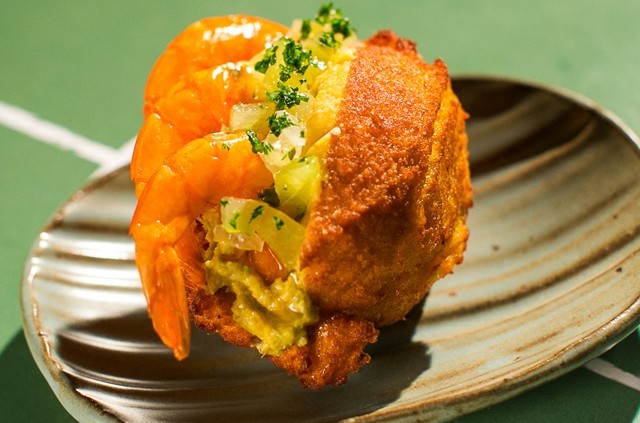
The method of preparation is practically the same; the difference lies in how it is served: it can be cut in half and stuffed with vatapá, caruru, sautéed prawns, chilli and salad of green and red tomatoes with coriander. The acarajé is similar to abará, differing only in the way it is cooked. The acarajé is deep-fried, whilst the abará is steamed.
Acarajé ingredients
The ingredients for acarajé are half a kilogram of black-eyed beans — peeled and ground —, 150g of onion, one dessert spoon of salt or to taste, and one litre of palm oil for frying. The prawn filling is made with 4 to 6 cups of palm oil, 3 onions chopped, garlic to taste, 700g of prawns smoked, peeled and fresh herbs sautéed for 10 to 15 minutes. You can add tomato and coriander, and as mentioned earlier, caruru, vatapá and chilli.
Frequently asked questions about acarajé
What is acarajé?
It is a small cake made from black-eyed pea paste, onion and salt, fried in palm oil. It is the signature dish of Afro-Bahian cuisine and also a sacred offering to the orisha Iansã in Candomblé terreiros.
What is the origin of the acarajé?
The acarajé has its roots in culinary and religious traditions brought over from West Africa (the region now comprising Nigeria and Benin) during the colonial period, and was preserved and reinvented in Brazil by the so-called ‘escravas de ganho’, who have been selling it on the streets of Salvador for at least three centuries.
Why is acarajé considered a sacred food?
This is because, in Candomblé, it is offered to Iansã (Oyá), the orixá of the winds, storms and fire. When prepared as an offering, the acarajé is always deep-fried and served without any filling, unlike the version sold on the streets.
What is the difference between acarajé and abará?
Both are made from the same black-eyed pea batter, but the acarajé is fried in palm oil, whilst the abará is steamed, wrapped in a banana leaf.
Who is allowed to sell acarajé on the streets of Salvador?
Nowadays, anyone can sell these items, provided they comply with local regulations (Decree 12.175/1998 and subsequent regulations), which require training courses, standardised uniforms, hygiene measures and a minimum distance of 50 metres between stalls. In the past, selling these items was restricted to the daughters of Iansã and Xangô.
Is acarajé part of Brazil’s cultural heritage?
Yes. The ‘Craft of the Acarajé-Making Women of Bahia’ was inscribed by IPHAN in 2005 as part of Brazil’s intangible cultural heritage, and in 2022 this inscription was extended to cover the whole of the country. There is also a proposal, currently under discussion between Brazil and Nigeria, to have acarajé recognised as a UNESCO World Heritage site.
Where can you get a good acarajé in Salvador?
The classic thing to do is to look for the ‘baianas de tabuleiro’ in the streets and squares of neighbourhoods such as Rio Vermelho, Itapuã, Pelourinho and Barra — each with their own recipe for vatapá, caruru and prawns. It’s worth asking the locals which ‘tabuleiro’ is the most traditional in each neighbourhood, as word of mouth tends to spread the word.

Publicações Relacionadas
Monte Santo in Bahia: History and Religious Tourism

European architecture - chronology, styles and characteristics
The culture of Northeastern Brazil: how it originated, influenced and flourished

Musical styles, rhythms, singers and composers of northeastern Brazil

Extreme sports in the Northeast of Brazil: Destinations not to be missed

Influences and main dishes of northeastern cuisine
Brazil's historic moments illustrated in great works
Biography of Victor Meirelles and analysis of the work "The First Mass in Brazil"
Jean-Baptiste Debret: biography and works in Brazil
History of Baroque Architecture in the Northeast and Minas Gerais
Popular Art from the Northeast of Brazil

History, biography and paintings of Frans Post in Dutch Brazil

History and Chronology of the Portuguese Tile Industry

Franciscans in Brazil: Urban, architectural and artistic heritage
Colours of houses and buildings in the colonial architecture of the northeast
King Momo, Pierro, Harlequin and Colombina - Carnival characters

History and Chronology of the Carnival of Salvador de Bahia

History of the introduction of Portuguese tiles in Brazil

Maranhão's handicrafts have more than 400 years of tradition
The influence of Arab architecture on the buildings of Pernambuco

Historic Towns in the Northeast: Explore the Past

Northeastern Brazilian Rhythms: 7 Main Musical Styles
Rural Maracatu: A carnival tradition in the interior of Pernambuco
Woodcuts and Cordel Literature in Northeastern Brazil

Brazil's northeastern subsoil has emeralds and archaeology
History of the 8-bass accordion and its influence on forró

June festivals: Tradition and Culture in the Northeast of Brazil

Bobbin lace and embroidery: predominant handicrafts in Ceará

Diógenes Rebouças and His Architectural Legacy
Turban is Religion, Fashion and Culture in Brazil and the World
Casa Grande & Senzala: The Work of Gilberto Freyre
São Jorge dos Erasmos Sugar Mill: A Landmark in Brazil

Graciliano Ramos: The life and work of the Brazilian writer
Lampião and Cangaço: Between history and mythology
Lampião and the Cangaço: Between History and Mythology
José Américo de Almeida: A Brazilian Literary Icon
This post is also on:
 Português
  English
  Deutsch
  Español
  Français