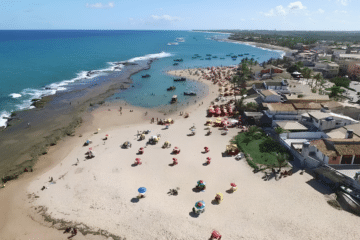
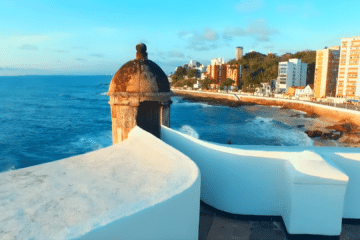
Tourism in Bahia is characterised by the fact that the state is one of the most important tourist centres in Brazil.
Bahia has an immense variety of landscapes, cultural traditions and attractions, allowing it to be divided into tourist areas, each with a name characteristic of its main physical and thematic identity.

The following map shows the Tourist Regions of Bahia.

Tourist areas in Bahia
1. Bay of All Saints.
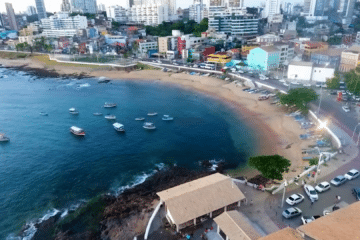
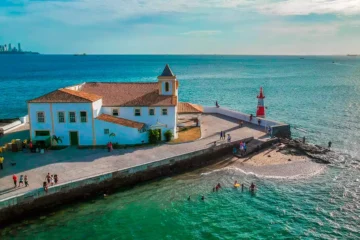
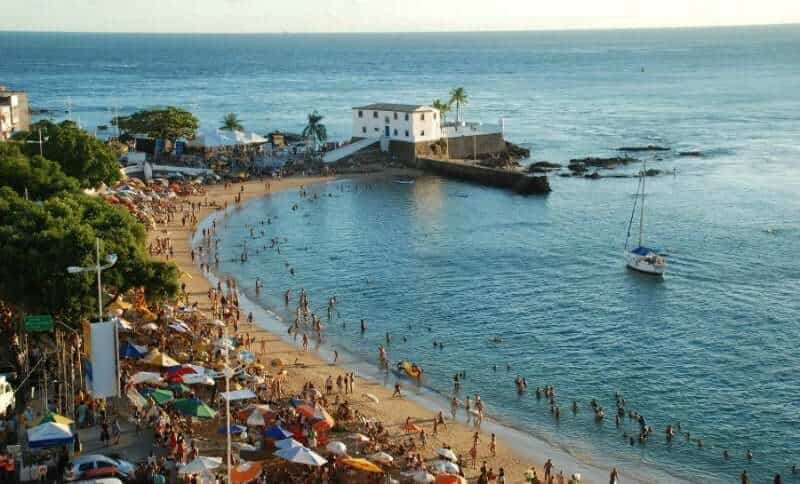
The main gateway for tourists visiting Bahia, this tourist area includes the state capital (Salvador) and the municipalities of Cachoeira, Itaparica, Jaguaripe, Madre de Deus, Maragojipe, Nazaré, Salinas de Margarida, Santo Amaro, São Félix, São Francisco do Conde, Saubara and Vera Cruz.
Culture and traditions
Rich in traditions and popular festivals, the Bay of All Saints is a true cultural melting pot, combining European, indigenous and Afro-Brazilian elements in a unique way.
Places of interest
Gastronomy, Music, Theatre and a vast Historical heritage are some of the attractions of this tourist area, which also boasts Natural beauty such as islands covered with native vegetation and preserved mangroves. The bay itself, which gives the city its name, is an element of integration and access, offering excellent conditions for navigation and leisure.
Infrastructures
The Bay of All Saints is served by Salvador International Airport, which can handle aircraft of all sizes, and a single-engine airport at Itaparica.
It has a seaport for passengers in Salvador and terminals for ferries between Salvador and Itaparica. It also has regular air, road and sea transport services.
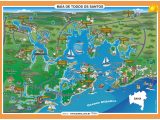
See the map of Todos os Santos Bay


2. Coconut Coast
Formed by the municipalities north of the capital, Bahia (Camaçari, Conde, Entre Rios, Esplanada, Jandaíra, Lauro de Freitas and Mata de São João), The Costa dos Coqueiros is one of the most popular tourist areas in the state, with well-known destinations such as Praia do Forte, Costa do Sauípe (the largest resort complex in South America), Imbassaí and Mangue Seco.
Served by Salvador International Airport and the environmentally friendly Linha Verde (Green Line) motorway, which runs parallel to the coast, the Costa dos Coqueiros is easily accessible, with a range of flight options.
With services such as electricity, drinking water, sanitation and telecommunications, this region has attracted hotel developments integrated with high quality residential condominiums. Its small beachfront villages offer inns, restaurants, shops and other tourist support services.
In addition to the vast coconut groves that adorn its nearly 200 kilometres of coastline, the Costa dos Coqueiros is rich in stunning landscapes framed by rivers, lagoons, small waterfalls and mangroves, forming a rich and diverse ecosystem.
3. Dendê Coast
Located south of Salvador, in an area adjacent to the Bay of All Saints, the Dendê Coast comprises the municipalities of Cairu, Camamu, Igrapiúna, Ituberá, Maraú, Nilo Peçanha, Taperoá and Valença. Ituberá, Maraú, Nilo Peçanha, Taperoá and Valença. As the name suggests, it is here that the culture of the Dendê palm tree is concentrated, which is the source of one of the basic ingredients of the much-loved Bahian cuisine – Dendê oil.
The Dendê Coast, due to its geographical configuration (indented coastline), offers ideal conditions for a variety of nautical activities, both recreational and sporting.
Full of deserted beaches, archipelagos, historical heritage sites and small villages, the region preserves unspoilt natural landscapes, as well as important folklore traditions and handicraft production. Natural attractions include more than 100km of beaches, three large islands and Camamu Bay.
The Valença airport can handle Boeing 737 aircraft, and there is also a single engine runway in Morro de São Paulo and another on the Maraú Peninsula.
Other modes of transport, such as road and sea, are also regularly available in the region, which has electricity, drinking water, sanitation and telecommunications services in several locations. Sanitation and Telecommunications services in several locations.
See the map of Costa dos Coqueiros
4. Cocoa Coast
Cocoa Coast
Comprising the municipalities of Canavieiras, Ilhéus, Itacaré, Santa Luzia, Una and Uruçuca, this region became world famous through the stories of love and adventure told by Jorge Amado.
Producer of the fruit from which chocolate is made, the Cocoa Coast, long known for its wealth and prosperity, still preserves a considerable architectural heritage from the golden age of cocoa farming.
The cocoa farming model, which used native vegetation to shade the cocoa trees, also helped to preserve significant remnants of the Atlantic Forest, which are now protected areas.
In addition to 200km of white sandy beaches and warm waters, the region’s landscape is complemented by rivers, lagoons, waterfalls and caves. It also preserves unique popular traditions.
The airports of Ilhéus and Comandatuba (private) can handle Boeing 737s, while Canavieiras Airport can handle smaller aircraft.
The region also has the Ilhéus seaport and paved highways serving several neighbouring towns. Regular air and road transport services are available, as well as electricity, drinking water, sewerage and telecommunications.
4. Discovery Coast
Discovery Coast
Considered the cradle of Brazilian history and civilisation, the Discovery Coast – formed by the municipalities of Belmonte, Porto Seguro and Santa Cruz Cabrália – offers a unique combination of historical and natural attractions.
It is the second largest tourist destination in the state and has the largest hotel network in Bahia. The region is home to a well-preserved historical and architectural complex dating back to the early days of Brazil’s history, as well as stunning ecosystems and landscapes, including beaches, cliffs, mangroves, rivers and remnants of the Atlantic Forest.
There are three national parks in the region – Descobrimento, Monte Pascoal and Pau Brasil – as well as protected areas and indigenous reserves. Indigenous handicrafts and traditions such as the reisado, pastoral dances, puxada do mastro and mandus are preserved elements of the rich and diverse local culture.
The Discovery Coast has an international airport in Porto Seguro, as well as paved highways linking the region’s main towns and providing regular air and road links. It is served by electricity, drinking water, sewerage and telecommunications in several locations.
5. Whale Coast
Whale Coast
Comprising the municipalities of Alcobaça, Caravelas, Mucuri, Nova Viçosa and Prado, the Whale Coast has as its main tourist attraction the annual migration of humpback whales to the southernmost coast of the country, which can be observed in the Abrolhos Marine National Park.
This beautiful spectacle is complemented by the region’s extensive and diverse underwater geography, ideal for diving and other water sports, as well as other terrestrial protected areas and folkloric traditions influenced by Portugal.
The region also has other attractions such as the Descobrimento National Park, the Barra do Cahy region – where Cabral’s fleet first landed to replenish its water supplies – and the Franz Krajcberg Ecological Museum, a cultural space located in Nova Viçosa.
The Whale Coast has basic infrastructure, including airports in Caravelas and Teixeira de Freitas (for small aircraft), motorways, electricity, water and telecommunications services, as well as nautical tourism and ecotourism companies.
See the map of the Whale Coast
6. Chapada Diamantina
Diamantina Escarpment
Divided into four circuits – Chapada Norte, Circuito do Ouro, Circuito do Diamante and Chapada Velha – the Chapada Diamantina is one of the largest tourist areas in Bahia. Located in the central region of Bahia, the communities included in these circuits have a history linked to important moments in Brazilian history, such as gold mining in the 17th, 18th and 19th centuries.
The landscape of this region, world famous for its rich biodiversity, consists of mountainous terrain, waterfalls, underground lakes, as well as a large number of springs, rapids, canyons and caves, making it an excellent place for adventure tourism and ecological tourism. Its main attraction is the Chapada Diamantina National Park.
It is served by Lençóis Airport, which can handle aircraft as large as a Boeing 737, and is connected to the main natural areas by paved roads.
It has regular road transport services and electricity, drinking water and telecommunications in several places.
See the map of Chapada Diamantina
Excursions in Chapada Diamantina
- Diamante: Its main attractions are its rich historical heritage, the Chapada Diamantina National Park, the Vale do Capão, as well as relics from the opulent days of diamond mining, waterfalls and rivers. Main destination: Lençóis
- Gold: Home to a wide variety of natural, historical and cultural attractions, including waterfalls, natural pools, rapids, limestone caves and rock paintings. The Mangabeiras Cave is a particular highlight. Main destination: Rio de Contas.
- Chapada Norte: It has a unique geography, with caves, waterfalls and rivers protected by conservation units, as well as archaeological sites, cultural traditions and typical regional cuisine. It has low temperatures and high altitudes. Main destinations: Jacobina and Morro do Chapéu.
- Chapada Velha: In addition to its natural attractions, the region preserves historical characteristics and customs, which are evident in the traditional regional festivals. Main destination: Gentio do Ouro.
7. São Francisco Lakes
Lakes of the São Francisco River
Characterised by the influence of the São Francisco River, this tourist area is made up of the municipalities of Abaré, Casa Nova, Curaçao, Glória, Juazeiro and Curaçá, Glória, Juazeiro, Paulo Afonso, Remanso, Rodelas, Santa Brígida and Sobradinho, whose main attractions are activities related to fishing and water sports in general.
Its main attractions include natural monuments, dams and hydroelectric power stations, as well as rural culture; while irrigated fruit growing and wine growing have attracted agri-tourism.
In addition to these attractions, there are physiographic features that allow the practice of various extreme sports (abseiling, canyoning, zip-lining, bungee jumping, base jumping, hang gliding, rock climbing and rallies, among others), which have generated significant tourist traffic to the region.
The basic infrastructure of the São Francisco Lakes includes the airports of Paulo Afonso and Petrolina, highways, electricity, sanitation and telecommunications. Sanitation and Telecommunications Services.
See the map of São Francisco Lakes
8. Paths of the West
São Francisco River Region
Located on the left bank of the São Francisco River, this region comprises the municipalities of Barreiras, Bom Jesus da Lapa, Correntina, Santana, Santa Maria da Vitória, São Félix do Coribe and São Desidério.
Considered attractive for its exotic landscapes, this tourist area has experienced significant economic growth, driven by notable advances in its agro-industrial sector, particularly in grain production.
It is also considered to be one of the richest in water resources in the Northeast of Brazil, with the Branco, Corrente, Ondas and Grande rivers being the most important. In addition to these characteristics, there is also tourist potential in the form of mountains, waterfalls, caves, rivers with rapids and river beaches, favouring the development of nature tourism in its various forms.
It has airports in Barreiras and Bom Jesus da Lapa, an extensive road network linking the main towns in the region, as well as electricity, sanitation and telecommunications. Sanitation and Telecommunications services.
See the map of routes in the west
9. Jiquiriçá Valley
Jiquiriçá Valley
Located about 150 km west of Salvador, this new tourist area is made up of the municipalities of Jiquiriçá, Laje, Mutuípe, Santa Inês, Ubaíra and Amargosa.
With its beautiful waterfalls, rivers, mountains and lush flora and fauna, the valley attracts visitors seeking contact with nature, whether for simple contemplation or to practise nature sports such as horse riding, trekking, canoeing and fishing.
Other important attractions include the historical and cultural heritage, the region’s rich handicrafts and rural tourism.
The region has paved highways linking its main towns, as well as regular road transport services, electricity, drinking water and telecommunications.
It includes the municipalities of Feira de Santana, Candeal, Serrinha, Teofilândia, Araci, Tucano, Cipó, Nova Soure, Itapicuru, Ribeira do Pombal, Banzaê, Euclides da Cunha, Monte Santo, Uauá and Canudos, this new tourist area is still under development, although it already attracts tourists on a regular basis.
It shows a strong vocation for religious tourism and historical and cultural tourism, especially in the municipalities of Monte Santo and Canudos, which were the scene of a social movement led by Antônio Conselheiro – an episode that culminated in the so-called “War of Canudos”, whose historical importance led to the creation of the Canudos Historical Park.
Thermal waters are another major attraction in the region, especially in Cipó and Tucano, where there are two hydro-mineral resorts.
The region has paved roads between the main towns, regular road transport, electricity, drinking water and telecommunications.
Bahia.ws is the largest tourism and travel guide for Bahia and Salvador.

Publicações Relacionadas
Arembepe: beaches (Piruí, Praia do Canto), Hippie Village and the Tamar Project

Paranaguá Palace — History, architecture and visiting information | Ilhéus (BA)

São Jorge Parish Church in Ilhéus — history, architecture and religious art

History of the Convent and Church of Nossa Senhora da Piedade in Ilhéus

São Sebastião Cathedral (Ilhéus) — History, architecture and tourism
The 15 Most Visited and Well-Known Beaches in Bahia
The 3 most paradisiacal beaches in Bahia

Skydiving, Paragliding and Ballooning in Bahia

Historic Towns in Bahia: A Journey Through Time
Places to visit on the south coast of Bahia

História da Arte - Caracteristicas, Aspectos e Periodos
Tourist Attractions in Bahia: main attractions, beaches and cities

Subaúma, Bahia: where it is, things to do and where to stay
Massarandupió Naturist Beach, Bahia: Rules and Access
Beaches on the South Coast of Bahia: 10 Best and Tips
Towns and the Abrolhos Archipelago — The southernmost tip of Bahia

Baixio: Between lagoons, dunes and the charm of a village surrounded by nature
Best Beaches in Bahia: Your Guide to Paradise
Salinas da Margarida (BA) — Beaches, Attractions and a Complete Guide

Guarajuba Beach, Bahia: Natural Pools and Tips

Barra do Cahy: Brazil's first beach - history and nature

Garcez Beach: Discover Paradise in Jaguaripe

Barreiras: An Ecological Paradise in Bahia
Catabrigas Waterfall — A natural haven in Ibirajá, Itanhém (BA)

Serra Grande: Your Guide to Bahia's Paradise
Corumbau, Bahia: Ponta de Corumbau, beaches, map, how to go

Taipu de Fora: Discovering Natural Pools

Iguaí: A Guide to Waterfalls and Relaxation
Morro de São Paulo: Map, Beaches & How to Get There (2026)
Tourism in São Francisco do Conde (BA) — Tips and Attractions
Todos-os-Santos Bay (Bahia) — History, geography and conservation
Todos os Santos Bay — Nature, History and Water-based Tourism
Bay of Todos os Santos: nature, history and cultur

Rafting in Taboquinhas: The Ultimate Adventure Guide
Abseiling Sites in Bahia: Top Locations to Explore

Diving Spots in Bahia: Discover Underwater Treasures
This post is also on:
 Português
  English
  Deutsch
  Español
  Français