Published on · Updated on
Mata de São João (BA): guide to the municipality, beaches and things to do
Mata de São João is a municipality on the Litoral Norte (North Coast) of Bahia, on the Costa dos Coqueiros, about 60 km from Salvador. Although its town center lies inland, the most famous destinations are on the coast, such as Praia do Forte, Imbassaí and the Costa do Sauípe. In addition, the municipality has rustic villages, Atlantic Forest reserves and natural pools.
- Location: Litoral Norte of Bahia, on the Costa dos Coqueiros.
- Population: 42,566 inhabitants (IBGE 2022 Census).
- Distance from Salvador: about 60 km to the town center and 80 km to Praia do Forte.
- Beaches and villages: Praia do Forte, Imbassaí, Diogo, Santo Antônio and Costa do Sauípe.
- Highlights: Projeto Tamar, Castelo Garcia d’Ávila, Reserva de Sapiranga and humpback whales.
- Suggested time: 4 to 5 days for the coast.

Video about Mata de São João in Bahia

Mata de São João na Bahia
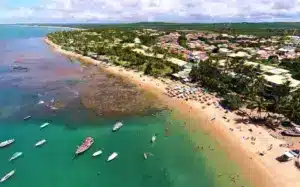
PRAIA DO FORTE EM MATA DE SÃO JOÃO NA BAHIA11:18
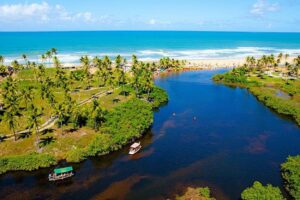
IMBASSAÍ NA MATA de SÃO JOÃO BA02:41

Vôo sobre as Praias da Mata de São João03:58
Where it is and what the municipality is like

The municipality is part of the Região Metropolitana de Salvador (Salvador Metropolitan Region) and covers about 605 km², according to the IBGE. People born there are called matense (the local demonym).
In practice, the territory has two sides. On one side, there is the town center, an inland town with shops, services and traditional festivals. On the other, there is the coast, crossed by the BA-099 (Estrada do Coco and Linha Verde), where the beaches, villages and resorts are.
That is why many people know the most famous village on the coast without realizing that it belongs to Mata de São João. Likewise, Imbassaí, Diogo, Santo Antônio and the Costa do Sauípe are also part of the municipality.
Around it, the Costa dos Coqueiros also includes other municipalities, such as Camaçari, Lauro de Freitas, Entre Rios, Esplanada, Jandaíra and Conde.
History of Mata de São João
Settlement of the region began in the 16th century, with the colonists who accompanied Garcia d’Ávila. He arrived in Bahia with Tomé de Sousa in 1549 and received large tracts of land on the northern coast. In addition, the Jesuits also helped to form the first communities.
Later, in 1761, the district of Mata de São João was created. Then, provincial law no. 241 of April 15, 1846 raised the settlement to the status of a town. Since then, this date has been the municipality’s anniversary, and it turned 180 in 2026.
Interestingly, the name changed twice in the 20th century. First, in 1931, it became simply Mata. Then, in 1938, it returned to its current name.
Beaches and villages on the coast
Praia do Forte

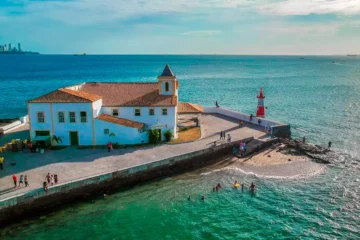
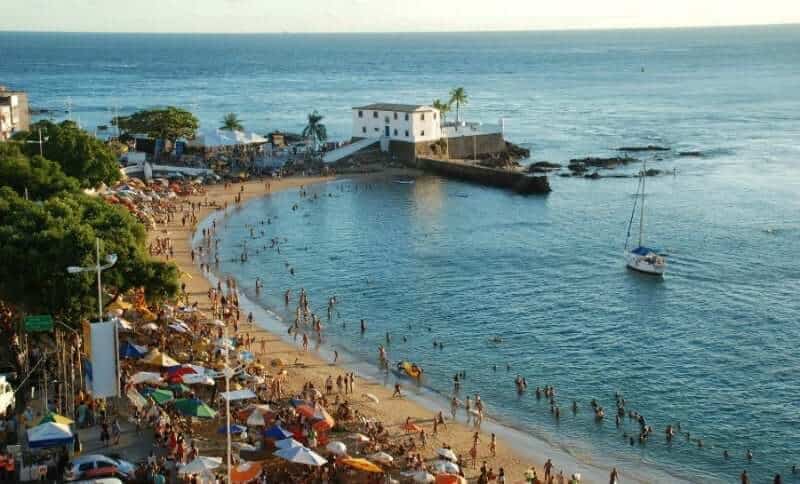
Praia do Forte is the most famous district of the municipality, about 80 km from Salvador. A former fishing village, today it has guesthouses, resorts, shops and restaurants, as well as natural pools and the Projeto Tamar. To get to know the village in detail, see our complete guide to Praia do Forte and the Alameda do Sol.
Imbassaí

According to tradition, Imbassaí means “caminho do rio” (“path of the river”) in Tupi. Indeed, here the rio Imbassaí runs parallel to the sea, separated from it by dunes and coconut palms, until it meets the ocean. Thus, you can choose between the calm fresh water of the river and the waves of the sea.
In addition, the village is great for kayak trips, raft crossings and watching the sunset. On the riverbank, the beach huts serve seafood, such as crab, pititinga (small fried fish) and fried fish.
Diogo
Just past Imbassaí, the Vila do Diogo is small, rustic and surrounded by coconut palms. The best-known outing is an easy walk across the dunes to the spot where the river meets the sea, a view that changes with the tide. For this reason, it is a great option for those who want to escape the crowds.
Vila de Santo Antônio
Near the Costa do Sauípe, the Vila de Santo Antônio has sandy streets, simple houses and residents who make a living from fishing and handicrafts. In addition, the beach is long and almost deserted and, at low tide, it forms pools between the reefs. As for the food, seafood, especially lobster, is the big highlight.
Costa do Sauípe
Further north, the Costa do Sauípe is a resort complex, and many of its resorts are all-inclusive. For this reason, it is very popular with families and couples who want comfort without leaving the hotel.
Tourist attractions in Mata de São João
Projeto Tamar

Created in 1980, the Projeto Tamar (Brazil’s sea turtle conservation project) protects endangered sea turtles through research, environmental education and community involvement. Its national headquarters is in Mata de São João, in the village of Praia do Forte. In addition, the visitor center, next to the lighthouse, has tanks, aquariums and replicas of the protected species, so it appeals to all ages.
Castelo Garcia d’Ávila

Also known as Casa da Torre, the Castelo Garcia d’Ávila was built between 1551 and 1624. Initially, it served as a residence and as a lookout post over the coast. Later, it became the headquarters of one of the largest landed estates in colonial Brazil, with cattle corrals that reached deep into the backlands.
Today, the complex is heritage-listed by IPHAN and is considered the only medieval-style building in the Americas. Besides the ruins, which overlook the sea, the park has a museum that tells the story of the Garcia d’Ávila family.
Reserva de Sapiranga

About 2 km from the village, the Reserva de Sapiranga protects more than 600 hectares of Atlantic Forest. Sloths and anteaters live there, among trees such as brazilwood and ipê. In addition, the reserve is crossed by the rios Sapiranga, Terebu and Pojuca. As a result, it offers trails, quad bike rides, a zip line and canoeing.
Natural pools

At low tide, the reefs form clear-water pools, which are great for snorkeling. On the coast of Mata de São João, the best known are the Papa-Gente pool, which is deeper and full of fish, and the Praia do Lord pool, which is shallower and therefore ideal for families. In Santo Antônio, on the other hand, the pools between the reefs are calmer. In all cases, check the tide table before you go.
Alameda do Sol

The Alameda do Sol is the village’s main street. It is a tree-lined, pedestrian-only promenade with shops, restaurants, bars, cafés and handicrafts. That is why, at night, it becomes the meeting point for locals and tourists.
Humpback whale watching

From July to October, humpback whales arrive on the Bahia coast to breed. During this season, schooner, speedboat and catamaran tours leave from the municipality’s coast, usually guided by biologists. Before boarding, moreover, there is usually a talk about whale behavior and the whale-watching rules.
For the tour, bring water, snacks, light clothing, sunscreen and a cap. Also, take back all the trash you produce.
Eco Parque Sauípe

Near the Costa do Sauípe complex, the Eco Parque Sauípe brings together restinga (coastal scrub), mangroves and Atlantic Forest. Among the activities, there are trails, kayaking on the lagoons and in the mangrove, bike rides, treetop adventure courses and a zip line. Thus, it is a nice break for those staying at the resorts.
São João de Mata: the June festivals in the town center
As the name itself suggests, São João (the Feast of Saint John) is the biggest festival in the municipality. In the town center, the main program takes place in Praça Amado Bahia, with free concerts, quadrilha square dances and a themed village inspired by the countryside of Brazil’s Northeast. In addition, the coast also hosts events in several locations. Therefore, June is a good time to discover the inland side.
How to get there and practical tips
- To the coast: from Salvador, take the BA-099 (Estrada do Coco and Linha Verde). The first district you reach is about 80 km away, and the villages further north are a little farther on.
- To the town center: the most common route is via the BR-324 and the BA-093, about 60 km.
- Transportation: there are buses, vans and transfers leaving from Salvador; however, confirm the schedules with the companies.
- Where to stay: the best-known village has more options, while Imbassaí and Santo Antônio are quieter.
- High season: in summer and on public holidays, the region gets crowded, so book in advance.
Frequently asked questions about Mata de São João
Where is Mata de São João?
Mata de São João is on the Litoral Norte of Bahia, on the Costa dos Coqueiros, about 60 km from Salvador.
In addition, it is part of the Região Metropolitana de Salvador.
What is the difference between Mata de São João and Praia do Forte?
Mata de São João is the municipality, while Praia do Forte is its most famous district.
Likewise, Imbassaí, Diogo, Santo Antônio and the Costa do Sauípe also belong to the municipality.
What are the beaches of Mata de São João?
The main ones are Praia do Forte, Imbassaí, Diogo, Santo Antônio and Costa do Sauípe.
At low tide, for example, several of them form natural pools.
How many days do you need to explore the region?
In general, 4 to 5 days are enough to see the main villages on the coast.
That way, you can comfortably fit in Tamar, the Castelo and the Reserva de Sapiranga.
When is the best time to see the humpback whales?
From July to October, when the whales arrive on the Bahia coast to breed.
During this period, therefore, boat tours leave from the coast of Mata de São João.

Publicações Relacionadas
Arembepe Beach, Bahia: Hippie Village, Piruí and map

Paranaguá Palace — History, architecture and visiting information | Ilhéus (BA)

São Jorge Parish Church: historic church in Ilhéus, Bahia

Piedade Church, Ilhéus: history, convent and stained glass

Ilhéus Cathedral (São Sebastião): history and visit

Skydiving, Paragliding and Ballooning in Bahia

Historic Towns in Bahia: A Journey Through Time
Places to visit on the south coast of Bahia

História da Arte - Caracteristicas, Aspectos e Periodos
30 tourist attractions in Bahia, Brazil, by region

Subaúma, Bahia: where it is, things to do and where to stay
Massarandupió Naturist Beach, Bahia: Rules and Access
Beaches on the South Coast of Bahia: 10 Best and Tips
Towns and the Abrolhos Archipelago — The southernmost tip of Bahia

Baixio: Between lagoons, dunes and the charm of a village surrounded by nature
26 best beaches in Bahia, Brazil: list by region
Salinas da Margarida & Barra do Paraguaçu: beach guide

Guarajuba Beach, Bahia: Natural Pools and Tips

Barra do Cahy, Bahia: where it is and how to get there

Garcez Beach and Ilha d’Ajuda, Bahia: how to get there

Rio de Ondas, Barreiras: Acaba Vida and Redondo waterfalls
Cachoeira dos Catabrigas, Bahia: photos and how to get there

Serra Grande, Bahia: beaches, map and things to do
Corumbau, Bahia: Ponta de Corumbau, beaches, map, how to go

Taipu de Fora: Discovering Natural Pools

Iguaí (BA): attractions, waterfalls, map and history
Morro de São Paulo: Map, Beaches & How to Get There (2026)
São Francisco do Conde, Bahia: what to do and history
Bay of All Saints, Bahia: history, islands and Recôncavo

Rafting in Taboquinhas: The Ultimate Adventure Guide
Abseiling Sites in Bahia: Top Locations to Explore

Diving Spots in Bahia: Discover Underwater Treasures
Paragliding at Pitinga Beach in Arraial d'Ajuda
Extreme Sports in Bahia: Adventure Awaits You

Skydiving in Bahia: An Unforgettable Experience