The Tamar Project was founded in 1980 by Brazilian researchers concerned about the conservation of sea turtles that were threatened with extinction off the coast of Brazil. The name “Tamar” comes from the combination of the words TArtaruga MARinha.
The initiative began under the coordination of the then Brazilian Institute for Forest Development (IBDF), an organisation that later became IBAMA (Brazilian Institute for the Environment and Renewable Natural Resources) and is now associated with ICMBio (Chico Mendes Institute for Biodiversity Conservation).

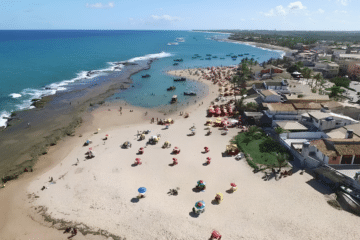
Praia do Forte, in the municipality of Mata de São João, Bahia, was chosen as the project’s national headquarters because it is one of the most important sea turtle nesting sites in Brazil.
In 1988, the Pró-Tamar Foundation was created, a support organisation that works alongside the government to facilitate research, environmental education and community development.
Today, the Tamar Project is one of the world’s greatest examples of marine conservation, with 21 bases spread over more than 1,100 kilometres of Brazilian coastline, protecting not only turtles but also sharks, rays, corals and other marine life, always involving local communities as partners in conservation.
See 5 species of sea turtles found in Brazil.
Videos about the Tamar Project


What is Projeto Tamar?
It is the national headquarters of the Brazilian Sea Turtle Conservation Project, active since 1980. Praia do Forte is one of the most important nesting and feeding sites in the country.

Why visit?
- Get up close to live sea turtles in observation tanks.
- Learn about Brazil’s marine fauna with interactive exhibits.
- Discover the work of research, environmental education and involvement with local communities.
- Ideal for the whole family, with a focus on children and educational tourism.
- Service in Portuguese, English, Spanish and Italian.

What you’ll find there
- Tanks with turtles of different species and sizes
- Educational trails and information panels
- Gift shop and local handicrafts
- Cultural activities and special events throughout the year
- Contact with nature and ecotourism experiences
Useful information
- Schedule: Check the official website for up-to-date days and times
- Tickets: A symbolic amount to help maintain the project
- Accessibility: The venue is adapted for wheelchair users and people with reduced mobility.
Location
- Where it is: Vila dos Pescadores, Praia do Forte – Mata de São João (BA).
- How to get there: It’s about 80 kilometres from Salvador on the Green Line (BA-099).
- Map: Next to the Garcia D’Ávila lighthouse, at the entrance to the village.
Tourist tip
Visit between November and March, the turtle nesting season. If you’re lucky, you’ll see the eggs hatch and the hatchlings released into the sea – an unforgettable moment!

Publicações Relacionadas
Barreiras: An Ecological Paradise in Bahia
Main Towns and Villages in the Chapada Diamantina Region
Cathedral Basilica of Salvador — History, Sacred Art and Collection
Tourist attractions in the Gamboa neighbourhood in Salvador BA
The Municipality of Conde, Bahia: Beaches and a Comprehensive History
Tinharé Archipelago: Discover Hidden Island Gems
Mucuri and Costa Dourada — Beaches, cliffs and ecotourism in Bahia
Chocolate Road and trails of the Cocoa Coast - video
Palaces in Salvador to visit and learn about Brazil's history
Discover the Abrolhos Archipelago: a haven for humpback whales and a biodiversity hotspot
Tourist attractions for children in Salvador: Fun and learning
Subaúma Beach: The Perfect Escape in Bahia
Learn more about the sloth and its unique characteristics
Lapão Cave: The Ultimate Adventure Experience
Barreiras: Where Carnival Meets Adventure Tourism
Beaches and Waterfalls of Itacaré: A Hidden Gem
Discover the Magnificence Fort of Nossa Senhora de Monte Serrat
4 Must-See Museums in Salvador: Art, History and Culture
7-day itinerary in Salvador and the surrounding area: Pelourinho, the islands and Praia do Forte
Parks and Squares in Salvador for Leisure Activities
Serra Grande: Your Guide to Bahia's Paradise
Tourist Attractions and Documentaries about Chapada Diamantina
Picos das Almas, Itobira and Barbado Trekking Guide
Camaçari: Industry, History and Natural Beauty
South Coast of Bahia: Discover Stunning Beaches
Trekking - Route through the Chapada Diamantina in 7 days
Juazeiro: Discover the Land of the Carrancas
History of grape and wine production in the São Francisco Valley
Ilha dos Frades — History, beaches and tourist attractions
Maraú Peninsula: Explore Its Stunning Beaches
Tourist Attractions in Bahia: main attractions, beaches and cities
Skydiving, Paragliding and Ballooning in Bahia
Extreme Sports in Bahia: Adventure Awaits You
Ecotourism in Bahia: discover village of Santo André
Ibicoara: An Unmissable Tourist Destination
Palmeiras: A Gateway to Chapada Diamantina
This post is also on:
 Português
  English
  Deutsch
  Español
  Français