Travel guides for Bahia, Alagoas, Ceará and the whole of the North-East of Brazil: beaches, ready-made itineraries, culture and accommodation tips. Get inspired and plan your trip.
Bahia Travel Guide
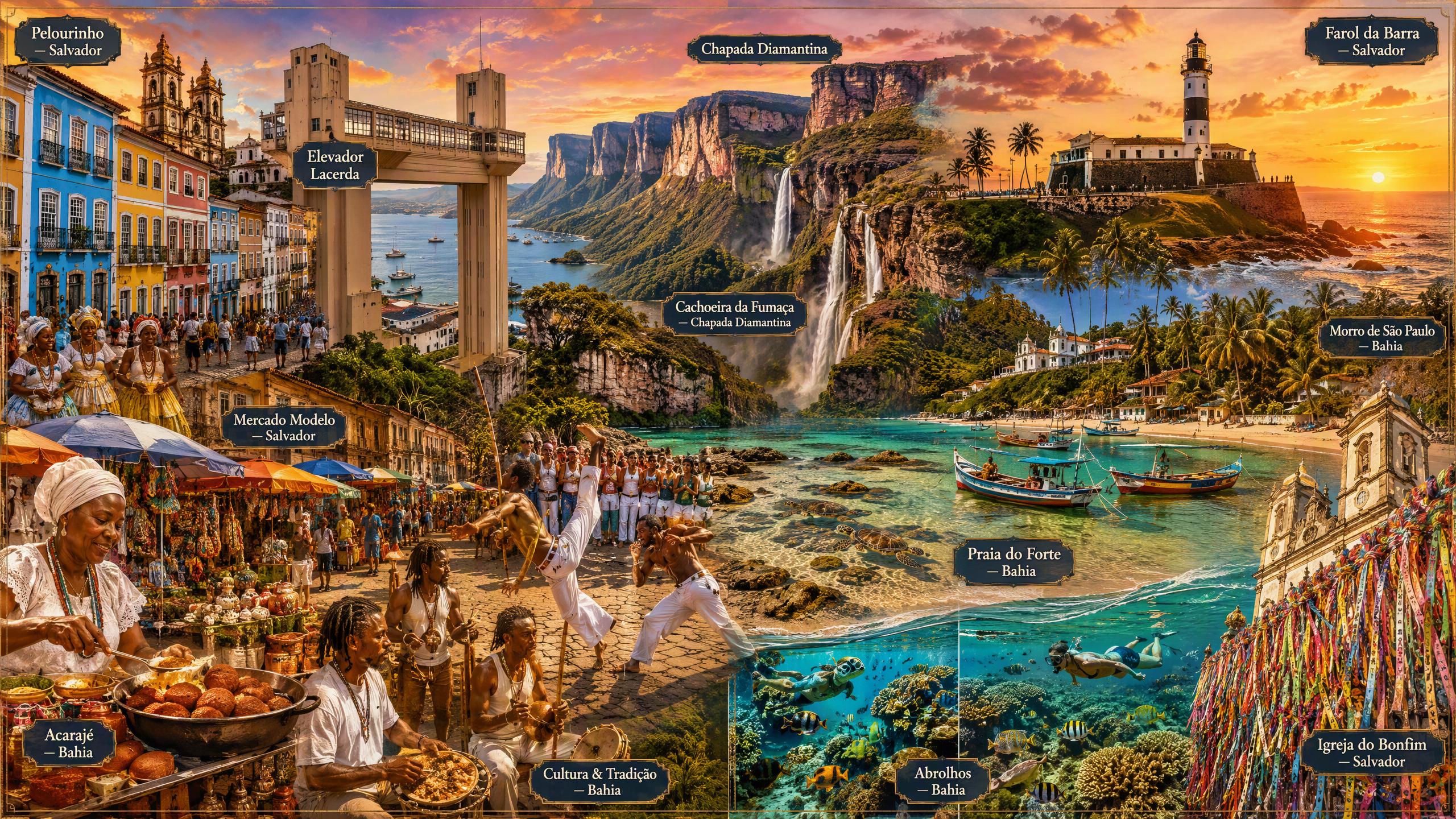
Bahia brings together, within a single state, a historic capital, one of Brazil’s longest coastlines, mountain ranges with waterfalls, and a distinctive Afro-Brazilian culture reflected in its music, dance and cuisine.
This Bahia travel guide organises the destinations by region so you can choose where to go and plan your itinerary according to the time you have available and your travel style.
Bahia Travel Guide
Salvador and the Bay of All Saints
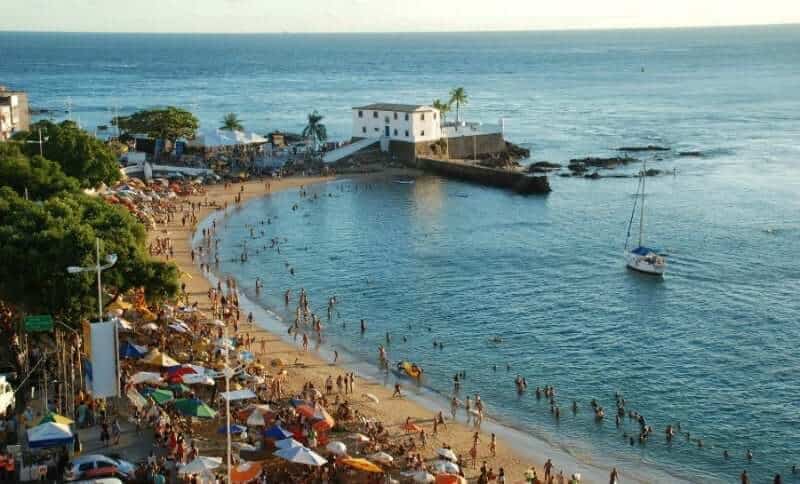
Salvador, the state capital, was Brazil’s first capital and is home to the Pelourinho, churches, museums, forts, beaches and one of the country’s best-known carnivals. Near the capital are Lauro de Freitas and Baía de Todos os Santos, with islands ideal for day trips.
The most popular destinations are Salvador, Porto Seguro, Trancoso, Arraial d’Ajuda, Morro de São Paulo, Itacaré, Praia do Forte and the Chapada Diamantina. Each region has its own distinct character, and the full list can be found under tourist attractions in Bahia.
When is the best time to visit Bahia?
It depends on the destination. The coast welcomes tourists all year round, with the highest numbers during the summer and at Carnival. Humpback whale watching on the Costa das Baleias and in Abrolhos takes place between July and November. For hiking in the Chapada Diamantina, it is worth checking the weather forecast, as rain can affect rivers and trails.
How many days do you need to explore Salvador?
Generally speaking, three to four days are enough to visit the Pelourinho, the churches, the museums, the forts and a few beaches. Take a look at the Salvador guide to plan your itinerary.
What are the best beaches in Bahia?
Bahia has beaches all along its coastline, from the North Coast to the southernmost tip. Take a look at the list of the best beaches in Bahia, featuring destinations for families, couples and those looking for quieter beaches.
What are the tourist regions in Bahia?
These include Todos os Santos Bay, the Costa dos Coqueiros, the Costa do Dendê, the Costa do Cacau, the Costa do Descobrimento, the Costa das Baleias, the Chapada Diamantina and the São Francisco Valley. See the map of tourist regions.
Where can you see whales in Bahia?
The Whale Coast and the Abrolhos Archipelago, at the southernmost tip of the state, are the best-known spots for spotting humpback whales between July and November. Find out more in the guide to the Whale Coast.
What is there to do in Chapada Diamantina?
The most common activities are hiking, swimming in waterfalls, visiting caves and day trips from Lençóis. Read the Chapada Diamantina guide to choose your excursions.
Was Salvador Brazil’s first capital?
Yes. Salvador was Brazil’s first capital, from 1549 to 1763, and as such it boasts one of the country’s most important collections of colonial architecture, as illustrated by the history of the Bay of All Saints.
The Salvador Carnival is one of the biggest street parties in the world: for six official days, trios elétricos, Afro blocos and millions of revellers take over the city. In 2027, the official festival runs from 4 to 9 February, with pre-Carnival events from 29 January. That is why this […]
Salvador, one of Brazil’s most vibrant and culturally rich cities, offers a wide range of experiences and practices related to prostitution, sex, massage parlours, bars and nightclubs. This landscape is shaped by the city’s diversity and the interaction between its different urban, cultural and social environments. General context Prostitution in […]
The Church and Convent of São Francisco (Igreja e Convento de São Francisco), in Salvador’s Historic Center, is called the “Golden Church” because of the gilded woodcarving that covers its interior. In addition, it is one of the richest examples of Portuguese Baroque in Brazil. So, in this guide, you […]
Pelourinho is the heart of the Historic Centre of Salvador, a UNESCO World Heritage Site since 1985. In addition, it brings together stone hills, colonial mansions, Baroque churches, museums and Afro-Bahian music. In this guide, therefore, you will find the history of Pelourinho, what to do in each square, which […]
The history of Salvador officially begins on 29 March 1549, when the first governor-general, Tomé de Sousa, arrived in the Bay of All Saints to found the capital of Brazil. However, before that the bay was already home to the Tupinambá, the castaway Caramuru and the Vila Velha settlement. That […]
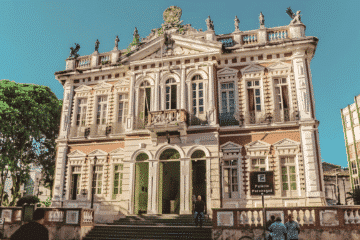
The Church of São Pedro dos Clérigos stands on Terreiro de Jesus, in Salvador’s Historic Centre, next to the Church of São Domingos de Gusmão. Built from 1709 by the brotherhood of the city’s priests, it received its current facade in 1887 and shows the transition from Rococo to Neoclassicism […]
The tourist attractions of Salvador include Baroque churches, forts, viewpoints, markets and beaches, in Brazil’s first capital. In addition, the city blends Portuguese and Afro-Brazilian heritage like few places in the world. So, in this guide, you will find the main attractions organized by area, with links to the full […]
The Senhor do Bonfim ribbon is Salvador’s most famous symbol: a colourful ribbon tied around the wrist with three knots, one for each wish. Created in 1809 as the “Bonfim measure”, it was born at the Church of Nosso Senhor do Bonfim and is now known all over the world. […]
The Bonfim Church, officially the Basílica do Senhor do Bonfim, is the most famous church in Salvador. It stands on the Colina Sagrada (Sacred Hill), in the Cidade Baixa, and is known for the Lavagem do Bonfim and for the ribbons tied to its railings. In this guide, therefore, you […]
The regions of Bahia for tourism are 13 tourist zones, which range from the beaches of the coast to the mountains of the Chapada Diamantina and the backlands of the São Francisco. So, in this guide, you will find the tourist map of Bahia, the map of the coast, the […]
Tourism in Bahia is characterised by the fact that the state is one of the most important tourist centres in Brazil. Bahia has an immense variety of landscapes, cultural traditions and attractions, allowing it to be divided into tourist areas, each with a name characteristic of its main physical and […]
The origin of capoeira lies with the enslaved Africans brought to Brazil and their descendants. They blended fighting styles, dances, songs and rhythms from many parts of Africa, especially the Bantu region, and thus created on Brazilian soil an art that is at once a fight, a dance, music and […]
War of Canudos: Bahia revives the village of Canudos Bahia will build its first scenographic city in honour of Canudos. The State Secretary for Tourism, Domingos Leonelli, announced that the project to build the city will represent the village of Canudos, in the hinterland, and also aims to revive the […]