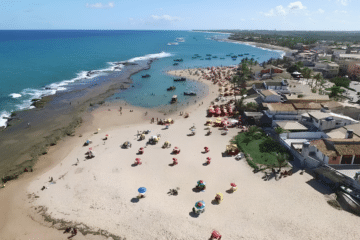
Discover the east coast of Ceará: Wild beaches and impressive cliffs
The east coast of Ceará, stretching from Aquiraz to the border with Rio Grande do Norte, is known as the Costa do Sol Nascente.
This coast includes the municipalities of Pindoretama, Cascavel, Beberibe, Fortim, Aracati, Icapuí and Itaiçaba.

All along its length you can see white sails reaching the sea before the sunrise, a movement repeated daily as fishermen push their rafts towards the ocean.
Visiting the east coast of Ceará, in addition to the sun and the dunes that make up beautiful landscapes, means being in the midst of a culture that maintains its authenticity even on the busiest beaches.
The short distances between the beaches along this stretch, which is served by the CE-040 motorway, make for pleasant day trips.

Videos – Main Beaches of the East Coast of Ceará
See the map of the East Coast of Ceará

Jericoacoara no Ceará03:28
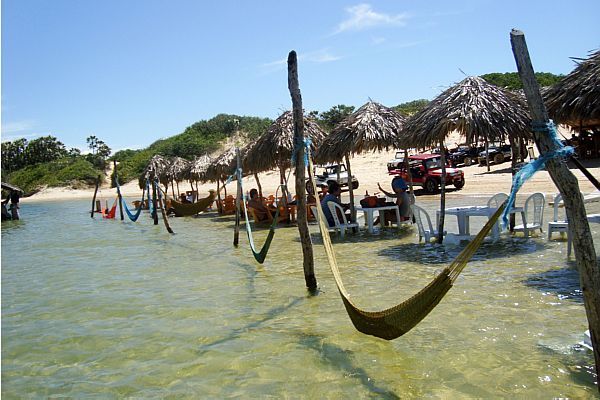
Lagoa da Tatajuba no Ceará12:08

Canoa Quebrada de cima00:59

Litoral Leste do Ceará03:10
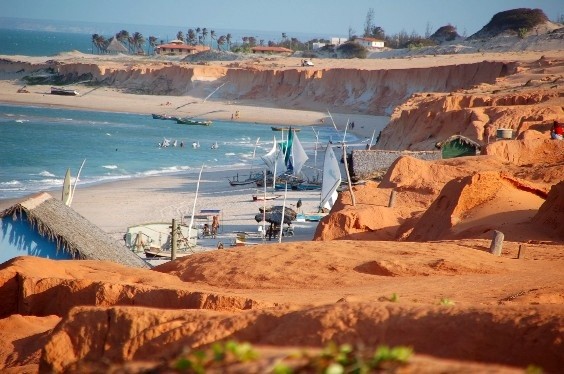
Canoa Quebrada no Ceará05:32
Aquiraz noCeará03:15

Praias de Beberibe no Ceará03:32

Praia das Fontes em Beberibe00:59

Praia do Morro Branco em Beberibe01:32

Praia do Canto Verde em Beberibe03:50

Cascavel no Ceará00:29

Icapuí no Ceará02:50

Top 5 Praias do Litoral Leste do CEARÁ26:28

Main Tourist Attractions of the East Coast of Ceará
- Municipality of Aquiraz
- Municipality of Aracati
- Municipality of Cascavel and Beberibe
- Municipality of Icapuí
1 Municipality of Aquiraz
Located on the east coast of Ceará, Aquiraz has 36 kilometres of beautiful beaches as its main natural attraction, in addition to its historical and architectural value.

The main beaches are
- Porto das Dunas (where Beach Park is located)
- The beach
- Iguape Beach
- Prison
- Black clay
- Batoque
All the beaches in Aquiraz have similar characteristics, such as a tropical climate and a constant breeze.
Tourist development is of a high standard, preserving the local flora and fauna and offering quality services in restaurants, inns and lodges.
There are several options for sightseeing in Aquiraz.
In the Historical and Cultural Centre you can visit the Igreja da Matriz, the Ruins of the Jesuits, the Sacred Museum, the Praça da Matriz, the Mercado Velho, the Vila do Capitão Mor, the Centro das Rendeiras, the Porto das Jangadas and the Handicraft Centre, where you can find lace, mazes and embroidery, as well as perfect replicas of miniature rafts ranging from 30 centimetres to almost two metres.
Leisure activities include rafting on the Iguape and Manguezais rivers or in the lagoons, or longer trips to neighbouring Beberibe to see the cliffs of Praia do Morro Branco and the dunes of Praia das Fontes.
In 1713, the small village of Aquiraz, the scene of violent clashes between Europeans and natives, was elevated to the status of town and served as the seat of the Siará captaincy until 1726.
The town, located 32 kilometres from Fortaleza, preserves buildings from the colonial period and retains its rural atmosphere, although today it is very popular due to the Beach Park, a large development that attracts tourists from all over the country.
1.1 São José de Ribamar Mother Church and Sacred Museum
Built in the mid-18th century, the Mother Church of São José de Ribamar has undergone several transformations over time, resulting in a mixture of neoclassical and baroque elements.

The three large upholstered doors at the main entrance, the carved wooden pulpit and the painted panels on the chancel ceiling depicting passages from the life of São José de Ribamar (Praça Cônego Araripe, s/n, Centro) are original.
The São José de Ribamar Sacred Museum, with a collection of almost five hundred pieces from the 17th, 18th and 19th centuries, is housed in a well-preserved townhouse that was once the town hall and prison, and whose construction was completed in 1877.

In the upper part, the ceiling is reinforced with carnauba beams; the most important piece is a silver cross from the 18th century, brought to Aquiraz by Jesuit priests (Praça Cônego Araripe, 22, Centre).
1.2 Miniature rafts
Timbaúba, a wood native to the region, is transformed into small works of art in the hands of Seu Oliveira, a former fisherman from Prainha. This wood is prized for its properties and is used to carve miniature rafts.

The craftsman, who learnt his trade at the age of eight, spends much of the day on the veranda of his house, carving small rafts with a sharp knife.
The perfection and richness of the details (sails, samburás, fishing lines and other instruments used by fishermen) reflect the local culture and attract the attention of tourists passing by the beach (Rua Damião Tavares, 349, Prainha).
The pieces can also be found in the Prainha Rendeiras Centre.
1.3 Beach Park on the east coast of Ceará
The Beach Park is located on the Porto das Dunas beachfront on the east coast of Ceará. The park offers a wide range of family activities, with seventeen water rides of all kinds, from the more gentle ones suitable for small children to the more “radical” ones.

The complex includes snack bars, restaurants and shops.
You don’t need to pay if you just want to enjoy the beach area and the bar and restaurant services (R. Porto das Dunas, 2734, Porto das Dunas).
1.4 Rendeiras
In the seven kiosks of the Prainha Lace Makers’ Centre, forty lace makers take turns selling to tourists and making bobbin lace with thick or thin threads (more delicate and laborious, taking several days to complete).

These include bedspreads and tablecloths (Rua Damião Tavares, s/n, Prainha).
At the Iguape Lace Makers Centre, near the dune and the fishermen’s hut, you can find labyrinth embroidery and bobbin lace. You can buy table runners, towels, bath towels, tray cloths, patches for clothes and even bags (Av. da Praia, s/n, Iguape).
1.5 Art market
This 19th century building, a former trading post and meat market, is now a cultural centre with art workshops, craft shops and a restaurant, as well as a public library.
The geometric harmony of the roof frame and the precise construction technique, based on the use of carnauba and adobe, are worth a visit (Rua Santos Dumont, s/n, Centro).
1.6 The beaches of Aquiraz
Aquiraz isn’t just about the trendy and expensive Jericoacoara and Canoa Quebrada (in Aracati). Aquiraz is only 27 kilometres from Fortaleza, on the east coast of Ceará.
- Porto das Dunas
Porto das Dunas has soft white sand and stretches that are ideal for surfing. It is the beach with the best infrastructure, with hotels, restaurants and apartments. - Praínha
Always very crowded and popular for excursions, it is dotted with shacks. There is a lot of hassle from guides offering tours and accommodation. - Presidio
Home to holiday homes on a wide stretch of white sand, interspersed with lagoons and bordered by the Salinas River. Famous for its street carnival in the sand. - Iguape
The most urbanised beach in Aquiraz, with white sands, a calm sea dotted with rafts and a lonely dune. It has modest inns, restaurants and stalls. - Barro Preto
Straight, with dark sand, coconut groves, a few holiday homes, small hotels and huts. The buggies stop at Giovane Cavalcante’s picturesque hut, decorated with scrap metal. - Praia do Batoque
Isolated, with few huts, dunes, cliffs and lagoons nearby, clear sand and calm sea. Access involves crossing a stretch of the Barro Preto River.


2. Municipality of Aracati
Aracati, on the east coast of Ceará, is known for its natural beauty, with Canoa Quebrada Beach as its postcard. It is one of the most popular beaches in the state and receives many tourists during the summer. Its beautiful scenery and infrastructure are ideal for enjoying a great day at the beach.
The nightlife is also lively and will please those who like to have fun, with a choice of bars and restaurants serving typical dishes such as grilled fish, crab, tapioca and manioc cake.
The city of Aracati has a good infrastructure, including hotels, restaurants and restaurants serving typical local cuisine.
Sports are popular, and for the more adventurous there is hiking along the cliffs of Canoa Quebrada.
It’s an ideal place to relax, recharge your batteries and enjoy a wonderful weekend.
2.1 Beaches in Aracati
The Porto Canoa beach can be reached on foot from neighbouring Canoa Quebrada.
The landscape of reddish cliffs contrasts with the white sails of rafts resting on the sand.

The Majorlândia beach is good for swimming and has colourful cliffs from which sand was taken to decorate the famous bottles sold throughout the state of Ceará.
It has an infrastructure of bars, restaurants and inns on a beach area framed by coconut trees and white and red cliffs.
In October, the beach is the starting point for the Majorlândia Raft Regatta.

Set between white cliffs, Quixaba beach is recommended for those seeking quiet, as is the semi-deserted Lagoa do Mato, which can be reached on foot or by buggy. To reach the small lagoon that gives the beach its name, climb the dunes.
At Fontainha, where the sea is not suitable for swimming, the colourful dunes appear again. Retirinho is a small stretch of coastline bordered by a reef; in Retiro Grande, as well as in cosy Ponta Grossa and little Redondas, there are sargassums and a small fishing village perched on the cliffs.
1. Majorlândia
Located 12 km from Aracati, 170 km from Fortaleza and 6 km from neighbouring Canoa Quebrada.

Majorlândia is a fishing village founded in 1937 by Major Bruno da Silva Figueiredo (Majorlândia = ‘Land of the Major’).
Dense coconut groves and reddish-white cliffs dominate Majorlândia beach. The fishermen’s boats anchored along the beach harmonise with the beauty of the place.
Surfers enjoy the strong, constant waves.
Majorlândia is said to be the origin of the famous coloured sand bottles made by local artisans.

Majorlândia has the infrastructure to welcome visitors: inns, bars and restaurants with an abundance of fresh fish and seafood.
2. Quixaba Beach
Located in the parish of Aracati.

A beach in a fishing village with a few holiday homes and restaurants. It is surrounded by clear cliffs with a few coconut palms scattered around the landscape.
3. Porto Canoa
Between reddish cliffs, this is a beach where fishermen gather their boats to rest at dusk – hence its name.
4. Lagoa do Mato
A deserted and unspoilt beach with few buildings, it is crossed by buggy drivers on their tours.

5. Fountain
A short stretch of clear sand surrounded by colourful dunes. The sea, with its strong waves, is only explored by fishermen.

6. Retirinho
A stretch of reef rises between the sea and the beach; in the bay, the sea reaches the reddish cliff at high tide.

7. Retiro Grande
Sargasso Sea and dark sand in a small fishing village with a few houses perched on the cliffs.

8. Canoa Quebrada
Canoa Quebrada beach, on the east coast of Ceará, is the most famous beach in the region, located in the municipality of Aracati, 161 kilometres from Fortaleza.


The town, which grew rich in the 18th century thanks to the jerky trade, is now known for its lively street carnival, although there are few places to stay.
In Aracati, the preservation of the houses left over from the colonial period, sometimes clad in Portuguese tiles, leaves something to be desired, but the buildings still catch the eye of those passing through on the BR-304 motorway, the main access to Canoa Quebrada – by far the biggest local attraction, with good tourist facilities, as well as bars and restaurants.
Canoa Quebrada is a magical place that surprises everyone with its vibrancy and paradisiacal beauty! The dunes, the cliffs, the sea and the dazzling sun are inexhaustible sources of energy and inspiration, making it a paradise for anyone who wants to be seduced.
In the 1970s, Canoa was discovered by hippies who were enchanted by its landscape of calm waters and dunes.

The transformation that has taken place in the city in recent decades is symbolised by the change of name of its main street: the former Dragão do Mar Street – the nickname of the jangadeiro who became famous for his militancy against slavery – is now called Broadway, melancholically because of the bars and pubs where the evenings go on until dawn.
3. Municipalities of Cascavel and Beberibe
- Cascavel, 64 kilometres from Fortaleza on the CE-040, is known for its beautiful beaches and rich handicrafts.
- Beberibe, on the other hand, is a small town with no urban attractions, 83 kilometres from the capital and 20 from Cascavel. However, this region is home to two of the most famous beaches on the east coast: Morro Branco and Praia das Fontes.
3.1 Beaches in Beberibe

Beberibe, located on the east coast of Ceará, is famous for its stunning beaches, with Morro Branco being the postcard of the region.

This is the busiest beach, just four kilometres from the centre, surrounded by beautiful dunes and reefs.
Main beaches
- Morro Branco: This is one of the most popular destinations for buggy rides, with stops near the cracks in the labyrinth of cliffs, the result of erosion in the sand of different shades. In the village square, visitors will find the traditional bottles decorated with grains of coloured sand. The beach has an infrastructure of bars and restaurants, attracting many tourists.
- Praia das Fontes: Known for its freshwater fountains, caves, dunes and cliffs, it is an ideal place for families, with calm waters. Lagoa do Uruaú, accessible from Praia das Fontes, is surrounded by huts with tables almost in the water and offers speedboat, jet-ski and kayak rides.
- Praia do Diogo: A less busy beach surrounded by dunes and freshwater gullies. The houses are perched on the cliffs, offering privileged views.
- Barra do Sucatinga: A fishing village and kiosks, surrounded by reddish sand formations, the sea dotted with rafts.
- Ariós: Accessible by buggy, this is a quiet and secluded beach, ideal for those seeking peace and quiet.
- Prainha do Canto Verde: One of the quietest beaches in the region, perfect for those who want to relax in a peaceful environment.
- Praia do Paraíso: Deserted and dotted with lagoons, it offers a serene atmosphere.
- Praia e Lagoa de Uruaú: Also known as Praia de Marambaia, it has a long stretch of white sand. Although it is a nature reserve, the lagoon is used for water sports.


3.2 Beaches in Cascavel
Cascavel, with the fewest beaches on the east coast of Ceará, is known for its tranquillity and cosiness. It has beautiful landscapes, such as the beaches of Águas Belas and Caponga, postcards of the city.
It’s a good option for a holiday where you can relax and take a refreshing dip in the sea. Both beaches have good facilities, with kiosks selling fresh fish snacks.
- Capanga: Urbanised, it lies in a bay where the summer houses of Fortaleza’s residents are concentrated. It has white sand and calm waters, with reefs, and is home to one of the largest rafting harbours on the Ceará coast.
- Águas Belas – Quiet, with a fishing colony, it begins at the end of Caponga Bay. Its landscape is characterised by dunes and coconut palms, and by the Malcozinhado River with its mangroves.
- Barra Nova: A small deserted beach with mobile dunes and coconut trees, and a strip of reef in the sea. Only accessible by car or on foot via Águas Belas beach.


3.3 Cascavel Handicraft Centre
The Craft Centre in Cascavel, on the east coast of Ceará, is located at the entrance to the town. Among the items on display are ceramics with indigenous and Portuguese influences from the neighbouring community of Moita Redonda, and furniture and objects made from cipó-de-fogo, the typical vegetation of the surrounding forests. CE-040, km 56, entrance to Cascavel.
3.4 Rapadura mills
On the CE-040 motorway, between the towns of Aquiraz and Cascavel, there are several sugar cane mills where you can see how rapadura, alfenins, mill honey, cane brandy and brown sugar are made.
All of these products made from garapa sugar cane can be tasted during your visit.
Among the mills, Casa Grande stands out, with the largest rapadura in the world. You can also see the old ox-drawn mill and the current production mill (CE-040, km 37).
4. The beaches of Icapuí
The beaches of Icapuí, surrounded by coconut groves and cliffs, attract tourists to this charming municipality on the border between the east coast of Ceará and Rio Grande do Norte.
The region is characterised by dunes, cliffs and the bustle of fishing rafts.
Icapuí has fifteen beaches, of which Ponta Grossa Beach is the cleanest in Ceará, according to an assessment by the state environmental department and IBAMA.
This beach invites you to swim in the sea, with its gentle waves and stunning sunset views from the top of the cliffs. Two other outstanding beaches in the region are Praia da Redonda and Praia da Requenguela, each offering a unique experience.
1. Ponta Grossa Beach
Located 200 kilometres from Fortaleza, Ponta Grossa Beach is ideal for those who want to understand the formation of cliffs over time as a result of the action of the sea.

Visitors can explore trails that reveal natural sculptures, as well as caves, coloured rocks and curious formations, in a generally quiet and deserted environment.
2. Redonda beach
Praia da Redonda stands out for its infrastructure, which includes several inns and restaurants.

With a calm sea and a landscape that mixes dunes and cliffs, it’s the perfect place to relax. Icapuí is also famous for its abundance of lobster, and visitors can’t fail to try this delicacy in mango sauce.
3. Requenguela Beach
At the opposite end of the coast, Requenguela Beach has a different atmosphere, with mangroves that enchant visitors.

An environmental station offers free activities and ecology lessons on a 240-metre-long hanging path that crosses the mangrove swamp.
At the end of the trail, tourists will find Barra Grande, known for its unique feature: at low tide, the sea can recede up to three kilometres, revealing an impressive view with cliffs on one side and mangroves on the other.
East Coast of Ceará Tourist Guide

Publicações Relacionadas
Route of Emotions: An Adventure through North-East Brazil
Kitesurfing in Tatajuba — Spots, Access and Season
Where to Stay in Fortaleza: Neighbourhoods and Beaches (2026)
Aquiraz, Ceará: Guide to Porto das Dunas and Beach Park
The Mountains of Ceará: A Guide to Mountain Towns for Tourists
Cariri in Ceará: A Comprehensive Guide to Tourism and Culture
Serra da Ibiapaba: A Complete Guide to Attractions and Tips
Guaramiranga: The Complete Guide to the ‘Switzerland of Ceará’ (Itineraries and Tips)
Icapuí, Ceará: The perfect destination for those seeking the ‘Land of the Lobster’
Things to Do in Paracuru, Ceará: Beaches and Sports
Tatajuba, Ceará: things to do, how to get there and top attractions
Caetanos de Cima is one of the most beautiful beaches in Ceará
Icó, Ceará: History, Architecture and Tourist Attractions
What to Do in Fortaleza in 3 Days: A Complete Itinerary
Fortim and the Jaguaribe River, Ceará: A Complete Travel Guide
The Best Beaches in Fortaleza and Ceará: A Complete Guide with 22 Options
Salgado River Canyon in Lavras da Mangabeira, Ceará
Beach Park – Complete guide: attractions, tickets and tips for Porto das Duna
Aracati, CE: A Complete Guide to Canoa Quebrada and the Surrounding Area
Fortaleza: A Guide to Ceará's Vibrant Capital
Ceará: Must-see tourist destinations in Brazil
Quixadá, Ceará: Monoliths, the Cedro Dam and the Sertão
Religious Tourism in Cariri (CE): Padre Cícero and Pilgrimages
The Baturité Massif: A Complete Guide to Tourism in Ceará
Ubajara National Park: A Complete Visitor’s Guide
The Cliffs Route in Ceará: A Complete Travel Guide
Jericoacoara, Ceará: Complete Guide and 5-Day Itinerary
Canoa Quebrada, Ceará: A Guide to Cliffs and Beaches
Juazeiro do Norte: Things to Do and a Guide to Religious Tourism
The Costa dos Ventos Route, Ceará: A Complete Guide to 9 Towns
Tourism in the Cariri region of Ceará: A complete 3-day itinerary through the Araripe Geopark
Beaches on the West Coast of Ceará: A Complete Guide
Ceará: The Best of Ecotourism and Extreme Sports in Brazil
Cumbuco Beach (Ceará): The Definitive Guide to Kitesurfing and Leisure
This post is also on:
 Português
  English
  Deutsch
  Español
  Français