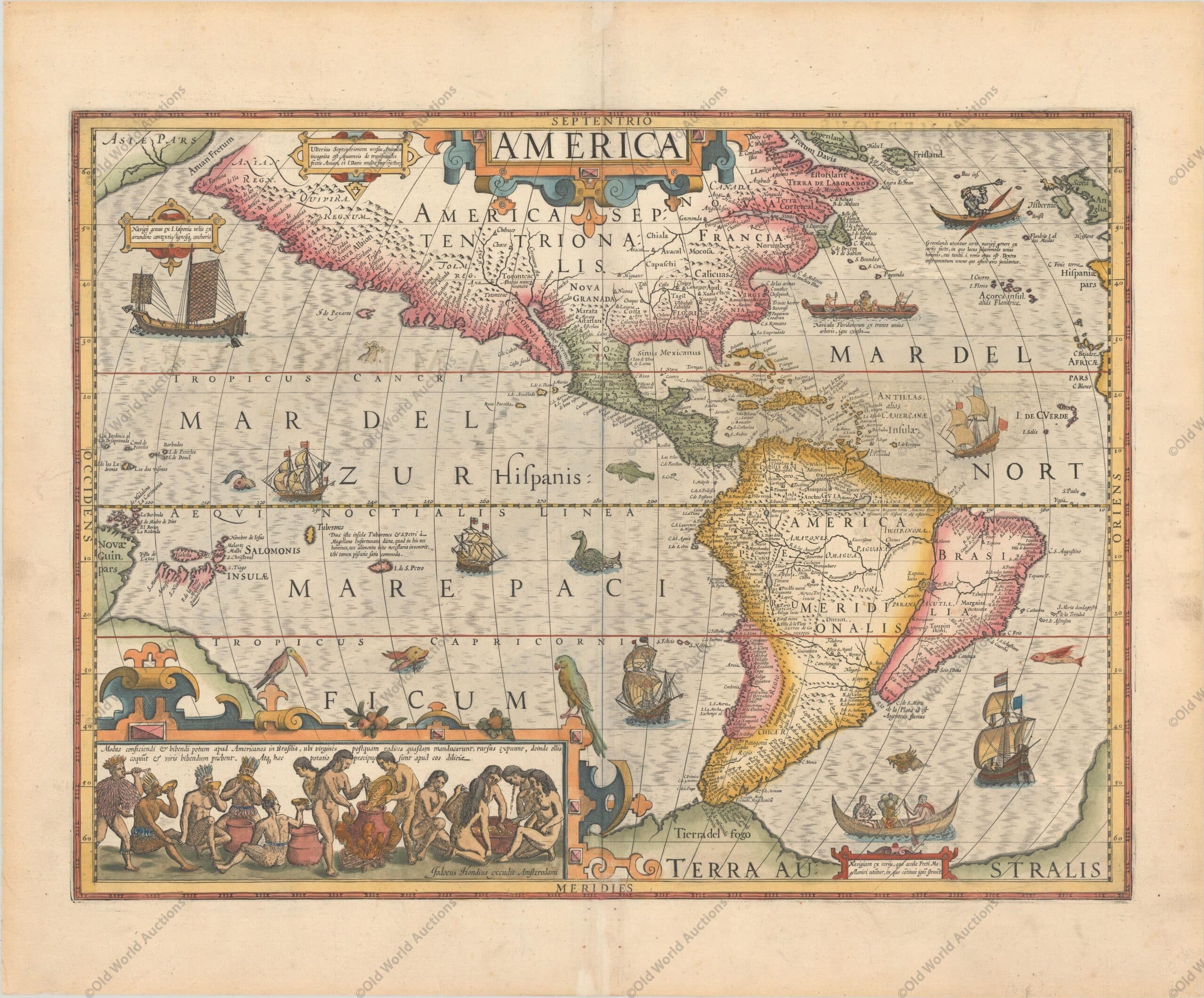
Map of the Western Hemisphere, 1628
Jodocus Hondius’ map of the Americas is one of the most elaborate examples of fine Dutch cartography.
The decorations, including sea monsters, native birds, native canoes and sailing ships, were taken from De Bry’s Grand Voyages.
Particularly noteworthy is the scene of the natives preparing an intoxicating drink made from manioc roots, derived from Hans Staden’s harrowing adventure in Brazil.
The continents are shown in a stereographic projection, which became increasingly popular in the early 17th century.
It shows a more accurate western coastline of South America and reduces the width of Mexico.
However, North America is still very wide and Virginia has an exaggerated coastline. Newfoundland is based on Plancius.
The coasts are fully engraved with place names. This is from the latest French edition of this important atlas.
1628 Map of the Western Hemisphere – Historical Map
Publicações Relacionadas
All Saints Bay Map of 1644 - Historical Map
Map of South America from 1615: Explore the Details
Map of South America from 1650: A Historical Overview
1730 Map of Northern South America - Historical Map
1730 Map of the Western Hemisphere - Historical Map
Map of the Gulf of Mexico and the Caribbean, 1594
Map of the Brazilian coast from the Paraíba River to Cabo de Santo Agostinho
Map of the Western Hemisphere from 1700 - Historical Map
Map of the Gulf of Mexico and the Caribbean from 1650-80
The Catalan Atlas: Redrawing the Medieval World and Asia
1550 Map of the Western Hemisphere - Historical Map
1677 Map of the Western Hemisphere - Historical Map
Engraving of Vila de Olinda in 1671 - Historical Engraving
Map of Recife in Pernambuco from 1679: Historical Insights
1609 Map of the Western Hemisphere - Historical Map
Map of the Gulf of Mexico and the Caribbean, 1681
1671 engraving of Fort Orange on the island of Itamaraca
Engraving of Salvador de Bahia from 1770 - Historical Maps
Map of the Brazilian Coast from 1678 - Historical Map of Brazil
1575 Map of Europe - Historical Map
1694 Map of South America - Historical Map
Map of Brazil from 1798: Explore Historical Details
Map of the Cape Verde Islands, 1697
Map of Rio de Janeiro, 1840 - Historical Map
Map of South America, 1840
Map of the Province of Paraíba from 1698 Overview
Engraving of the Fort of the Three Kings in Natal, 1671
Engraving of Cabo Santo Agostinho from 1645 - Historical Engravings
Map of Rio de Janeiro, 1750 - Historical Map
Map of Recife of 1764 - Historical Map
Historical maps showing the territorial development of Brazil
1659 Map of the Western Hemisphere - Historical Map
Map of Rio de Janeiro from 1682 - Historical Map
1587 Historical Map of the Western Hemisphere
Map of Olinda in Pernambuco from 1640 - Historical Map
1631 Map of the Western Hemisphere - Historical Map
This post is also on:
 Português
  English
  Deutsch
  Español
  Français