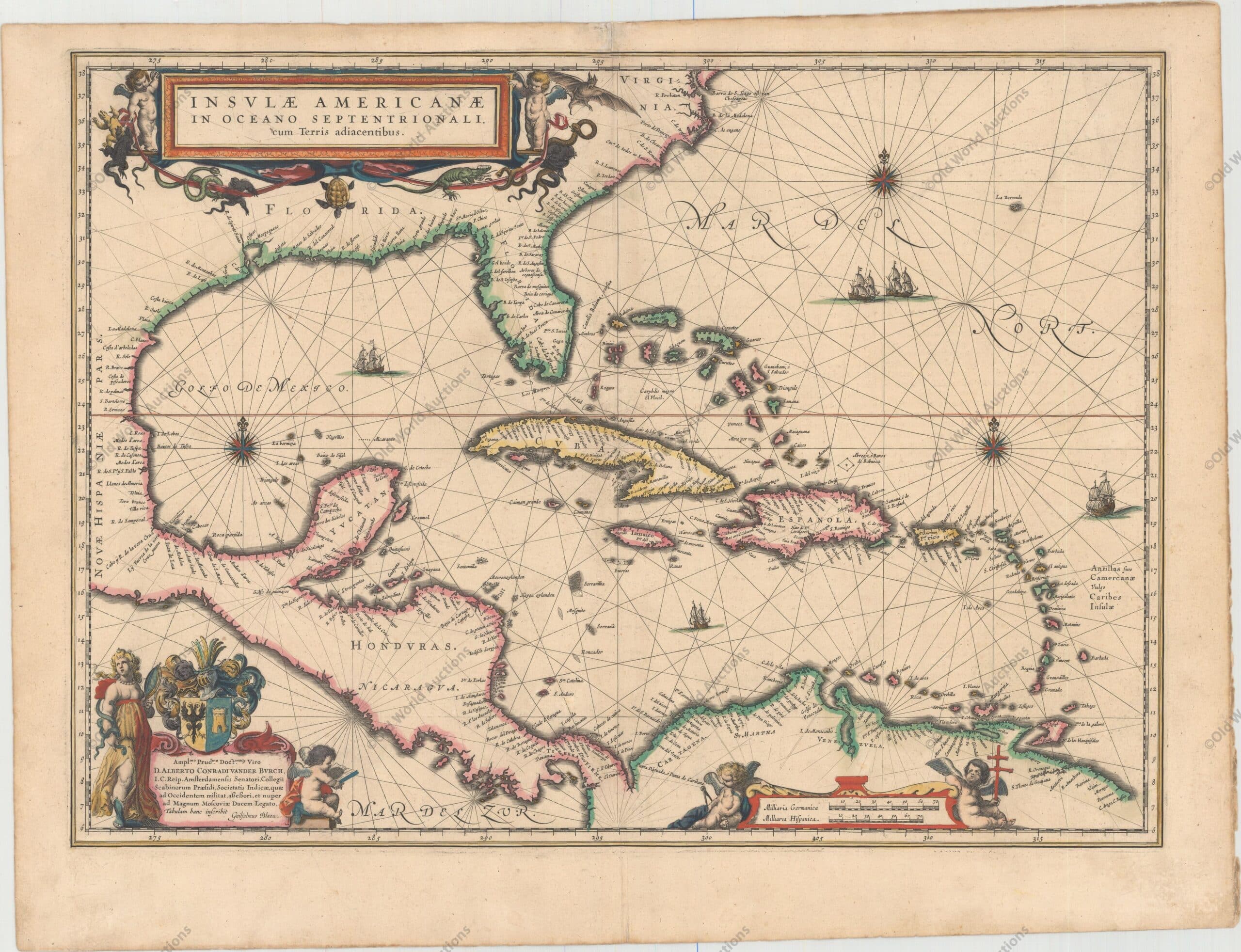
Map of the Gulf of Mexico and the Caribbean from 1638 – Theatre du Monde ou Nouvel Atlas…
“Insulae Americanae in Oceano Septentrionali, cum Terris Adiacentibus”, Blaeu, Willem
This beautiful map of the West Indies reflects the first hand knowledge of Hessel Gerritsz during his voyage to South America and the West Indies in 1628.
It covers the same area as Gerritsz’s 1631 map, from the Chesapeake Bay to the north coast of South America, with the addition of the west coast of Central America.
The nomenclature in North America is virtually identical, with the notable addition of the name Virginia.
The nomenclature was probably derived from a Spanish map, as there is no French influence.
The map is richly decorated with three beautiful cartouches, sailing ships, rhumb lines and compass roses.

Publicações Relacionadas
Map of the Gulf of Mexico and the Caribbean, 1594
Engraving of Fort Nassau in Pernambuco, 1671
Map of Brazil from 1652: A Historical Perspective
Map of Olinda in Pernambuco from 1640 - Historical Map
1592 Map of the Western Hemisphere - Historical Map
Map of Recife of 1764 - Historical Map
Engraving of Sirinhaém from 1671
Map of South America 1601 - Historical Map
1623 Map of the Western Hemisphere - Historical Map
Engraving of Cabo Santo Agostinho from 1645 - Historical Engravings
Map of Brazil from 1850: A Historical Overview
1631 Map of the Western Hemisphere - Historical Map
Map of Brazil from 1798: Explore Historical Details
Historical maps showing the territorial development of Brazil
1579 Map of the Western Hemisphere - Historical Map
1694 Map of South America - Historical Map
Map of Cabo Santo Agostinho from 1645 - Historical Map of Brazil
Copper Engraving of Salvador from 1748: History Explored
Map of Brazil 1730 - Historical Map
1671 engraving of Fort Orange on the island of Itamaraca
1823 Map of Brazil - Historical Map
1671 Map of Jamaica
View of Rio de Janeiro in 1840: Beauty Captured
Map of Rio de Janeiro of 1810 - Historical Map
Map of the Captaincy of Pernambuco from 1698 Overview
Map of Europe from 1644: A Classic Antique
1628 Historical Map of the Western Hemisphere
Engraving of the town of Olinda in 1633 - Historical Engraving
Reis Magos Fort Engraving from 1690 - Engravings Stories
Map of the Brazilian Coast from 1678 - Historical Map of Brazil
1719 Map of the Western Hemisphere - Historical Map
Map of Madeira and the Canary Islands from 1692
The Catalan Atlas: Redrawing the Medieval World and Asia
1620 Map of Portugal and Spain - Historical Map
Map of South America and Brazil 1624 - Historical Map
1697 Map of the Western Hemisphere - Historical Map
This post is also on:
 Português
  English
  Deutsch
  Español
  Français