Map of Brazil from 1850: A Historical Overview

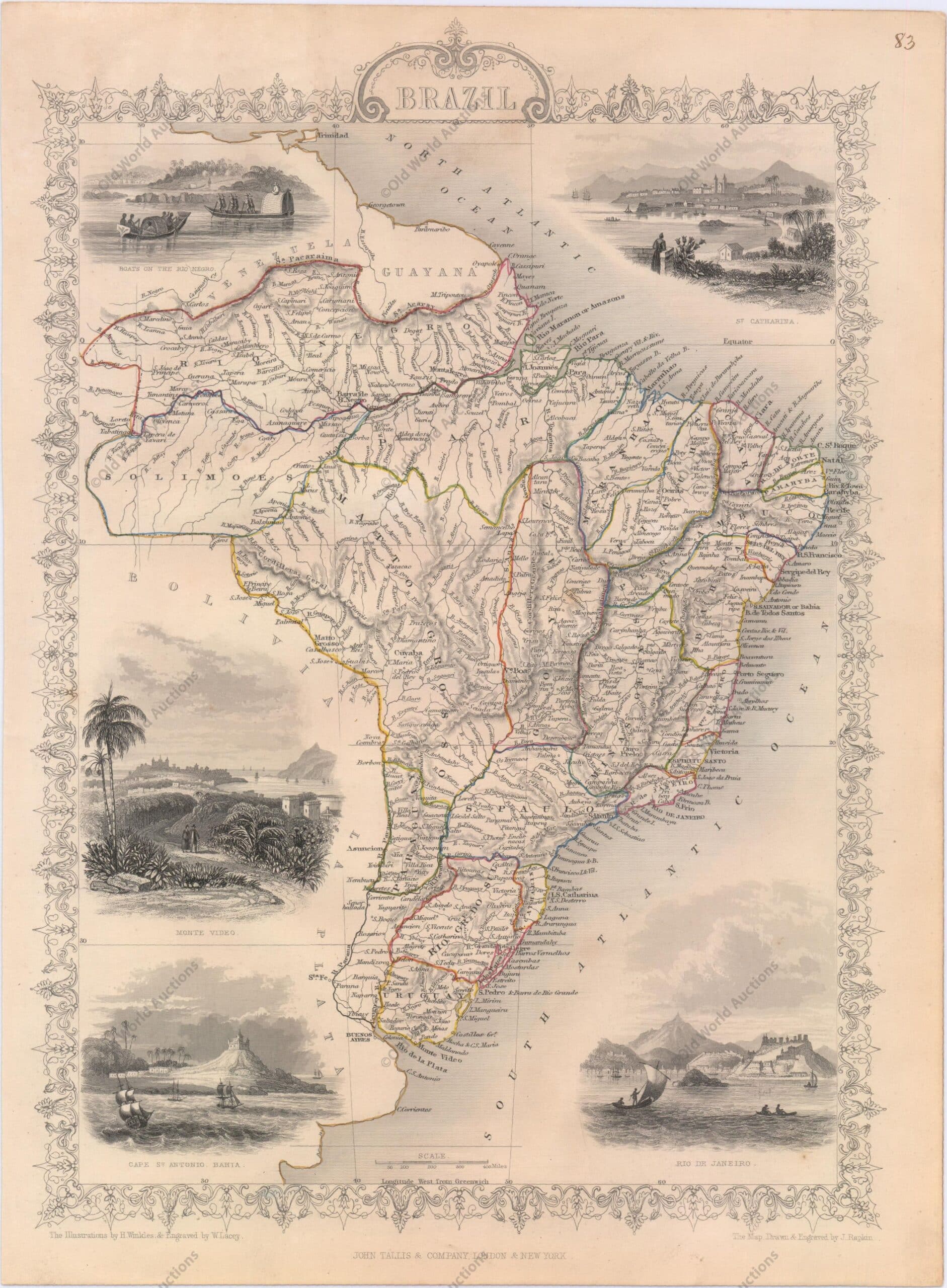
Mapa do Brasil de 1850 - Os mapas do The Illustrated Atlas foram publicados pela primeira vez em forma de série para um público-alvo que levava uma vida isolada devido aos custos e dificuldades das viagens. Tudo isso mudou à medida que o progresso do século XIX trouxe mudanças rápidas e dramáticas na consciência pública de lugares distantes. Sem dúvida, os mapas de Tallis desempenharam um papel importante nesse despertar dramático. Esses mapas não apenas forneceram conhecimento geográfico atualizado, mas também usaram visualizações de vinhetas no design do mapa para mostrar os povos nativos e suas ocupações, cidades e pontos de interesse. Os mapas remontam a uma tradição cartográfica dos cartógrafos holandeses do século XVII com bordas decorativas finamente gravadas. Os mapas foram desenhados e gravados por John Rapkin com vistas desenhadas e gravadas por vários artistas proeminentes. Os mapas foram publicados como um volume completo de 1851 até cerca de 1865. Alguns dos mapas também foram publicados em outros livros de história publicados por Tallis, incluindo colônias britânicas e, sem as vinhetas, em dicionários geográficos e enciclopédias até cerca de 1880. Um belo e decorativo mapa gravado em aço mostrando a região em grande detalhe. Apresenta cinco vinhetas, desenhadas por H. Winkles e gravadas por W. Lacey: "Barcos no Rio Negro", "Santa Catharina", "Monte Vídeo", "Cabo Santo Antônio, Bahia" e "Rio de Janeiro ." Cercado por uma borda decorativa delicadamente gravada. O mapa foi desenhado e gravado por J. Rapkin. "Brazil", Tallis, John
Map of Brazil, 1850 – The maps in The Illustrated Atlas were first published as a series for an audience that was isolated by the cost and difficulty of travel. All this changed as the 19th century brought rapid and dramatic changes in public awareness of distant places. Undoubtedly, Tallis’s maps played an important role in this dramatic awakening. These maps not only provided up-to-date geographical knowledge, but also used vignettes in the map design to show the native peoples and their occupations, towns and points of interest. The maps are in the cartographic tradition of 17th century Dutch cartographers with finely engraved decorative borders. The maps were drawn and engraved by John Rapkin, with views drawn and engraved by several prominent artists. The maps were published as a complete set from 1851 to about 1865. Some of the maps were also published in other history books by Tallis, including British Colonies, and, without the vignettes, in geographical dictionaries and encyclopaedias until about 1880. A beautiful and decorative steel engraved map showing the region in great detail. It contains five vignettes designed by H. Winkles and engraved by W. Lacey: “Boats on the Rio Negro”, “Santa Catharina”, “Monte Vídeo”, “Cabo Santo Antônio, Bahia” and “Rio de Janeiro”. Surrounded by a finely engraved decorative border. The map was drawn and engraved by J. Rapkin. “Brazil”, Tallis, John

Map of Brazil from 1850

The maps in The Illustrated Atlas were first published as a series for an audience that was isolated by the cost and difficulty of travel.

All this changed as the nineteenth century brought rapid and dramatic changes in public awareness of distant places.

Undoubtedly, Tallis’s maps played an important role in this dramatic awakening.

These maps not only provided up-to-date geographical knowledge, but also used vignettes in map design to show indigenous peoples and their occupations, towns and points of interest.

The maps are in the cartographic tradition of 17th-century Dutch cartographers, with finely engraved decorative borders.

The maps were drawn and engraved by John Rapkin, with views drawn and engraved by several prominent artists.

The maps were published as a complete set from 1851 to about 1865. Some of the maps were also published in other history books by Tallis, including British Colonies, and, without the vignettes, in geographical dictionaries and encyclopaedias until about 1880.

A beautiful and decorative steel engraved map showing the region in great detail.

It contains five vignettes drawn by H. Winkles and engraved by W. Lacey: “Boats on the Rio Negro”, “Santa Catharina”, “Montevideo”, “Cabo Santo Antônio, Bahia” and “Rio de Janeiro”.

Surrounded by a finely engraved decorative border. The map was designed and engraved by J. Rapkin, “Brazil”, Tallis, John.

Map of Brazil from 1850 – Historical Maps of Brazil

Publicações Relacionadas

1714 Map of the Western Hemisphere - Historical Map

Southeastern Colonial Map of the United States, Bahamas and Greater Antilles, 1706

Map of Rio de Janeiro, 1775 - Historical Map

1659 Map of the Western Hemisphere - Historical Map

Map of the Gulf of Mexico and the Caribbean, 1681

Map of the Gulf of Mexico, the Caribbean and the Southern United States, 1682

Map of Paraíba from 1662: An Engraved Masterpiece

1609 Map of the Western Hemisphere - Historical Map

1638 Map of the Gulf of Mexico and the Caribbean - Historical Map

Engraving of Fort Nassau in Pernambuco, 1671

1639 Map of Paraíba - Historical Map of Brazil

1623 Map of the Western Hemisphere - Historical Map

Reis Magos Fort Engraving from 1690 - Engravings Stories

Copper Engraving of Salvador from 1748: History Explored

All Saints Bay Map of 1644 - Historical Map

Map of Brasil from 1757: Historic Coastal Views

Map of the Brazilian Coast from 1678 - Historical Map of Brazil

Map of South America, 1840

1713 Map of the Western Hemisphere - Historical Map

1660 Map of the Western Hemisphere - Historical Map

1744 Map of the Western Hemisphere - Historical Map

1550 Map of the Western Hemisphere - Historical Map

Map of Brazil 1698 - Historical Map

Map of Europe from 1644: A Classic Antique

Map of Brazil from 1850 - Historical Map of Brazil

1643 Map of the Western Hemisphere - Historical Map

Engraving of Cabo Santo Agostinho from 1645 - Historical Engravings

The Catalan Atlas: Redrawing the Medieval World and Asia

1638 Map of South America - Historical Map

Map of Brazil from 1798: Explore Historical Details

Map of South America from 1619: A Historical Insight

Engraving of Vila de Olinda in 1671 - Historical Engraving

1628 Map of the Western Hemisphere - Historical Map

Map of Southern South America, 1668 - Historical Map

Map of Madeira and the Canary Islands from 1692

1579 Map of the Western Hemisphere - America - Historical Map

This post is also on: Português English Deutsch Español Français