Travel guides for Bahia, Alagoas, Ceará and the whole of the North-East of Brazil: beaches, ready-made itineraries, culture and accommodation tips. Get inspired and plan your trip.
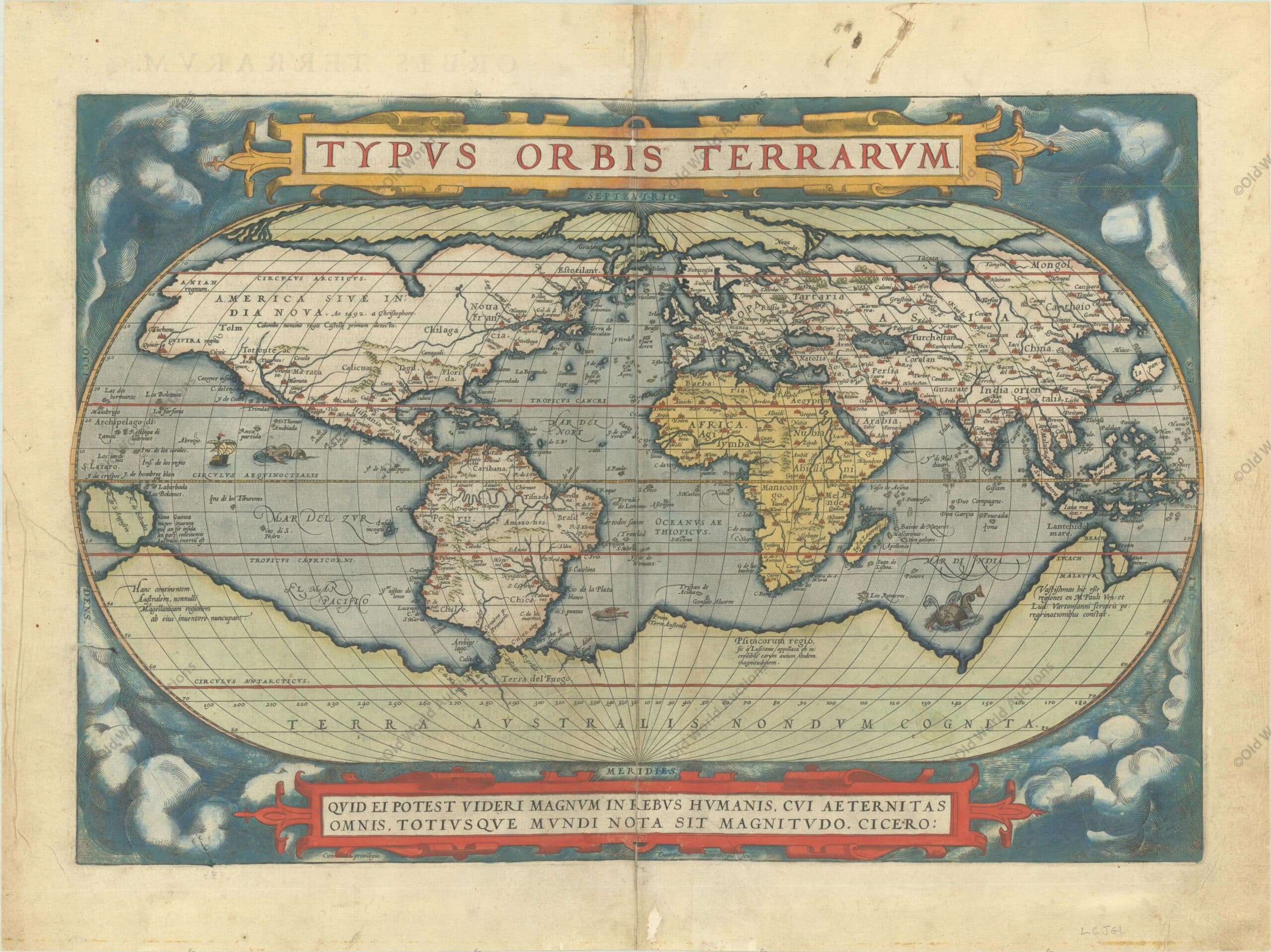
1584 World Map – Theatrum Orbis Terrarum Ortelius’ famous world map – first plate in full contemporary colour “Typus Orbis Terrarum”, Ortelius, Abraham This is the first (of three) world maps included in Ortelius’ famous atlas. It is a simplified reduction of Mercator’s influential map of 1569, presented in an oval projection rather than the projection for which Mercator is now famous. It is known from surviving correspondence that Mercator encouraged Ortelius and provided him with information, including the coordinates of places in the Americas. Against a background of clouds, the map shows that North America is too wide and that South America retains the unusual bulging south-west coast. At the poles, a prominent Northwest Passage winds south from the four islands that make up the Arctic regions, and a vast Terra Australis Nondum Cognita forms the imaginary southern continent. A note next to New Guinea indicates that it is not known whether this large island is part of the southern continent. The title is shown in a band at the top, balanced by a quotation from Cicero at the bottom. This magnificent map was engraved by Frans Hogenberg, with his signature at the bottom. The plate was used in the first 16 editions of the Theatrum. From 1570 a crack appeared in the lower left corner. This copy shows evidence of this crack, along with small imprints of screws.
1584 World Map – Theatrum Orbis Terrarum
Ortelius’ famous world map – first plate in full contemporary colour
“Typus Orbis Terrarum”, Ortelius, Abraham
This is the first (of three) world maps included in Ortelius’ famous atlas.
It is a simplified reduction of Mercator’s influential map of 1569, presented in an oval projection rather than the projection for which Mercator is now famous.
It is known from surviving correspondence that Mercator encouraged Ortelius and provided him with information, including the coordinates of places in the Americas.
Against a background of clouds, the map shows that North America is too wide and that South America retains the unusual bulging south-west coast.
At the poles, a prominent Northwest Passage winds south from the four islands that make up the Arctic regions, and a vast Terra Australis Nondum Cognita forms the imaginary southern continent. A note next to New Guinea indicates that it is not known whether this large island is part of the southern continent.
The title is shown in a band at the top, balanced by a quotation from Cicero at the bottom. This magnificent map was engraved by Frans Hogenberg, with his signature at the bottom.
The plate was used in the first 16 editions of the Theatrum. From 1570 a crack appeared in the lower left corner. This specimen shows evidence of this crack, together with small imprints of screws.
Written by Willy Sievert
Editor of Bahia.ws since its founding in 2009. Based in Salvador, he travels frequently across the Northeast and all of Brazil to keep the guides up to date. Learn more about Willy Sievert →