Map of Recife in Pernambuco from 1679: Historical Insights

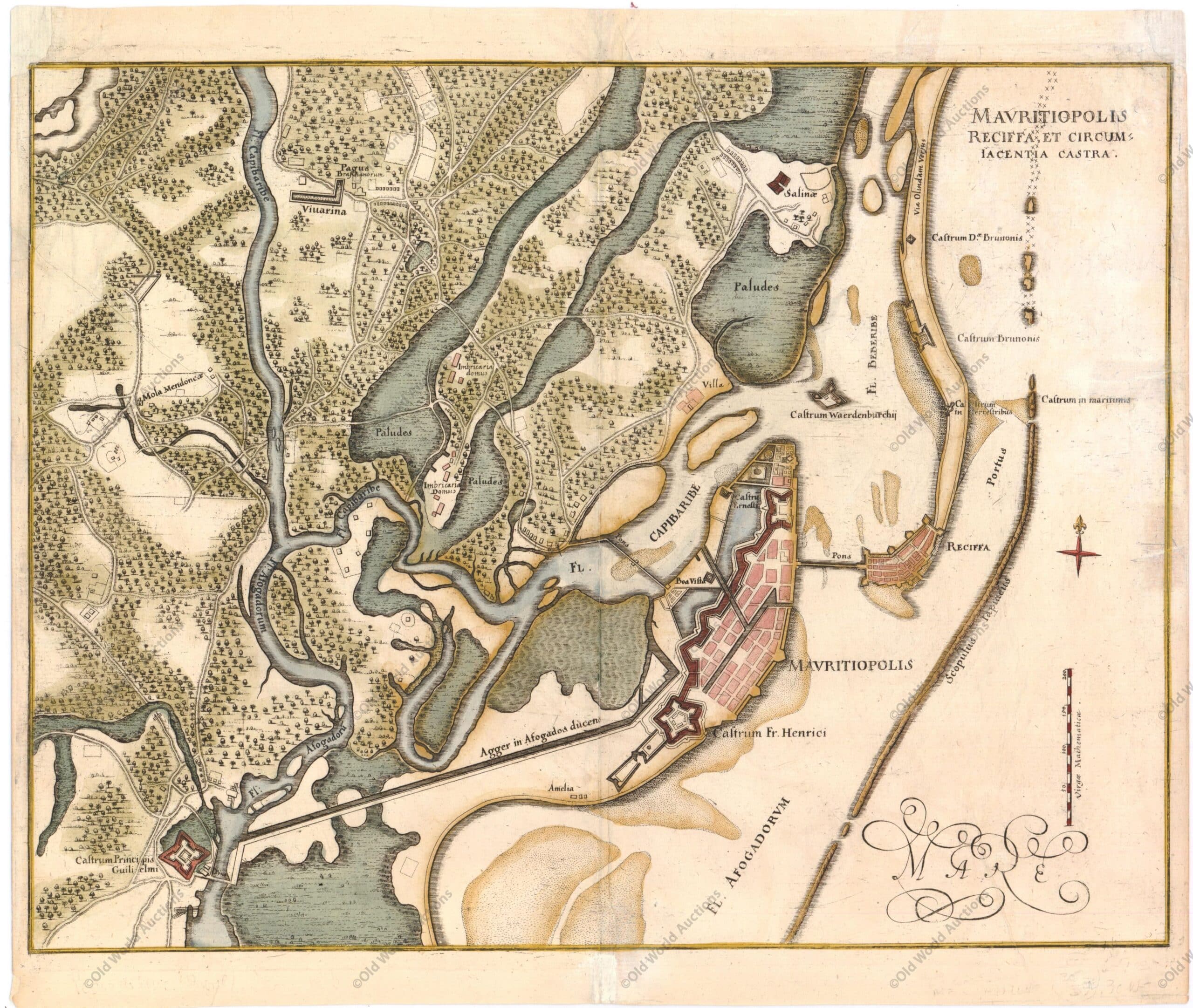
Mapa de Recife em Pernambuco de 1679 - Brasil - Rara planta aérea da cidade do Recife e arredores com destaque para as fortificações holandesas. Embora inicialmente fundada pelos portugueses, os holandeses decidiram invadir várias cidades de Pernambuco devido à indústria local de cana-de-açúcar. De 1630 a 1654 os holandeses controlaram a cidade do Recife, que se tornou a nova capital do Brasil holandês, a cidade de Mauritsstad. Mauritsstad (aqui chamada de Mauritiópolis) tornou-se uma das cidades mais cosmopolitas do mundo sob o domínio holandês e é conhecida por abrigar a primeira comunidade judaica e sinagoga, jardim botânico e zoológico das Américas. "Mauritiopolis Reciffa, et Circumiacentia Castra", Merian, Matthaus
Map of Recife in Pernambuco from 1679 – Brazil – Rare aerial view of the city of Recife and its surroundings, highlighting the Dutch fortifications. Although originally founded by the Portuguese, the Dutch decided to invade several cities in Pernambuco due to the local sugar cane industry. From 1630 to 1654, the Dutch controlled the city of Recife, which became the new capital of Dutch Brazil, the city of Mauritsstad. Mauritsstad (here called Mauritiópolis) became one of the most cosmopolitan cities in the world under Dutch rule and is known for being home to the first Jewish community and synagogue, botanical garden and zoo in the Americas. “Mauritiopolis Reciffa, et Circumiacentia Castra”, Merian, Matthaus

Map of Recife in Pernambuco from 1679 – Brazil

A rare aerial view of the city of Recife and its surroundings, particularly notable for its Dutch fortifications.

Although originally founded by the Portuguese, the Dutch decided to invade several cities in Pernambuco due to the local sugar cane industry.

From 1630 to 1654, the Dutch controlled the city of Recife, which became the new capital of Dutch Brazil, the city of Mauritsstad.

Mauritsstad (here called Mauritiopolis) became one of the most cosmopolitan cities in the world under Dutch rule and is known for being home to the first Jewish community and synagogue, botanical garden and zoo in the Americas. “Mauritiopolis Reciffa, et Circumiacentia Castra”, Merian, Matthaus

Map of Recife in Pernambuco from 1679 – Historical Maps of Brazil

Publicações Relacionadas

1579 Map of the Western Hemisphere - America - Historical Map

Map of Brazil 1698 - Historical Map

1623 Map of the Western Hemisphere - Historical Map

1671 Map of Jamaica

1823 Map of Brazil - Historical Map

1666 Map of the Gulf of Mexico and the Caribbean - Historical Map

Map of the Azores from 1584

Map of South America and Brazil 1624 - Historical Map

Map of Brazil 1747 - Historical Map of Brazil

Map of Panama 1699 - Historical Map

1719 Map of the Western Hemisphere - Historical Map

Map of South America from 1615: Explore the Details

1671 Map of Mexico and Central America - Historical Map

Map of Madeira and the Canary Islands from 1692

1628 Map of the Western Hemisphere - Historical Map

Engraving of Cabo Santo Agostinho from 1645 - Historical Engravings

Map of Brazil from 1750 - Historical Map of Brazil

1584 World Map - Historical Map

Map of Africa 1593 - Historical Map

The Catalan Atlas: Redrawing the Medieval World and Asia

Map of Cabo Santo Agostinho from 1645 - Historical Map of Brazil

1679 Map of Recife - Historical Map

Southeastern Colonial Map of the United States, Bahamas and Greater Antilles, 1706

Map of Brazil 1747 - Historical Maps of Brazil

Map of the Gulf of Mexico and the Caribbean, 1594

Map of the Cape Verde Islands, 1697

1620 Map of Portugal and Spain - Historical Map

Reis Magos Fort Engraving from 1690 - Engravings Stories

Map of the East Coast of Brazil, 1647 - Historical Maps

Map of the Gulf of Mexico and the Caribbean, 1681

1757 Map of the Western Hemisphere

Map of West Africa and the Cape Verde Islands from 1699

Map of the Gulf of Mexico and the Caribbean, 1675

Map of Europe from 1644: A Classic Antique

Map of Southern South America, 1656 - Historical Map

Engraving of Salvador from 1671: A Historical Insight

This post is also on: Português English Deutsch Español Français