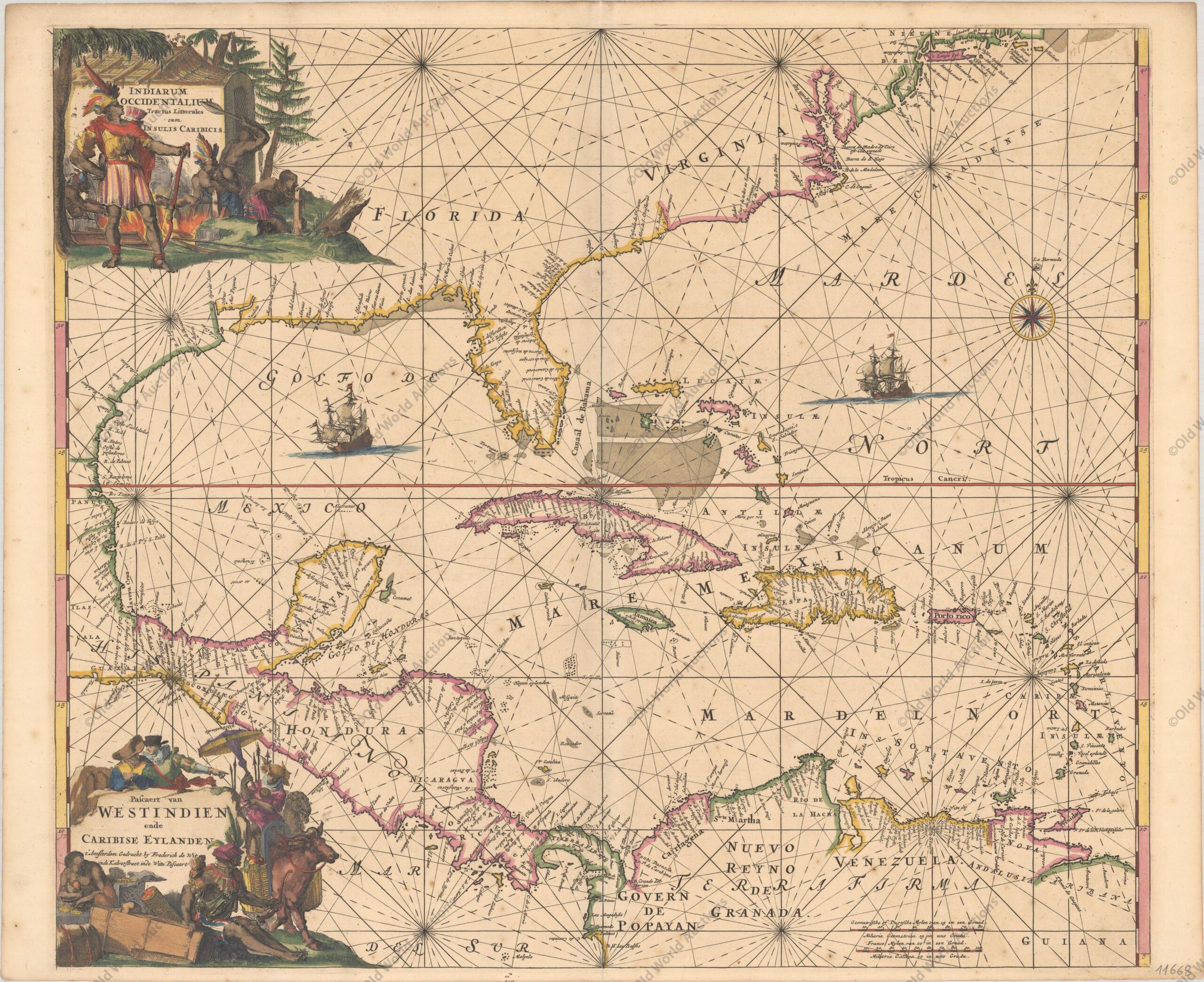
Map of the Gulf of Mexico and the Caribbean, 1675
“Indiarum Occidentalium Tractus Littorales cum Insulis Caribicis / Pascaert van Westindien ende Caribise Eylanden”, Wit, Frederick de
This is a scarce first edition of one of the most beautifully engraved maps of the West Indies.
It extends to show the coastline of North America almost to New England, the whole of Central America and the northern coast of South America.
There is a wealth of navigational information including passages, anchorages, sandbanks and shoals.
Numerous place names line the coasts, including Charleston, St Augustine, Cape Canaveral, Roanoke Island, Santo Domingo and Havana.
The curvature of the Gulf Coast is nearly accurate, but the map predates Iberville and La Salle’s explorations of the Mississippi Delta and Mobile Bay.
The map is a masterpiece of decorative engraving, with illustrations of sailing vessels, a compass rose, and two elaborate title cartouches (Latin and Dutch), one depicting cannibalism and the other European pirates observing natives.
Bibliography: Burden #468.

Publicações Relacionadas
Map of Paraíba of 1690 - Historical Maps of Brazil
Historical maps showing the territorial development of Brazil
Engraving of the town of Olinda in 1633 - Historical Engraving
Map of the East Coast of Brazil, 1647 - Historical Maps
Map of Brazil from 1798: Explore Historical Details
Engraving of Todos os Santos Bay from 1671 Explained
Map of the Captaincy of Pernambuco and Ceará from 1680
Map of the Cape Verde Islands, 1697
1679 Map of Recife - Historical Map
Map of the Bay of All Saints and Pernambuco, 1700
Map of Rio de Janeiro from 1682 - Historical Map
1719 Historical Map of the Western Hemisphere
1609 Map of the Western Hemisphere - Historical Map
Engraving of Salvador from 1671: A Historical Insight
Map of the Brazilian Coast from 1678 - Historical Map of Brazil
1671 Map of Jamaica
Map of Brasil from 1757: Historic Coastal Views
1643 Map of the Western Hemisphere - Historical Map
1579 Map of the Western Hemisphere - America - Historical Map
1714 Map of the Western Hemisphere - Historical Map
Map of Brazil from 1652: A Historical Perspective
Map of eastern Brazil 1664 - Historical Map of Brazil
Map of Southern South America, 1656 - Historical Map
Map of West Africa and the Cape Verde Islands from 1699
Map of Brazil from 1695: A Historical Overview
Southeastern Colonial Map of the United States, Bahamas and Greater Antilles, 1706
Map of Cabo Santo Agostinho from 1645 - Historical Map of Brazil
Engraving of Sirinhaém from 1671
Map of the Province of Paraíba from 1698 Overview
Map of the Gulf of Mexico and the Caribbean from 1650-80
1587 Map of the Western Hemisphere - Historical Map
1823 Map of Brazil - Historical Map
Map of South America from 1619: A Historical Insight
1575 Map of Europe - Historical Map
All Saints Bay Map of 1644 - Historical Map
Map of Brazil from 1630: Cartography's Legacy
This post is also on:
 Português
  English
  Deutsch
  Español
  Français