Engraving of Todos os Santos Bay from 1671 Explained

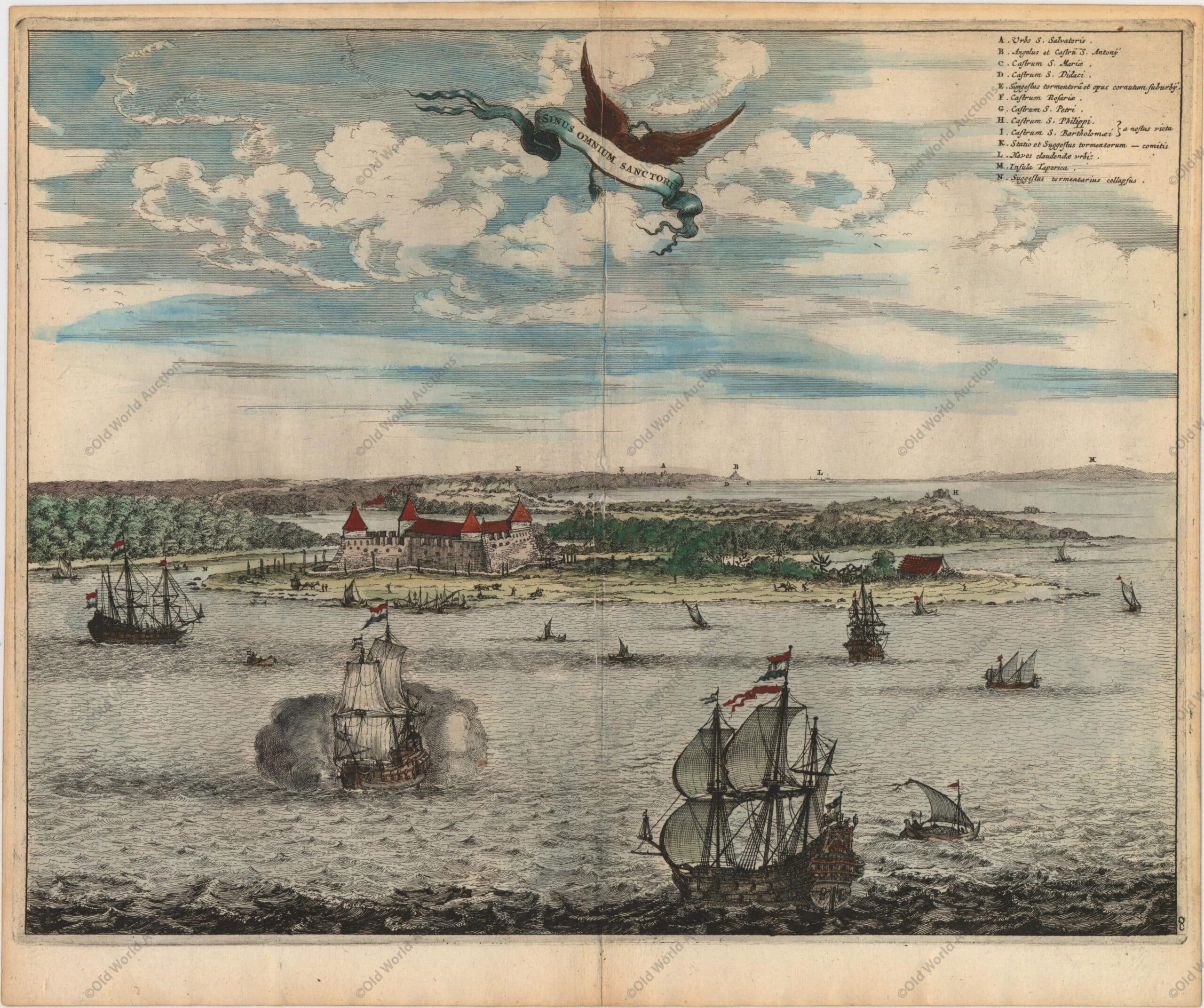
Baia de Todos os Santos, Brasil - 1671 - A obra de Montanus foi talvez o maior livro ilustrado sobre o Novo Mundo produzido no século XVII. Continha mais de cem placas, vistas e mapas lindamente gravados da América do Norte e do Sul. As placas retratam vividamente fortes, festivais, ocupações, frotas holandesas, batalhas, ritos religiosos e costumes dos habitantes nativos. Esta importante obra foi traduzida para o alemão por Olivier Dapper e para o inglês por John Ogilby. Várias das placas foram posteriormente adquiridas por Pierre Vander Aa. Esta é uma vista soberba da Baía de Todos os Santos com Salvador da Bahia ao fundo. A gravura ilustra a região quando os holandeses tentavam obter o controle das colônias portuguesas no Brasil e seu lucrativo comércio de açúcar. Em 1624, os holandeses capturaram e saquearam o Salvador da Bahia, mantendo-o junto com outros portos do nordeste até ser retomado por uma frota hispano-portuguesa. A cidade desempenhou então um papel estrategicamente vital na resistência luso-brasileira contra os holandeses na década de 1630. Essa visão foi tirada do trabalho de Frans Post. Suas obras são algumas das primeiras pinturas européias do Brasil e foram avidamente reproduzidas na impressão por gravadores holandeses. "Sinus Omnium Sanctoru", Montanus, Arnoldus
Baía de Todos os Santos, Brazil – 1671 – Montanus’ work was perhaps the greatest illustrated book of the New World produced in the 17th century. It contained more than a hundred beautifully engraved plates, views and maps of North and South America. The plates vividly depicted forts, festivals, occupations, Dutch fleets, battles, religious rites and native customs. This important work was translated into German by Olivier Dapper and into English by John Ogilby. Several of the plates were later acquired by Pierre Vander Aa. This is a superb view of Todos os Santos Bay with Salvador da Bahia in the background. The engraving shows the region when the Dutch were trying to gain control of the Portuguese colonies in Brazil and their lucrative sugar trade. In 1624, the Dutch captured and looted Salvador da Bahia and held it, along with other ports in the northeast, until it was recaptured by a Spanish-Portuguese fleet. The city then played a strategic role in the Portuguese-Brazilian resistance against the Dutch in the 1630s. This view is taken from the work of Frans Post. His works are among the earliest European paintings of Brazil and were eagerly reproduced in print by Dutch engravers. “Sinus Omnium Sanctoru”, Montanus, Arnoldus

Engraving of Todos os Santos Bay from 1671, Brazil

Montanus’s work was perhaps the greatest illustrated book on the New World produced in the 17th century.

It contained over a hundred beautifully engraved plates, views and maps of North and South America.

The plates vividly depicted forts, festivals, occupations, Dutch fleets, battles, religious rites and native customs.

This important work was translated into German by Olivier Dapper and into English by John Ogilby.

Several of the plates were later acquired by Pierre Vander Aa.

This is a superb view of Todos os Santos Bay with Salvador da Bahia in the background.

The engraving shows the region when the Dutch were trying to gain control of the Portuguese colonies in Brazil and their lucrative sugar trade.

In 1624, the Dutch captured and sacked Salvador da Bahia and held it, along with other ports in the north-east, until it was recaptured by a Spanish-Portuguese fleet.

The city then played a strategic role in the Portuguese-Brazilian resistance against the Dutch in the 1630s.

This view is taken from the work of Frans Post. His works are among the earliest European paintings of Brazil and were eagerly reproduced in print by Dutch engravers. “Sinus Omnium Sanctoru”, Montanus, Arnoldus

Engraving of All Saints Bay from 1671 – Historical Maps of Brazil

Publicações Relacionadas

1628 Map of the Western Hemisphere - Historical Map

1671 engraving of Fort Orange on the island of Itamaraca

Map of Recife in Pernambuco from 1679: Historical Insights

All Saints Bay Map of 1644 - Historical Map

1628 Map of the Western Hemisphere - Historical Map

1697 Map of the Western Hemisphere - Historical Map

Map of the Captaincy of Espírito Santo and Porto Seguro from 1698

1744 Map of the Western Hemisphere - Historical Map

Map of the Gulf of Mexico and the Caribbean, 1594

Map of South America and Brazil 1624 - Historical Map

Map of Cabo de Santo Agostinho from 1690

Map of Rio de Janeiro of 1764 - Historical Map

Engraving of Vila de Olinda in 1671 - Historical Engraving

1587 Map of the Western Hemisphere - Historical Map

1592 Map of the Western Hemisphere - Historical Map

1623 Map of the Western Hemisphere - Historical Map

Map of Southern South America, 1668 - Historical Map

Map of Brazil 1698 - Historical Map

Engraving of Salvador from 1671: A Historical Insight

Map of South America, 1840

Map of South America 1601 - Historical Map

Map of Europe from 1644: A Classic Antique

1607 Map of the Western Hemisphere - Historical Map

Map of Olinda in Pernambuco from 1640 - Historical Map

Painting of the Three Kings Fort in Natal from 1647

Map of the Province of Paraíba from 1698 Overview

Map of Africa from 1570

1832 Map of Brazil - Historical Map

Map of the Bay of All Saints and Pernambuco, 1700

1609 Map of the Western Hemisphere - Historical Map

1659 Map of the Western Hemisphere - Historical Map

Map of Rio de Janeiro, 1775 - Historical Map

Map of Rio de Janeiro of 1810 - Historical Map

1671 Map of Jamaica

Map of eastern Brazil 1664 - Historical Map of Brazil

Gravura da Baia de Todos os Santos de 1690

This post is also on: Português English Deutsch Español Français