Map of Rio de Janeiro, 1750 – Historical Map

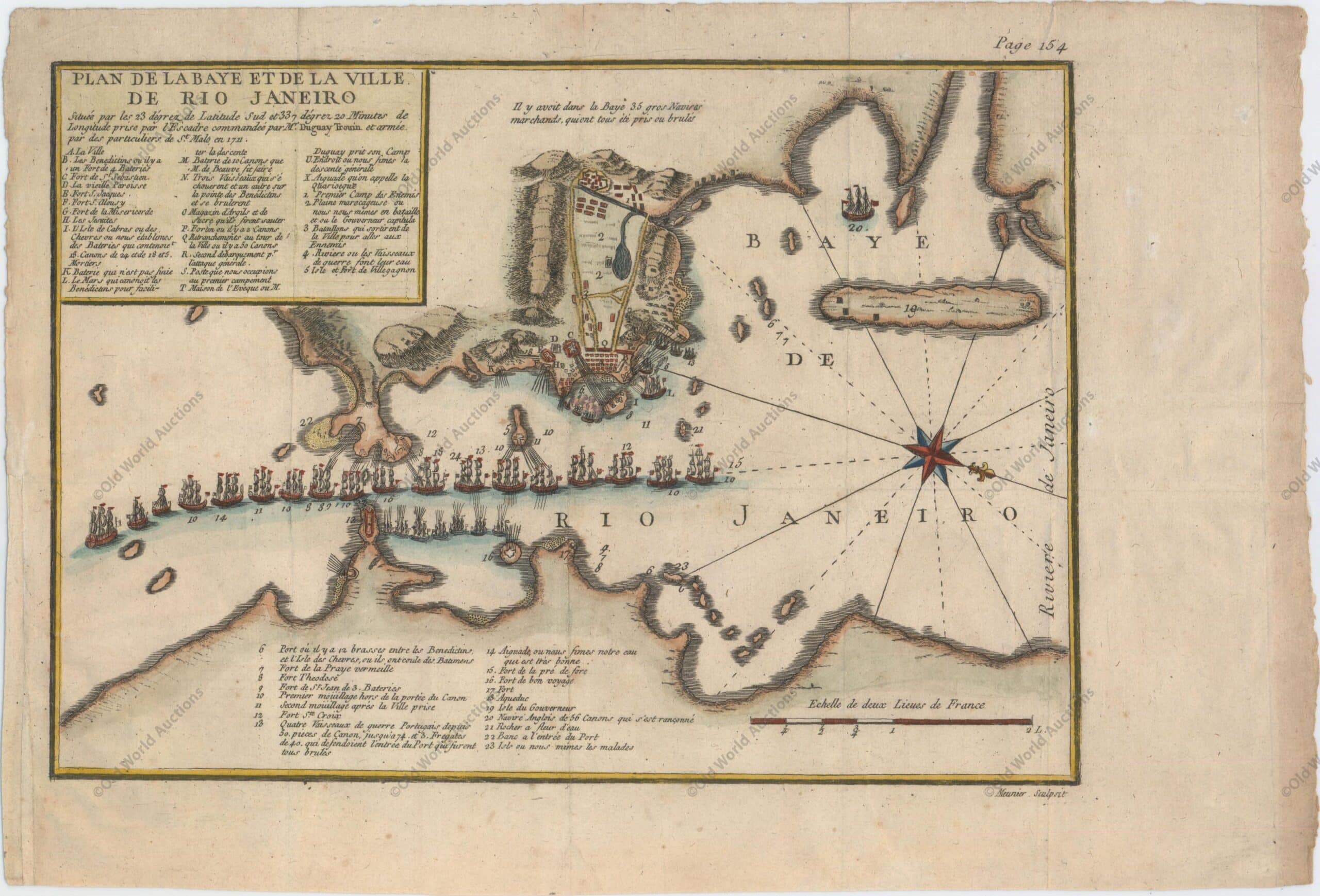
Mapa do Rio de Janeiro de 1750"Plan de la Baye et de la Ville de Rio janeiro..." Este belo plano panorâmico do Rio de Janeiro e da Baía de Guanabara foi criado para ilustrar o cerco francês de 1711. Uma grande rosa dos ventos orienta o norte para a direita. Legendas numeradas e com letras identificam vários navios e locais importantes, incluindo ilhas, fortes, armazéns e baterias. Gravado por Meunier. Este mapa foi publicado pela primeira vez em Memoires de Monsieur du Guay-Trouin em 1740, com duas edições posteriores do mapa publicadas em 1785. René Duguay-Trouin foi um pirata francês de Saint-Malo que mais tarde se tornou tenente-general da Marinha Real Francesa. Em 1711, durante a Guerra da Sucessão Espanhola, Duguay-Trouin liderou dezassete navios e 6.000 homens na Baía de Guanabara para capturar o Rio de Janeiro. Os franceses conseguiram derrotar os portugueses e tomaram a cidade. Depois de ocuparem a cidade durante dois meses, os franceses receberam a notícia de que estavam a ser enviados reforços portugueses sob o comando de António de Albuquerque. Duguay-Trouin decidiu regressar a França, assegurando primeiro um saque de cerca de 4 milhões de libras do ouro da cidade. Todas as edições deste mapa são muito raras. Mapa do Rio de Janeiro de 1750 - Mapa Histórico
Map of Rio de Janeiro from 1750 “Plan de la Baye et de la Ville de Rio Janeiro…” This beautiful panoramic plan of Rio de Janeiro and Guanabara Bay was made to illustrate the French siege of 1711. A large compass rose points north to right. Numbered and lettered legends identify various ships and important sites, including islands, forts, warehouses and batteries. Engraved by Meunier. This map was first published in Memoires de Monsieur du Guay-Trouin in 1740, with two later editions of the map published in 1785. René Duguay-Trouin was a French pirate from Saint-Malo who later became a lieutenant general in the French Royal Navy. In 1711, during the War of the Spanish Succession, Duguay-Trouin led seventeen ships and 6,000 men into Guanabara Bay to capture Rio de Janeiro. The French defeated the Portuguese and took the city. After occupying the city for two months, the French received news that Portuguese reinforcements were being sent under the command of António de Albuquerque. Duguay-Trouin decided to return to France, first securing a booty of around 4 million pounds of the city’s gold. All editions of this map are very rare. Map of Rio de Janeiro of 1750 – Historical Map

Map of Rio de Janeiro of 1750

“Plan de la Baye et de la Ville de Rio Janeiro…”

This beautiful panoramic plan of Rio de Janeiro and Guanabara Bay was created to illustrate the French siege of 1711.

A large compass rose points north to right. Numbered and lettered legends identify various ships and important sites, including islands, forts, warehouses and batteries. Engraved by Meunier.

This map was first published in Memoires de Monsieur du Guay-Trouin in 1740, with two later editions of the map published in 1785. René Duguay-Trouin was a French pirate from Saint-Malo who later became a lieutenant general in the French Royal Navy.

In 1711, during the War of the Spanish Succession, Duguay-Trouin led seventeen ships and 6,000 men into Guanabara Bay to capture Rio de Janeiro.

The French defeated the Portuguese and took the city. After occupying the city for two months, the French received news that Portuguese reinforcements were being sent under the command of António de Albuquerque.

Duguay-Trouin decided to return to France, first securing a booty of around 4 million pounds of the city’s gold. All editions of this map are very rare.

Map of Rio de Janeiro from 1750 – Historical Map

Publicações Relacionadas

Historical maps showing the territorial development of Brazil

Engraving of the town of Olinda in 1633 - Historical Engraving

Map of Brazil from 1652: A Historical Perspective

Map of the Captaincy of Espírito Santo and Porto Seguro from 1698

1730 Map of the Western Hemisphere - Historical Map

1666 Map of the Gulf of Mexico and the Caribbean - Historical Map

Map of South America from 1619: A Historical Insight

Engraving of Fort Nassau in Pernambuco, 1671

Map of the Gulf of Mexico, the Caribbean and the Southern United States, 1682

Map of Brazil from 1798: Explore Historical Details

1620 Map of Portugal and Spain - Historical Map

Map of Paraíba from 1662: An Engraved Masterpiece

Map of Southern South America, 1668 - Historical Map

1730 Map of the Western Hemisphere - Historical Map

Map of the Gulf of Mexico and the Caribbean, 1675

Map of Rio de Janeiro, 1794 - Historical Map

Map of the Gulf of Mexico and the Caribbean from 1650-80

1740 Map of the Western Hemisphere - Historical Map

Map of Cabo Santo Agostinho from 1645 - Historical Map of Brazil

Engraving of Salvador from 1671: A Historical Insight

Map of Brazil from 1750 - Historical Map of Brazil

Map of Rio de Janeiro from 1682 - Historical Map

Engraving of Vila de Olinda in 1671 - Historical Engraving

Map of South America and Brazil 1624 - Historical Map

1643 Map of the Western Hemisphere - Historical Map

Map of Paraíba of 1690 - Historical Maps of Brazil

Engraving of Salvador de Bahia from 1770 - Historical Maps

Map of the Gulf of Mexico and the Caribbean, 1681

1757 Map of the Western Hemisphere

1660 Map of the Western Hemisphere - Historical Map

Map of Brazil from 1606 - Historical Map

Map of Brazil from 1695: A Historical Overview

1587 Map of the Western Hemisphere - Historical Map

1677 Map of the Western Hemisphere - Historical Map

1671 Map of Jamaica

Map of Brazil 1747 - Historical Map of Brazil

This post is also on: Português English Deutsch Español Français