Map of Brazil 1554 – Historical Maps of Brazil

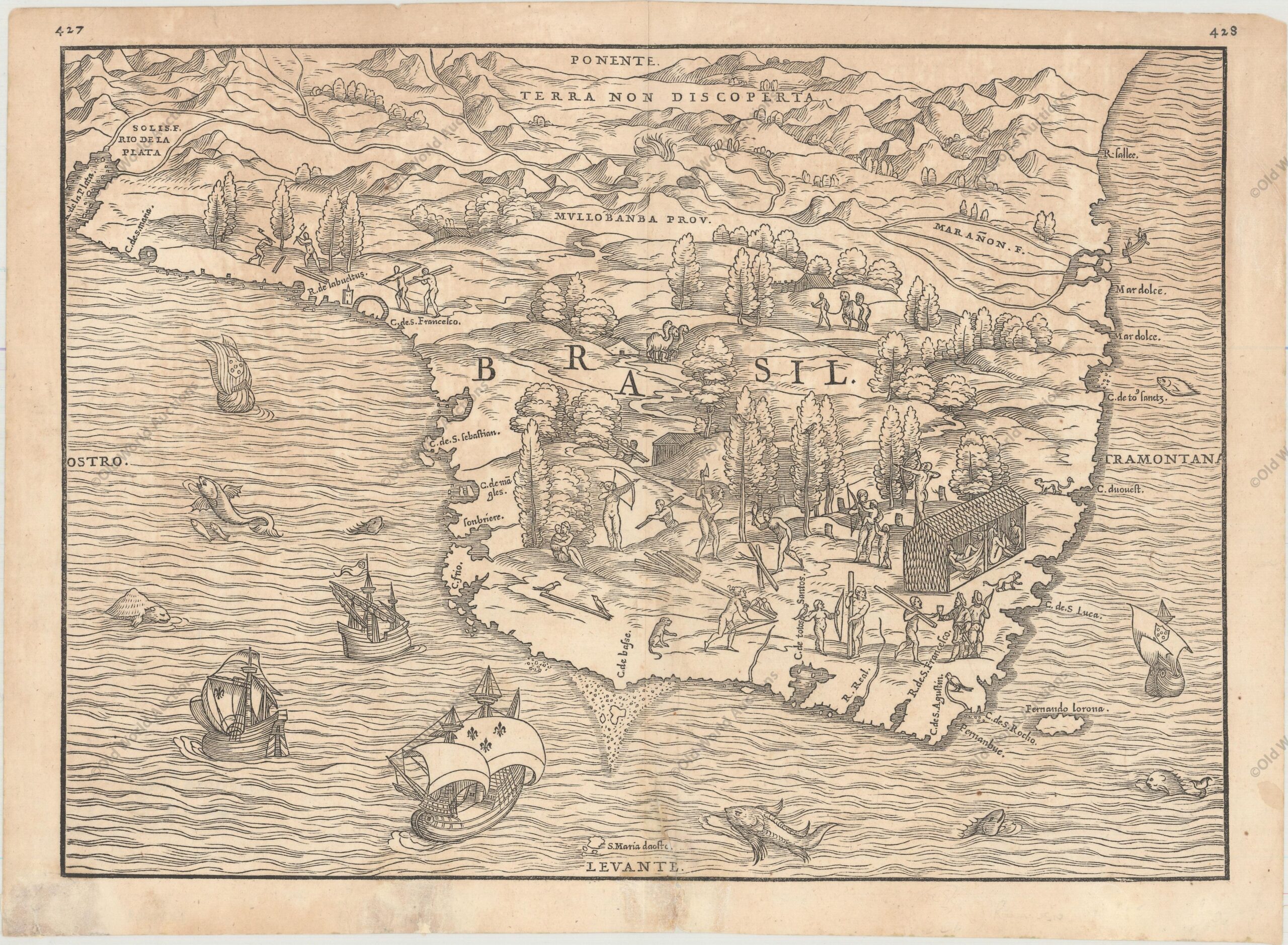
Mapa do Brasil de 1554 - Este fascinante mapa pictórico é um dos primeiros mapas regionais do Brasil disponíveis. Ilustrado com o norte à direita, o mapa é preenchido com vinhetas que representam a vida nativa, em vez de focar em informações geográficas. Os índios nativos são mostrados com arcos e flechas, machados, lhamas e redes, pelos quais os brasileiros são bem conhecidos. O oceano circundante está repleto de navios franceses e portugueses e monstros marinhos. Ao longo da costa, os europeus são retratados interagindo com os nativos. A informação geográfica limitada apresentada é bastante imprecisa. O rio Amazonas (aqui chamado Maranon F.) e o rio Paraná se originam de lagos ao lado de um vulcão em erupção. Montanhas e rios espúrios preenchem a porção ocidental do Brasil, rotulada como Terra non Descobrirta (terra não descoberta). Este mapa em xilogravura é do primeiro bloco, publicado em 1554 e depois destruído por um incêndio na gráfica de Thomaso Guinti em 1557. Um segundo bloco foi cortado em 1565, com a notável diferença de Descoperta escrito na parte superior central em vez de Discoperta. O segundo bloco foi usado novamente em 1606, distinguível da impressão anterior pelo aparecimento de danos causados ​​por carunchos no bloco de impressão. Muitos dos blocos da edição de 1554 do Delle Navigationi Et Viaggi de Ramusio foram produzidos pelo grande cartógrafo veneziano Giacomo Gastaldi. "Brasil", Ramusio, Giovanni Battista
Map of Brazil 1554 – This fascinating pictorial map is one of the first regional maps of Brazil available. Illustrated with north to the right, the map is filled with vignettes depicting native life rather than focusing on geographical information. Indians are shown with bows and arrows, axes, llamas and hammocks, for which Brazilians are well known. The surrounding ocean is filled with French and Portuguese ships and sea monsters. Along the coast, Europeans are shown interacting with the natives. The limited geographical information is rather inaccurate. The Amazon River (here called the Maranon F.) and the Paraná River originate from lakes near an erupting volcano. Mountains and false rivers fill the western part of Brazil, labelled Terra non Descobrirta (undiscovered land). This woodcut map is from the first block published in 1554, which was destroyed by a fire at Thomaso Guinti’s printing works in 1557. A second block was cut in 1565, with the notable difference that Descoperta is written at the top centre instead of Discoperta. The second block was used again in 1606, and can be distinguished from the previous print by the appearance of woodworm damage on the block. Many of the blocks in the 1554 edition of Ramusio’s Delle Navigationi Et Viaggi were made by the great Venetian cartographer Giacomo Gastaldi. “Brazil”, Ramusio, Giovanni Battista

Map of Brazil from 1554

This fascinating pictorial map is one of the first regional maps of Brazil available. Illustrated with north to the right, the map is filled with vignettes depicting native life rather than focusing on geographical information.

Indians are shown with bows and arrows, axes, llamas and hammocks, for which Brazilians are well known.

The surrounding ocean is filled with French and Portuguese ships and sea monsters. Along the coast, Europeans are shown interacting with the natives. The limited geographical information is rather inaccurate.

The Amazon River (here called the Maranon F.) and the Paraná River originate from lakes near an erupting volcano.

Mountains and false rivers fill the western part of Brazil, labelled Terra non Descobrirta (undiscovered land). This woodcut map is from the first block published in 1554, which was destroyed by a fire at Thomaso Guinti’s printing works in 1557.

A second block was cut in 1565, with the notable difference that Descoperta is written at the top centre instead of Discoperta.

The second block was used again in 1606, and can be distinguished from the previous print by the appearance of woodworm damage on the block.

Many of the blocks in the 1554 edition of Ramusio’s Delle Navigationi Et Viaggi were made by the great Venetian cartographer Giacomo Gastaldi. “Brazil”, Ramusio, Giovanni Battista

Publicações Relacionadas

Engraving of the Fort of the Three Kings in Natal, 1671

1575 Map of Europe - Historical Map

Map of Mexico and Central America, 1671 - Historical Map

Map of Rio de Janeiro, 1750 - Historical Map

Painting of the Three Kings Fort in Natal from 1647

1609 Map of the Western Hemisphere - Historical Map

1628 Map of the Western Hemisphere - Historical Map

Map of South America from 1615: Explore the Details

Map of Africa from 1570

1832 Map of Brazil - Historical Map

1628 Map of the Western Hemisphere - Historical Map

1744 Map of the Western Hemisphere - Historical Map

Map of Rio de Janeiro, 1775 - Historical Map

1823 Map of Brazil - Historical Map

Map of Southern South America, 1656 - Historical Map

Map of the Gulf of Mexico and the Caribbean, 1675

Map of the Captaincy of Espírito Santo and Porto Seguro from 1698

Map of Rio de Janeiro, 1840 - Historical Map

Map of Madeira and the Canary Islands from 1692

Map of Brazil 1747 - Historical Map of Brazil

Maritime chart of the east coast of Brazil Ilha Grande and Sapetiba Bay 1884

Map of the Azores from 1584

Map of Rio de Janeiro from 1682 - Historical Map

1643 Map of the Western Hemisphere - Historical Map

All Saints Bay Map of 1644 - Historical Map

Map of Brasil from 1757: Historic Coastal Views

Map of Brazil from 1850: A Historical Overview

Map of Brazil divided into fourteen hereditary captainships from 1657 onwards

Map of Cabo de Santo Agostinho from 1690

Map of South America and the Caribbean 1596 - Historical Map

1579 Map of the Western Hemisphere - Historical Map

Map of All Saints Bay 1769 - Historical Maps

Map of Brazil from 1606 - Historical Map

Map of South America 1601 - Historical Map

1730 Map of the Western Hemisphere - Historical Map

1727 Map of the Western Hemisphere - Historical Map

This post is also on: Português English Deutsch Español Français