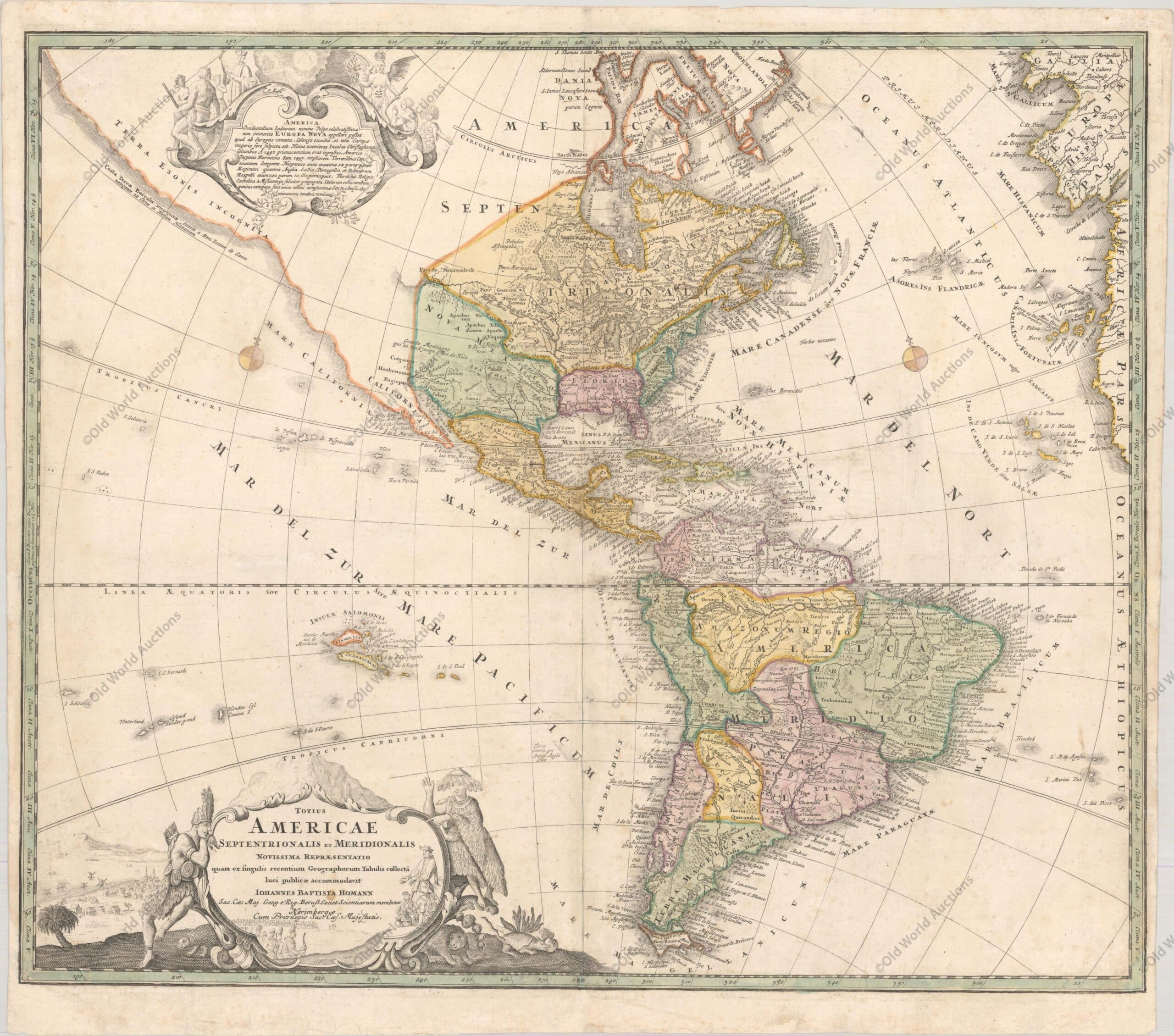
Map of the Western Hemisphere, 1730
This attractive map is a revision of old Homann’s 1710 map of America.
After his death in 1724, his son (Johann Christoph Homann) re-engraved the plate to correct the west coast of North America, which here extends far to the west and north, with very little detail.
The coast is called Costa Terrae Borealis and is attributed to the accounts of João da Gama, who sighted land while crossing the Pacific Ocean in 1589-90.
California is no longer shown as an island, although remnants of the inland sea can be seen near Pais de Moozemleck, where a river almost connects with the Mississippi River system, suggesting the possibility of a Northwest Passage.
The Great Lakes take shape and are actively explored by French fur traders and the Hudson Bay Company.
The Solomon Islands lie prominently in the Pacific, much too far to the east.
The map is decorated with two large cartouches, the upper one showing the natives worshipping a terrible demon on the right, while on the left they listen quietly to a priest.
The lower cartouche also shows the native landscape and fauna. “Totius Americae Septentrionalis et Meridionalis Novissima Repraesentatio quam ex Singulis Recentium Geographorum Tabulis Collecta Luci Publicae Accomodavit”, Homann, Johann Baptist
1730 Map of the Western Hemisphere – Historical Map
Publicações Relacionadas
Map of eastern Brazil 1664 - Historical Map of Brazil
Map of Santa Catarina Island 1777: A Historical Treasure
Map of Brazil from 1850: A Historical Overview
Map of South America from 1615: Explore the Details
1697 Map of the Western Hemisphere - Historical Map
Map of Olinda in Pernambuco from 1640 - Historical Map
1719 Historical Map of the Western Hemisphere
Reis Magos Fort Engraving from 1690 - Engravings Stories
Map of South America from 1740: Historical Insights
Map of the Azores from 1584
Map of Rio de Janeiro from 1682 - Historical Map
1719 Map of the Western Hemisphere - Historical Map
Engraving of Todos os Santos Bay from 1671 Explained
Map of the Captaincy of Paraíba and Rio Grande, 1720
Engraving of Cabo Santo Agostinho from 1645 - Historical Engravings
1592 Map of the Western Hemisphere - Historical Map
1575 Map of Europe - Historical Map
Map of Brazil divided into fourteen hereditary captainships from 1657 onwards
Map of South America and Brazil 1624 - Historical Map
Map of Africa 1593 - Historical Map
Map of Southern South America, 1668 - Historical Map
Map of Recife in Pernambuco from 1679: Historical Insights
Map of the Gulf of Mexico and the Caribbean, 1594
Map of Rio de Janeiro of 1810 - Historical Map
1609 Map of the Western Hemisphere - Historical Map
Map of the Captaincy of Pernambuco and Ceará from 1680
1639 Map of Paraíba - Historical Map of Brazil
Engraving of Vila de Olinda in 1671 - Historical Engraving
Map of the Captaincy of Pernambuco from 1698 Overview
Map of the Bay of All Saints and Pernambuco, 1700
Engraving of Sirinhaém from 1671
Map of Southern South America, 1656 - Historical Map
1744 Map of the Western Hemisphere - Historical Map
Engraving of Salvador de Bahia from 1770 - Historical Maps
Map of Rio de Janeiro, 1750 - Historical Map
Engraving of Fort Nassau in Pernambuco, 1671
This post is also on:
 Português
  English
  Deutsch
  Español
  Français