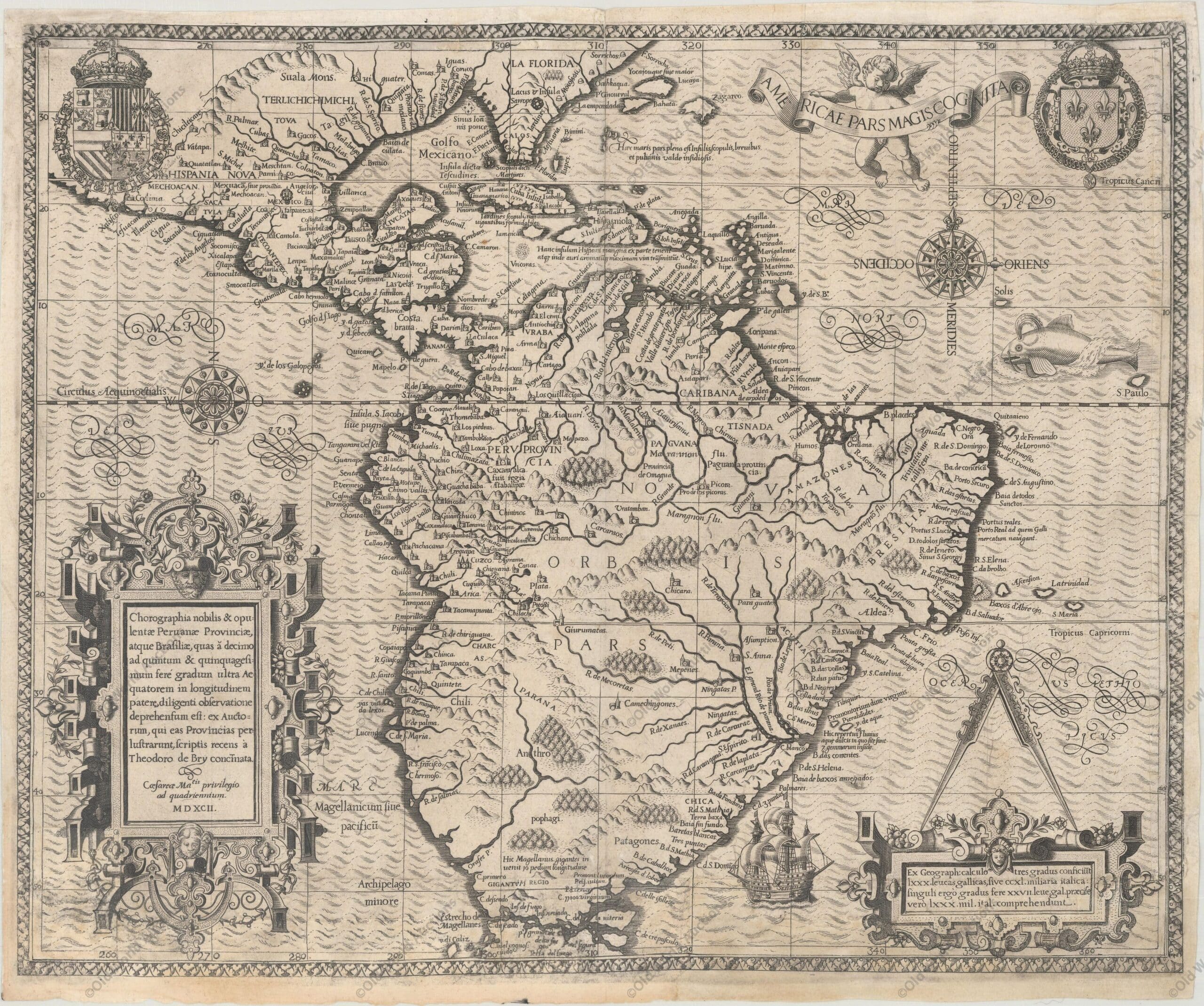
This map focuses on the Spanish possessions in the Americas and covers what is now the southern United States down to South America. It was published to accompany the travel accounts of Johann van Stadden and Jean de Lery. The cartography is taken from de Bry’s own map of Florida and the West Indies after Jacques le Moyne. However, there is no obvious source for the cartography of South America, the southern regions of which are shown very wide, but not as bulging as in Ortelius’ version. De Bry’s exceptional engraving skills and artistic style are evident in the large, elaborate cartouches, coats of arms, two compass roses, sea monster, Spanish galleon and intricate border.
Map of the Western Hemisphere, 1592
This engraving is part of a remarkable series of publications illustrating voyages of discovery and exploration in different parts of the world.
The project was begun by Theodore de Bry of Frankfurt in 1590 and was to continue for another 54 years.
Together they became known as the Grands Voyages (to America and the West Indies) and the Petits Voyages (to the Orient and the East Indies). De Bry died after completing the first six parts of the Grands Voyages.
The project was completed first by his widow and two sons, Johann Theodore de Bry and Johann Israel de Bry, and then by his son-in-law, Matthaus Merian, in 1644.
Focusing on the Spanish possessions in the Americas, this map covers what is now the southern United States down to South America.
It was published to accompany the accounts of the voyages of Johann van Stadden and Jean de Lery.
The cartography is taken from de Bry’s own map of Florida and the West Indies after Jacques le Moyne.
However, there is no obvious source for the cartography of South America, the southern regions of which are shown very wide, but not as bulging as in Ortelius’ version.
De Bry’s exceptional engraving skills and artistic style are evident in the large, elaborate cartouches, coats of arms, two compass roses, sea monster, Spanish galleon and intricate border.
Map of the Western Hemisphere 1592 – Historical Map
Publicações Relacionadas
Map of the Captaincy of Espírito Santo and Porto Seguro from 1698
1628 Map of the Western Hemisphere - Historical Map
Map of the Cape Verde Islands, 1697
Map of Cabo Santo Agostinho from 1645 - Historical Map of Brazil
1719 Historical Map of the Western Hemisphere
Map of the Gulf of Mexico and the Caribbean, 1681
1677 Map of the Western Hemisphere - Historical Map
Map of Rio de Janeiro from 1682 - Historical Map
Map of South America from 1619: A Historical Insight
1638 Map of South America - Historical Map
Painting of the Three Kings Fort in Natal from 1647
Map of Brazil 1747 - Historical Maps of Brazil
Map of the Western Hemisphere from 1700 - Historical Map
Map of Southern South America, 1656 - Historical Map
Map of Southern South America, 1668 - Historical Map
Map of Santa Catarina Island 1777: A Historical Treasure
1671 Map of Jamaica
Map of eastern Brazil 1664 - Historical Map of Brazil
Map of Brazil from 1652: A Historical Perspective
1620 Map of Portugal and Spain - Historical Map
Map of Brazil from 1630: Cartography's Legacy
1587 Map of the Western Hemisphere - Historical Map
Historical maps showing the territorial development of Brazil
1639 Map of Paraíba - Historical Map of Brazil
Map of South America 1601 - Historical Map
Map of Brazil from 1850 - Historical Map of Brazil
Map of Brazil 1698 - Historical Maps of Brazil
Map of Brazil from 1750 - Historical Map of Brazil
Map of Paraíba of 1690 - Historical Maps of Brazil
Map of Africa from 1570
Engraving of Todos os Santos Bay from 1671 Explained
1740 Map of the Western Hemisphere - Historical Map
Map of South America and the Caribbean 1596 - Historical Map
Map of Rio de Janeiro, 1750 - Historical Map
Map of Cabo de Santo Agostinho from 1690
1832 Map of Brazil - Historical Map
This post is also on:
 Português
  English
  Deutsch
  Español
  Français