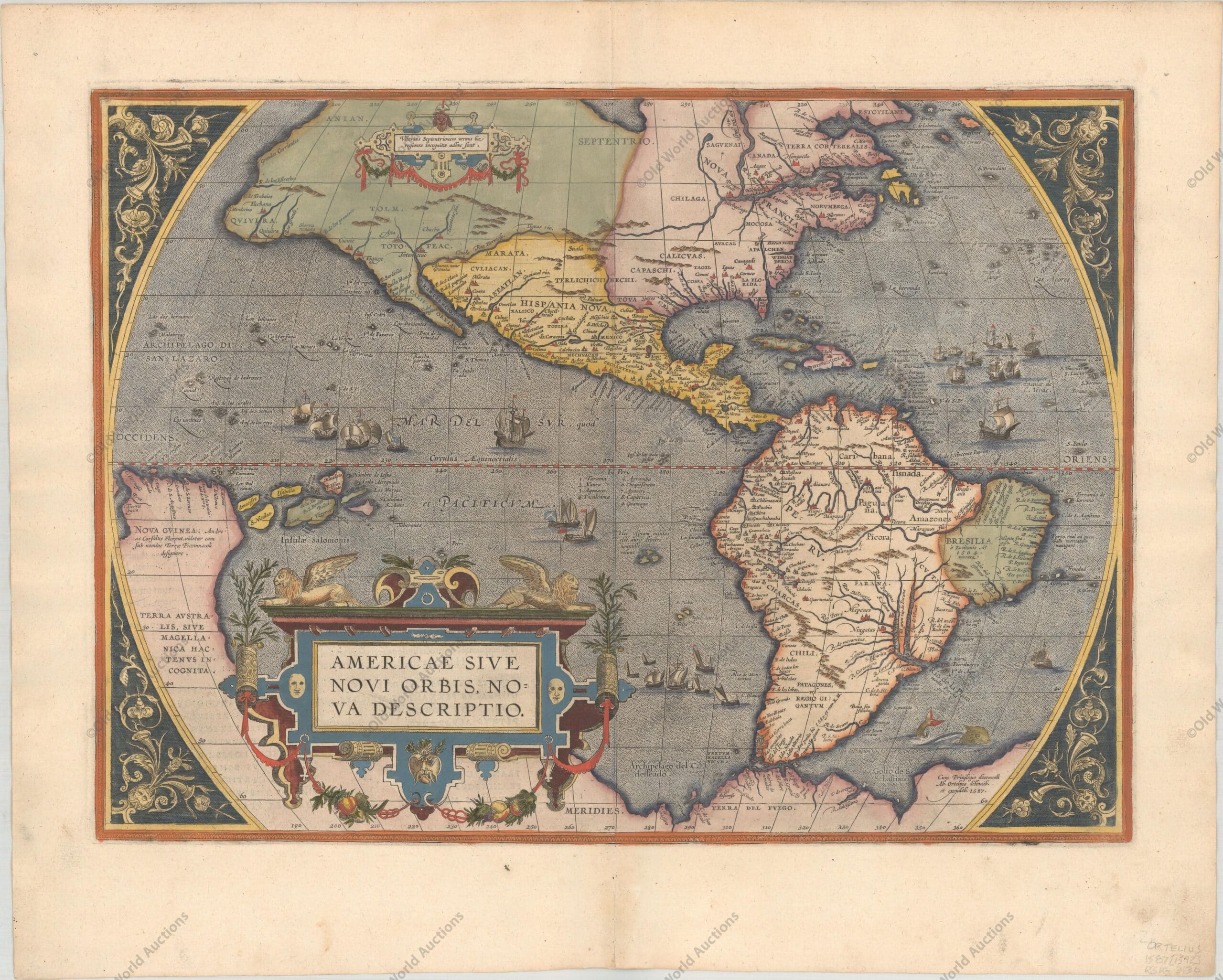
Map of the Western Hemisphere, 1587
This is one of the most famous maps of the Americas, and one that had an enormous influence on the future cartography of the New World.
It was engraved by Frans Hogenberg and is largely based on Gerard Mercator’s large multi-sheet world map of 1569.
The map shows an exaggerated extension of the North American continent, with the long St Lawrence River crossing the continent to almost meet the fictitious Tiguas River flowing westwards.
The strategically placed title card hides the unknown South Pacific and thus most of the supposed great southern continent, which is shown attached to New Guinea and Tierra del Fuego.
This is the third plate of the Americas used by Ortelius, as evidenced by the removal of the bulge on the south-west coast of South America and the addition of a cartouche in North America.
Also on this plate, the Solomon Islands are mentioned for the first time since their discovery in 1568, and the names California, R. de los estrechos and C. Mendocino are added to the west coast of North America.
The native name Wingandekoa is added to the east coast, the result of an unsuccessful attempt by the English to colonise the Outer Banks.
1587 Map of the Western Hemisphere – Historical Map
Publicações Relacionadas
Map of the Gulf of Mexico, the Caribbean and the Southern United States, 1682
Map of Brazil from 1695: A Historical Overview
1666 Map of the Gulf of Mexico and the Caribbean - Historical Map
Map of the Western Hemisphere from 1700 - Historical Map
Map of the Cape Verde Islands, 1697
1631 Map of the Western Hemisphere - Historical Map
Map of Paraíba from 1662: An Engraved Masterpiece
Map of South America from 1619: A Historical Insight
Map of Rio de Janeiro, 1794 - Historical Map
1643 Map of the Western Hemisphere - Historical Map
1740 Map of the Western Hemisphere - Historical Map
1671 Map of Jamaica
Painting of the Three Kings Fort in Natal from 1647
1584 World Map - Historical Map
Map of All Saints Bay 1769 - Historical Maps
Map of the Gulf of Mexico and the Caribbean, 1675
Map of Africa 1593 - Historical Map
Map of Recife of 1764 - Historical Map
1660 Map of the Western Hemisphere - Historical Map
Map of West Africa and the Cape Verde Islands from 1699
1713 Map of the Western Hemisphere - Historical Map
Map of the Captaincy of Pernambuco from 1698 Overview
1671 Map of Mexico and Central America - Historical Map
Map of Brazil from 1606 - Historical Map
Maritime chart of the east coast of Brazil Ilha Grande and Sapetiba Bay 1884
Map of Brazil from 1798: Explore Historical Details
Engraving of Fort Nassau in Pernambuco, 1671
Map of Brazil from 1850: A Historical Overview
Map of the Gulf of Mexico and the Caribbean, 1681
Map of Santa Catarina Island 1777: A Historical Treasure
Map of the Captaincy of Paraíba and Rio Grande, 1720
All Saints Bay Map of 1644 - Historical Map
1697 Map of the Western Hemisphere - Historical Map
Engraving of Salvador de Bahia from 1770 - Historical Maps
Map of Rio de Janeiro, 1775 - Historical Map
1719 Historical Map of the Western Hemisphere
This post is also on:
 Português
  English
  Deutsch
  Español
  Français