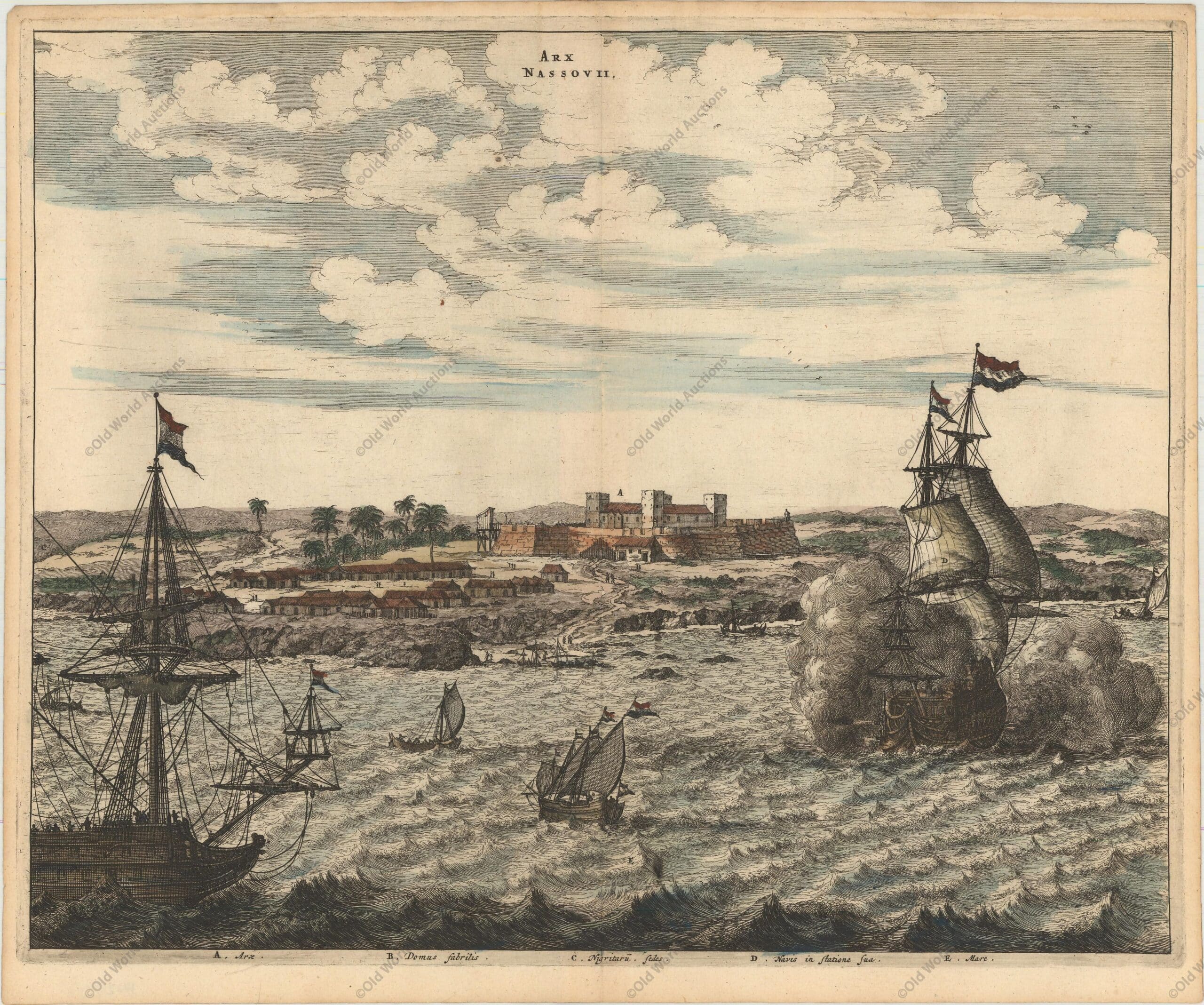
Engraving of Fort Nassau in Pernambuco, 1671

Gravura do Forte de Nassau em Pernambuco de 1671
Engraving of Fort Nassau in Pernambuco, 1671 – Montanus’ work was perhaps the largest illustrated book on the New World produced in the 17th century. It contained over a hundred beautifully engraved plates, views and maps of North and South America. The plates vividly depicted forts, festivals, occupations, Dutch fleets, battles, religious rites and native customs. This important work was translated into German by Olivier Dapper and into English by John Ogilby. Several of the plates were later acquired by Pierre Vander Aa.
This beautiful engraving shows the scene of a battle on the coast of Pernambuco, on the east coast of Brazil, during the conflict between the Dutch and the Portuguese over the ownership of the area. Fort Nassau was named after Count Mauritius of Nassau, a German in the service of the Dutch king, who was appointed governor of the territory. Published in Amsterdam by Jacob van Meurs (1619-1680).

Engraving of Fort Nassau in Pernambuco, 1671

Montanus’ work was perhaps the largest illustrated book on the New World produced in the 17th century.

It contained more than one hundred beautifully engraved plates, views and maps of North and South America.

The plates vividly depicted forts, festivals, occupations, Dutch fleets, battles, religious rites and native customs. This important work was translated into German by Olivier Dapper and into English by John Ogilby. Some of the plates were later acquired by Pierre Vander Aa.

This beautiful engraving shows the scene of a battle off the coast of Pernambuco, on the east coast of Brazil, during the conflict between the Dutch and the Portuguese over the ownership of the area. Fort Nassau was named after Count Mauritius of Nassau, a German in the service of the Dutch king, who was appointed governor of the territory.

Published in Amsterdam by Jacob van Meurs (1619-1680).

Engraving of Fort Nassau in Pernambuco from 1671 – Historical engraving

Publicações Relacionadas

1623 Map of the Western Hemisphere - Historical Map

1679 Map of Recife - Historical Map

1719 Map of the Western Hemisphere - Historical Map

Map of Cabo Santo Agostinho from 1645 - Historical Map of Brazil

Map of Recife in Pernambuco from 1679: Historical Insights

Map of Europe from 1644: A Classic Antique

Engraving of Salvador from 1671: A Historical Insight

Painting of the Three Kings Fort in Natal from 1647

Engraving of Salvador de Bahia from 1770 - Historical Maps

Map of Panama 1699 - Historical Map

Map of Santa Catarina Island 1777: A Historical Treasure

Map of the Gulf of Mexico and the Caribbean, 1675

1714 Map of the Western Hemisphere - Historical Map

Map of the Province of Paraíba from 1698 Overview

Map of Brazil from 1850: A Historical Overview

Map of Brazil from 1750 - Historical Map of Brazil

Map of Rio de Janeiro, 1794 - Historical Map

1713 Map of the Western Hemisphere - Historical Map

Map of the Bay of All Saints and Pernambuco, 1700

1727 Map of the Western Hemisphere - Historical Map

Map of South America from 1619: A Historical Insight

Map of South America from 1740: Historical Insights

Map of Olinda in Pernambuco from 1640 - Historical Map

Southeastern Colonial Map of the United States, Bahamas and Greater Antilles, 1706

1744 Map of the Western Hemisphere - Historical Map

Map of South America, 1840

Map of the Captaincy of Paraíba and Rio Grande, 1720

Copper Engraving of Salvador from 1748: History Explored

1609 Map of the Western Hemisphere - Historical Map

Map of Brazil 1747 - Historical Maps of Brazil

Map of Brazil divided into fourteen hereditary captainships from 1657 onwards

Map of the Brazilian coast from the Paraíba River to Cabo de Santo Agostinho

1719 Map of the Western Hemisphere - Historical Map

Map of the Captaincy of Pernambuco and Ceará from 1680

1643 Map of the Western Hemisphere - Historical Map

Map of Africa from 1570

This post is also on: Português English Deutsch Español Français