The Great Lakes are well defined in North America, which is devoid of geographical detail except for the major rivers and a few place names, including some missions and forts. The unknown northern parts of the continent are skilfully hidden by decorative notes and medallions, and the northeastern US and Quebec look rather elongated. In the South Pacific are other newly discovered lands, including the Solomon Islands south of California, several partially delineated islands labelled ‘land seen but unknown’, and the incomplete coastlines of Australia, New Zealand and Tasmania.
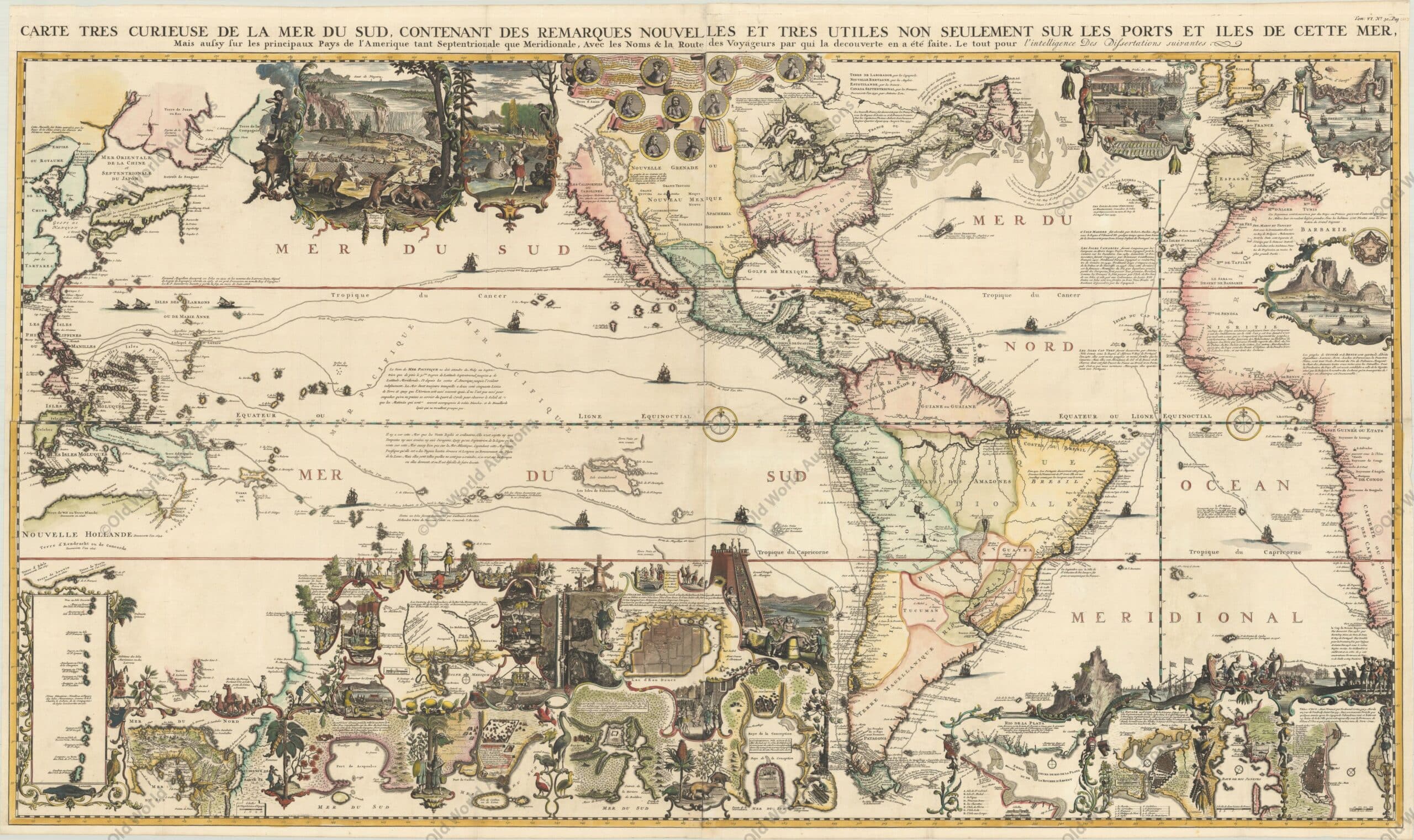
Over North America are 9 medallions depicting explorers notable for their voyages to the New World, including Columbus, Vespucci, Magellan, Le Maire, Drake and Dampier. The tracks of these explorers are traced along the oceans, along with representations of their ships. The map is filled with vignettes set within rococo borders that provide a panorama of the New World, highlighting key geographical locations, native culture, and indigenous flora and fauna. Maps and town plans of the entire southern hemisphere are included, including the Mississippi Delta, the Isthmus of Panama, the Rio de la Plata, Acapulco Bay, Mexico City, Havana and Veracruz. The vignettes include a spectacular view of Niagara Falls with the famous depiction of a beaver colony, a scene of cod fishing in Newfoundland, Native American hunting and Aztec and Inca rituals, including human sacrifice, mining and sugar production in South America. The inserts are surrounded by images of animals and plants native to the New World, such as an opossum, a muskrat, a tobacco plant and a pineapple.
Map of the Western Hemisphere, 1719
This spectacular wall map is richly engraved in the tradition of Dutch cartography.
Although the main focus of the map is the Americas, it also covers the entire Pacific, including the East Indies and Japan, and the entire Atlantic, including much of Western Europe and Africa.
The map is based on De Fer’s map of 1713 and appeared in the sixth volume, devoted to the Americas, of Chatelain’s monumental Atlas Historique.
In Sanson’s second model, California is shown as an island with a rugged northern coast, numerous place names and a note alluding to the controversy caused by Father Kino’s map of the peninsula.
This was one of the first European maps to challenge the myth of California as an island.
The Great Lakes are well defined in North America, which is devoid of geographical detail apart from the major rivers and a few place names, including some missions and forts.
The unknown northern parts of the continent are skilfully concealed by decorative notes and medallions, and the northeastern US and Quebec appear rather elongated.
In the South Pacific are other newly discovered lands, including the Solomon Islands south of California, several partially delineated islands labelled ‘land seen but unknown’, and the incomplete coastlines of Australia, New Zealand and Tasmania.
Above North America are 9 medallions depicting explorers notable for their voyages to the New World, including Columbus, Vespucci, Magellan, Le Maire, Drake and Dampier.
The tracks of these explorers are traced along the oceans, along with representations of their ships. The map is filled with vignettes set within rococo borders that provide a panorama of the New World, highlighting key geographical locations, native culture, and indigenous flora and fauna.
Maps and town plans of the entire southern hemisphere are included, including the Mississippi Delta, the Isthmus of Panama, the Rio de la Plata, Acapulco Bay, Mexico City, Havana and Veracruz.
The vignettes include a spectacular view of Niagara Falls with the famous depiction of a beaver colony, a scene of cod fishing in Newfoundland, Native American hunting and Aztec and Inca rituals, including human sacrifice, mining and sugar production in South America.
The inserts are surrounded by images of animals and plants native to the New World, such as an opossum, a muskrat, a tobacco plant and a pineapple.
1719 Map of the Western Hemisphere – Historical Map