1659 Map of the Western Hemisphere – Historical Map

Mapa do Hemisfério Ocidental de 1659
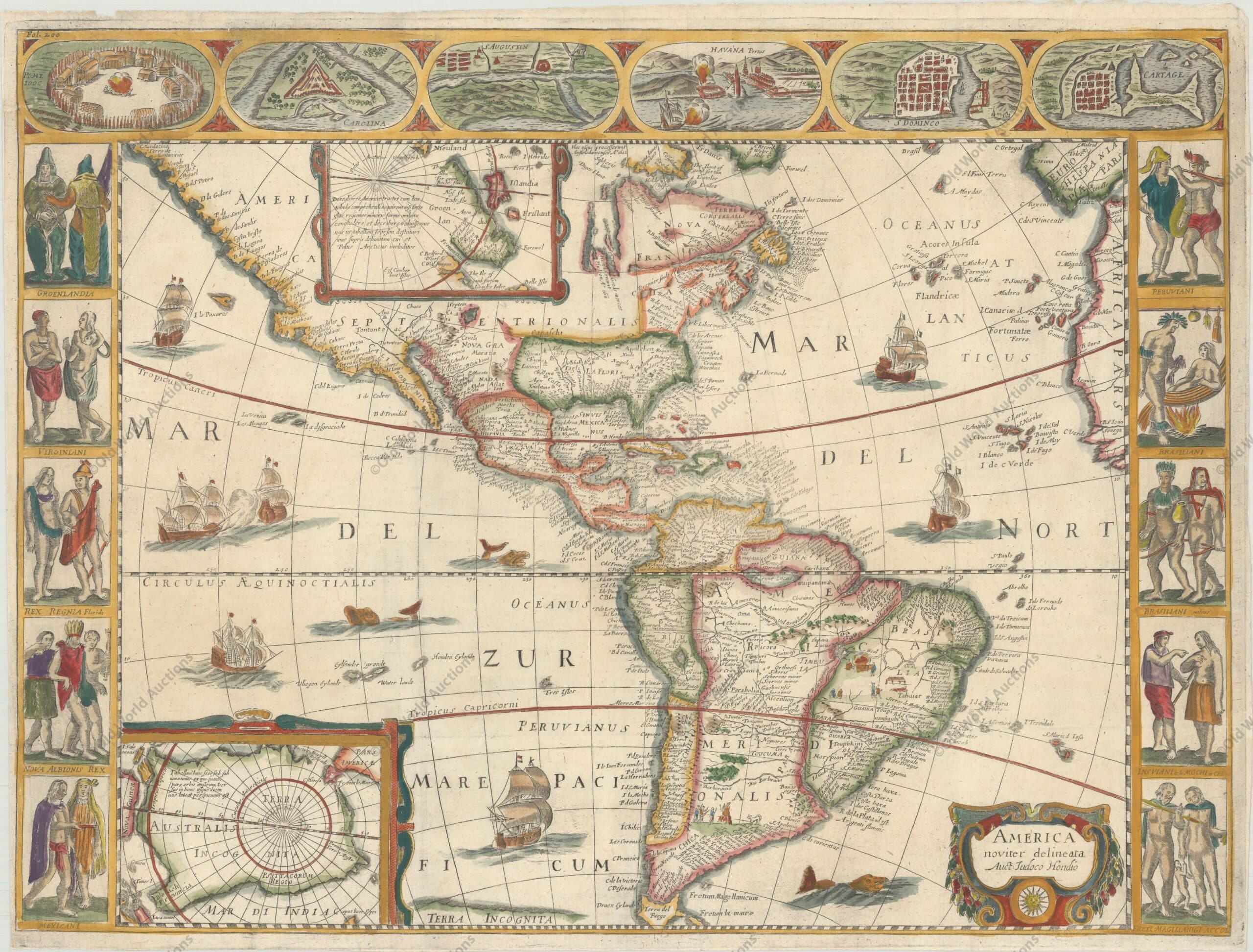
Map of the Western Hemisphere of 1659 – This is a very rare derivative of the important Hondius map of 1618. The engraver is unknown, although it is a close copy of Picart’s 1644 version, which in turn was derived from Jansson’s 1623 map. North America retains the peninsula of California, and there isn’t much detail along the east coast in the mid-Atlantic region. In the south-west, the famous Seven Cities of Cibola appear on the shores of a large false lake. In South America, the mythical Parime Lacus is shown south of Guyana, and there are two engraved scenes, one showing a cannibal feast and the other a mythical giant from Patagonia. Two stylised insets of the polar regions are placed on strip maps; the North Pole shows Frobisher’s theory of the Northwest Passage, and the South Pole shows the long-held notion of the mythical southern continent.
The map is flanked on three sides by carte-a-figure borders depicting Native Americans and their major cities. This map is easily distinguished from Hondius’s map by the fact that the figures on the sides were inverted when copied by the engraver. Unlike Blaeu’s similar map, the towns at the top include three North American towns: the Indian village of Pomeiooc in Virginia, the French fort of Carolina, and St Augustin in Florida.

Map of the Western Hemisphere, 1659

This is a very rare derivative of the important Hondius map of 1618.

The engraver is unknown, although it is a close copy of Picart’s version of 1644, which in turn was derived from Jansson’s map of 1623.

North America retains the peninsula of California, and there isn’t much detail along the east coast in the mid-Atlantic region.

In the south-west, the famous Seven Cities of Cibola appear on the shores of a large false lake.

In South America, the mythical Parime Lacus is shown south of Guyana, and there are two engraved scenes, one showing a cannibal feast and the other a mythical giant from Patagonia.

Two stylised insets of the polar regions are placed on strip maps; the North Pole shows Frobisher’s theory of the Northwest Passage, and the South Pole shows the long-held idea of the mythical southern continent.

The map is flanked on three sides by carte-a-figure borders depicting Native Americans and their major cities.

This map is easily distinguished from Hondius’s map by the fact that the figures on the sides were inverted when copied by the engraver.

Unlike Blaeu’s similar map, the towns at the top include three North American towns: the Indian village of Pomeiooc in Virginia, the French fort of Carolina, and St Augustin in Florida.

1659 Map of the Western Hemisphere – Historical Map

Publicações Relacionadas

1592 Map of the Western Hemisphere - Historical Map

Engraving of Fort Nassau in Pernambuco, 1671

Map of the East Coast of Brazil, 1647 - Historical Maps

1671 engraving of Fort Orange on the island of Itamaraca

Map of Brazil from 1630: Cartography's Legacy

Map of the Cape Verde Islands, 1697

Map of Brazil 1747 - Historical Maps of Brazil

1719 Map of the Western Hemisphere - Historical Map

Map of Rio de Janeiro, 1750 - Historical Map

Map of the Gulf of Mexico and the Caribbean, 1675

Map of Brazil from 1606 - Historical Map

The Catalan Atlas: Redrawing the Medieval World and Asia

Map of the Captaincy of Pernambuco and Ceará from 1680

1730 Map of Northern South America - Historical Map

Map of Paraíba of 1690 - Historical Maps of Brazil

1694 Map of South America - Historical Map

Map of South America and Brazil 1624 - Historical Map

1587 Map of the Western Hemisphere - Historical Map

Map of Rio de Janeiro, 1775 - Historical Map

Map of South America from 1615: Explore the Details

Map of Africa from 1570

1730 Map of the Western Hemisphere - Historical Map

All Saints Bay Map of 1644 - Historical Map

1623 Map of the Western Hemisphere - Historical Map

Southeastern Colonial Map of the United States, Bahamas and Greater Antilles, 1706

Map of Rio de Janeiro of 1764 - Historical Map

Reis Magos Fort Engraving from 1690 - Engravings Stories

Map of eastern Brazil 1664 - Historical Map of Brazil

1719 Map of the Western Hemisphere - Historical Map

Map of Brazil from 1750 - Historical Map of Brazil

1660 Map of the Western Hemisphere - Historical Map

1714 Map of the Western Hemisphere - Historical Map

1832 Map of Brazil - Historical Map

Map of West Africa and the Cape Verde Islands from 1699

Historical maps showing the territorial development of Brazil

Map of Panama 1699 - Historical Map

This post is also on: Português English Deutsch Español Français